Sciatica
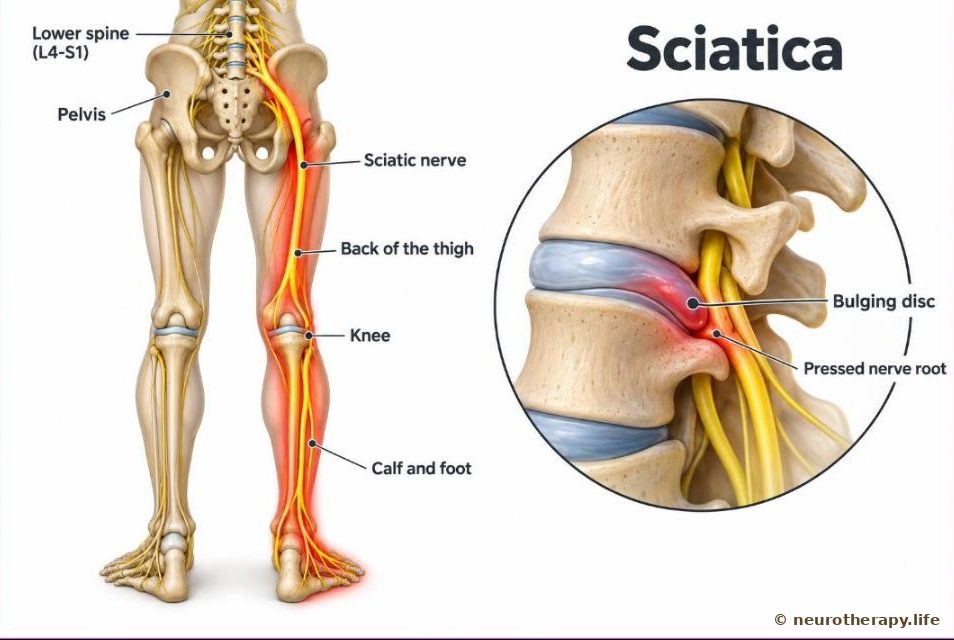
Sciatica is pain that runs from the lower back down the back of one leg, because the sciatic nerve is pressed or irritated — most often by a slipped disc.
- Between 10% and 40% of people get sciatica at some time in their lives
- Most cases settle within 4 to 6 weeks
- The sciatic nerve is the largest nerve in the body, formed from nerve roots L4 to S3
Source: StatPearls (Davis, Taqi & Vasudevan, 2024); MedlinePlus
What is Sciatica?
The sciatic nerve is the largest nerve in your body. It begins as several nerve roots leaving the lower spine, passes through the buttock, and runs down the back of each leg to the foot.
Sciatica is not a disease on its own — it is a sign that this nerve is being pressed or irritated. The commonest cause is a slipped or bulging disc in the low back. It usually affects one side only, and in many cases no single cause is found.
What are the symptoms?
- Sharp, burning pain from the buttock down the back of one leg
- Tingling or pins and needles in the leg or foot
- Numbness in the leg or foot
- Weakness in the leg or foot
- Pain worse on moving, coughing or sneezing
What causes it, and who is more likely to get it?
Narrowing or slipping in the spine
- Spinal stenosis — narrowing of the spinal canal
- Spondylolisthesis — one spinal bone slipping over another
Injury
- A back injury
- A broken pelvis or spinal bone
How is it found?
A doctor asks where the pain runs, and checks the strength, feeling and reflexes of the legs. Scans are used when the pain does not settle or a warning sign is present.
MRI or CT scan of the spine
Shows the discs and nerve roots, and where the nerve is being pressed.
A neurotherapist asks the same few warning-sign questions at every visit: numbness in the seat, trouble with urine or stools, pain or weakness in both legs. A scan showing a disc bulge changes little on its own — bulges are common in backs that do not hurt.
How Neurotherapy (LMNT) sees Sciatica
Neurotherapy (LMNT) treats sciatica through the low back and the leg together. L5–S1 ghisai works in three ways: it brings the bones of the back from L1 to S1 into place, relaxes the muscles of both buttocks, and draws up the muscles and nerves beside the spine that have slipped down. The Sciatica point then works along the painful leg itself.
The level of the disc decides the rest: JJ⁺² for a slipped disc at L4–L5–S1, JJ⁺¹ for L1–L3. Digestive work goes alongside. And every session begins with the warning-sign questions, because most backs mend — but a few must go to hospital today.
Whether or not the patient gets immediate benefit from our treatment, let no harm reach him through our carelessness — attend to this.
Neurotherapy (LMNT) treatment for Sciatica, step by step
Examine first
The therapist checks Liv° and Mu°, asks which leg hurts and how far down, and asks the warning-sign questions — at every visit, because the answers can change.
L5–S1 ghisai
Given face down in three stages, with different counts, to set the low back and relax the buttock muscles.
The Sciatica point — on the painful leg only
Light pressure with both big toes either side of the L5 bone, then the heel travels from the hip down to the heel of the painful leg, pressing or circling. Sciatica setting, at the foot, follows for a disc bulge.
By the level of the disc
JJ⁺² for a slipped disc at L4–L5–S1; JJ⁺¹ for a slipped disc at L1–L3.
Digestion alongside
Hard stools and too little water are looked after at every visit, alongside the back and leg work.
Points and formulas used
Never do this
- Stop and go to hospital the same day for numbness in the seat or inner thighs, new trouble passing or holding urine, loss of bowel control, or pain or weakness in both legs. Waiting can cause lasting damage.
- (6) L3, 4, 5 is never given where there is a fracture in any bone between L1 and S1. (6) L3, 4, 5
- JJ⁺¹ is not given to someone with knee pain — they get JJ⁺² instead. JJ⁺² is not given on the same day as BOF where there is knee pain with sole pain. JJ⁺¹
- ONS, the straight-leg lift, is not given where acute back pain runs below the knee or a disc is under treatment. In the Fracture point, the legs are raised by a helper — never by the patient — and nothing is given on the knee joint. ONS
- Keep taking the medicines your doctor prescribed. Neurotherapy (LMNT) works alongside your medical care, never instead of it.
Watch

A demo of L5–S1 ghisai in its three parts, given face down with the front of the foot over the lowest part of the back and the buttocks, followed by the Fracture point with the legs raised on pillows. It is used for relief in low back pain.

Shows JJ⁺¹ along the thighs and JJ⁺² just below the knees, given lying down with light jerks and pressure that rises over three rounds. JJ⁺¹ is for nerve trouble near L1–L3 and JJ⁺² for L4–L5–S1 in back pain.

Shows JJ⁺¹ along the thighs and JJ⁺² just below the knees with the patient sitting, using light jerks and pressure that rises over three rounds, then a gentle calf massage. JJ⁺¹ is for nerve trouble near L1–L3 and JJ⁺² for L4–L5–S1 in back pain.

BK Shivanand Bhai shares his experience: his MRI showed a pressed nerve, and he reports good relief in his back pain after four Neurotherapy (LMNT) sittings.
L5–S1 ghisai in its three parts, and JJ⁺¹ and JJ⁺² for a slipped disc.
From practice
The woman who thought it was the treatment working
A teaching case — a composite from practice, not one patient's file
57 years · low back pain and pain down the right leg for five months
- What was found
- Eleven days went well — Sciatica point on the right leg only, L5–S1 ghisai, digestive work alongside. On day twelve, asked the usual questions, she said she had to wait and push to pass urine, the toilet seat felt “not quite my own skin”, and the other leg had begun to ache.
- What was done
- No treatment was given that day. She was told calmly that she needed a doctor that same day, and sent with a note of her treatment and the three new findings. She was operated on within thirty-six hours.
- What it teaches
- Her scan's disc bulge changed nothing on day one or day twelve. Three answers to three simple questions changed everything. The warning-sign questions are asked at every session, not only at the first.
From Ayurveda and the kitchen
Kati and vāta — warmth held still
Ayurveda calls the waist and hips kati, a place where disturbed vāta settles — with stiffness, catching pain and pain worse in the cold. Its classic answer is warm oil held on the low back in a ring of dough, nothing pressed. Neurotherapy (LMNT) follows the same instinct: soften the low back slowly before any stronger work.
Test yourself
What research says
- Strong evidence
The sciatic nerve is formed from the nerve roots L4 to S3. A bulging or slipped lumbar disc is the commonest cause of sciatica, and most cases settle within 4 to 6 weeks.
- Strong evidence
Disc bulges show up on scans of many people with no back pain at all — in 30% at age 20 and 84% at age 80. A bulge on a scan does not by itself explain the pain.
No clinical trial of Neurotherapy (LMNT) in sciatica has been published yet. Improvements reported by neurotherapists are clinical observations.
For you
Pain in both legs
Sciatica on both sides is a warning sign. Tell your therapist or doctor straight away, and mention any change in urine, stools or feeling in the seat.
People who sit for long hours
Avoid sitting or lying still for long. Keep up gentle daily activity — it helps recovery more than rest.
Anyone with a scan report
A disc bulge on a report is common and not a reason for alarm on its own. How you feel, and the warning signs, matter more.
This page explains; it does not diagnose. Neurotherapy (LMNT) works alongside your medical care — keep taking the medicines your doctor prescribed, and see a doctor for any new or severe symptom.