Rheumatoid arthritis (RA) and rheumatism
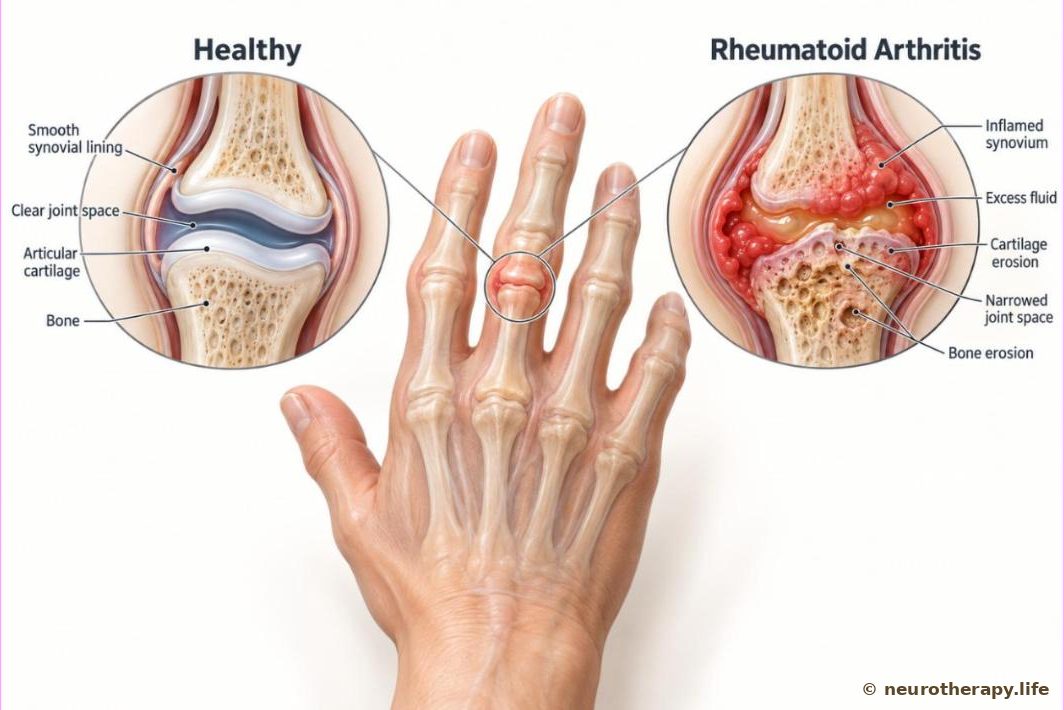
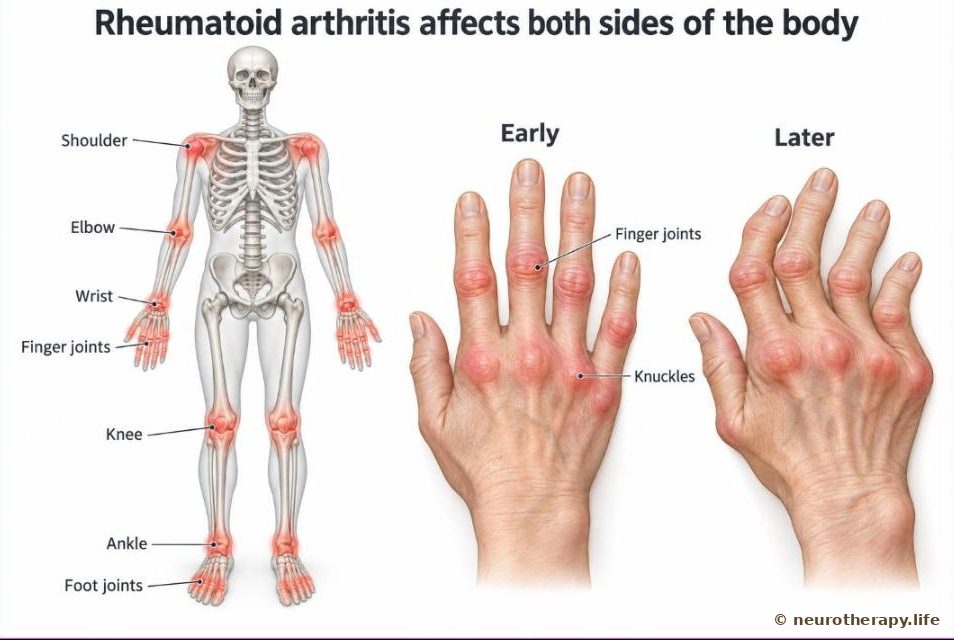
Rheumatoid arthritis is a long-lasting disease in which the body's own defence system attacks the lining of the joints. The small joints of the hands, wrists and feet become painful, swollen and stiff — usually on both sides, and worst in the morning.
- About 18 million people worldwide had rheumatoid arthritis in 2019
- About 70% of them are women, and 55% are over 55
- About 10% of people with RA test negative for both RF and anti-CCP antibodies
- Treatment started within six months of the first symptoms gives better use of the joints
Source: World Health Organization (Rheumatoid arthritis fact sheet); Chauhan et al., StatPearls 2023
What is Rheumatoid arthritis (RA) and rheumatism?
Rheumatoid arthritis (RA) is an auto-immune disease. The immune system, which should fight germs, attacks the lining of the joints instead. The lining swells, the joint fills with fluid, and over time the cartilage and bone can be damaged. It can also affect the eyes, skin, heart, lungs and nerves.
It is not a wearing-out like osteoarthritis. Without treatment it can badly damage the joints, so early diagnosis matters. 'Rheumatism' (vaat rog) is an older, everyday word for aches of the joints and muscles; LMNT teaching treats it alongside RA.
What are the symptoms?
- Joint pain and stiffness, worst in the morning
- Tender, warm, red or swollen joints
- The same joints affected on both sides of the body
- Tiredness, a mild fever and poor appetite
- Hard bumps under the skin near the joints
What causes it, and who is more likely to get it?
Genes and family
- RA in the family
- Other auto-immune problems
Triggers from outside
- Smoking and cigarette smoke
- Gum disease and lung disease
The body itself
- Being a woman, and hormones
- Older age and excess weight
How is it found?
There is no single test for RA. A doctor looks at the pattern — which joints, both sides or one, how long the morning stiffness lasts — and orders blood tests and pictures of the joints.
RF and anti-CCP
Blood tests for antibodies that are often found in RA. A negative result does not rule RA out.
ESR
A blood test that shows how much inflammation there is in the body.
X-ray or ultrasound
Show swelling inside the joint and any damage to the bone.
A neurotherapist uses the ring-finger sign: the middle joints of both ring fingers are squeezed at the same time and compared. Pain in both is taken as a sign that RA may be present or may come later. Even if the RF report is negative, the finding is written on the card in full — and the person is sent to a doctor within the month.
How Neurotherapy (LMNT) sees Rheumatoid arthritis (RA) and rheumatism
Neurotherapy (LMNT) starts from what may NOT be given. RA is not a wearing-out: the body's defences have turned round and begun taking the joints apart. So points that stimulate immunity are withheld. Then it looks at acid: where the blood circulation is disturbed, acid rises in the tissues — and one way to lower it is to breathe it out.
Breathing the acid out — how Mukha Dhauti is used in RA
- Circulationis disturbed in the joint, so acid rises in the tissues
- Left ring fingerhurts more than the right — the acid side is showing
- Forced breath outten times — carbon dioxide leaves the body and the acid is reduced
- One minute's restbetween rounds, so the alkali does not rise too fast
- Finger checkedas soon as the left ring-finger pain goes, the breathing stops
RA is also named among the old diseases in which undigested food is found, so where the stools show it, digestion comes first. And because a gland that is already spoiled should first be provoked less, RA patients are given the light form of the treatments.
Whether or not the patient gets immediate benefit from our treatment, let no harm reach him through our carelessness — attend to this.
Neurotherapy (LMNT) treatment for Rheumatoid arthritis (RA) and rheumatism, step by step
Examine first — and refer
The therapist squeezes both ring fingers together, checks Liv° and Mu°, asks about the stools, and asks about everything you take. Every RA patient is encouraged to tell their own doctor that they are coming for Neurotherapy (LMNT).
Digestion first
In old diseases, whatever the disease, correcting undigested food is the very first stage.
Mukha Dhauti at the RA dose
For those with much pain at Mu° or in the left ring finger, but less in the right: ten forced breaths out, one minute's rest, and again — ten, at most fifteen rounds — stopping as soon as the left ring-finger pain goes.
Light treatment, chosen by the findings
Along with the full joint-pain protocol, the Lactic Acid formula, (30) Medulla and Gas Only are used as the findings call for them. For rheumatism with strong pain at Mu°, the Acid Treatment Formula (ATF) — never without that Mu° pain, and checked again every day.
Look at the day, not only the joint
When treatment helps for a day and the pain returns every morning, the therapist asks about the room, the bed and the window. Sleeping with the window open can matter as much as the session.
Points and formulas used
Mukha Dhauti dosing for RA
A breathing kriya taught to the patient: forced breaths out, with a minute's rest between rounds, to help the body let go of acid. The left ring finger tells when to stop.
Open →Lactic Acid Conversion
Named for RA in LMNT — helps the body turn lactic acid back into muscle fuel.
Works through
Open →ATF, form (a)
The Acid Treatment Formula in its Adr form — for rheumatism only where Mu° is strongly painful.
Open →Never do this
- Withheld in RA and every auto-immune disorder: Armpit, Lymph, Spl, Thymus, Thymus + Chest, Ton 'P' and Ton 'T' — where the immune system is already misbehaving, it is not stimulated. So T., TT. and PT. Heparin, and ATF form (b), which carry Thymus + Chest, are not given either. Th + Ch
- During a flare — a joint hot, swollen and very tender — the joint itself is not worked. The therapist works around it and comes back to it when the heat has gone. Joints
- In RA the neck may be unstable: no forceful work there, and no Katka or Motor neuron point. A clumsy hand, an unsteady walk or new numbness needs a doctor first. Katka
- Mukha Dhauti always with one minute's rest between rounds, and stopped as soon as the left ring-finger pain goes. Mukha Dhauti
- In RA, time itself is the danger: a joint that has been eaten into does not grow back. See a doctor early, and never delay, reduce or stop the medicines that protect the joints.
- Cancer: if the person has cancer, (10) Pan, Thymus, Pit, Lu + Sh, Rt. Ov / Lt. Ov and (30) Medulla are never given — the therapist changes the plan.
- Keep taking the medicines your doctor prescribed. Neurotherapy (LMNT) works alongside your medical care, never instead of it.
From practice
The woman whose pain came back every morning
Recorded in the therapy's own account — a case from Guruji's practice at the Bandra clinic
A woman in middle years · Mumbai · rheumatoid arthritis for some years, joints worst on waking
- What was found
- She came for many days. Each day the treatment felt good until night — and the next morning the pain was back. Other RA patients were being helped by the same treatments, so the answer was not in her file.
- What was done
- Guruji asked a question that had nothing to do with joints: did she sleep with the window open or shut? Afraid of the cold, she shut it every night — so more carbon dioxide stayed in the room, and in her body. He asked her to try two nights with the window open. From the next day the morning pain stopped arriving, and the same treatments began to help her.
- What it teaches
- When a treatment works for many people and not for one, stop changing the technique and start asking about the life. The session is half an hour; the other twenty-three and a half belong to the patient.
From Ayurveda and the kitchen
Mukha Dhauti — a cleansing breath from yoga
Mukha Dhauti came into the treatment of RA from the ashram's morning yoga class, where, after the fast exercises, people bend forward and throw the breath out forcefully. It was first used for a woman whose fingers were so painful that no one could touch them — something she could do sitting where she was.
Test yourself
What research says
- Strong evidence
About 18 million people lived with RA in 2019, about 70% of them women. Untreated, RA can badly damage the joints; early diagnosis and management can reduce symptoms, slow the disease and prevent disability.
World Health Organization. Rheumatoid arthritis — fact sheet.
- Strong evidence
RA usually begins in the small joints of the hands and feet, on both sides, with morning stiffness. About 10% of patients have neither RF nor anti-CCP antibodies in the blood — so a negative test does not rule the disease out. Treatment started within six months of the first symptoms gives better results.
Chauhan K, Jandu JS, Brent LH, Al-Dhahir MA. Rheumatoid Arthritis. StatPearls. 2023.
No clinical trial of Neurotherapy (LMNT) in rheumatoid arthritis has been published yet. Improvements reported by neurotherapists are clinical observations.
For you
Women
Most people with RA are women. Morning stiffness in the small joints of both hands is worth showing to a doctor early, not after years.
People who smoke
Smoking raises the risk of RA. Stopping helps your joints as well as your lungs.
People with a 'negative' report
A negative RF test does not settle the question. If the pattern fits — both sides, small joints, long morning stiffness — keep your doctor's follow-up.
This page explains; it does not diagnose. Neurotherapy (LMNT) works alongside your medical care — keep taking the medicines your doctor prescribed, and see a doctor for any new or severe symptom.