Allergy
An allergy is your immune system over-reacting to something harmless — like pollen, dust, a food or a pet — and causing sneezing, itching, rashes or a blocked, running nose.
- About 1 in 3 adults (31.8%) in one large US survey had a seasonal allergy, eczema or a food allergy
- Seasonal allergy alone affected about 1 in 4 adults (25.7%)
- A severe reaction, called anaphylaxis, can be life-threatening
Source: US CDC, NCHS Data Brief 460 (2021 survey); MedlinePlus
What is Allergy?
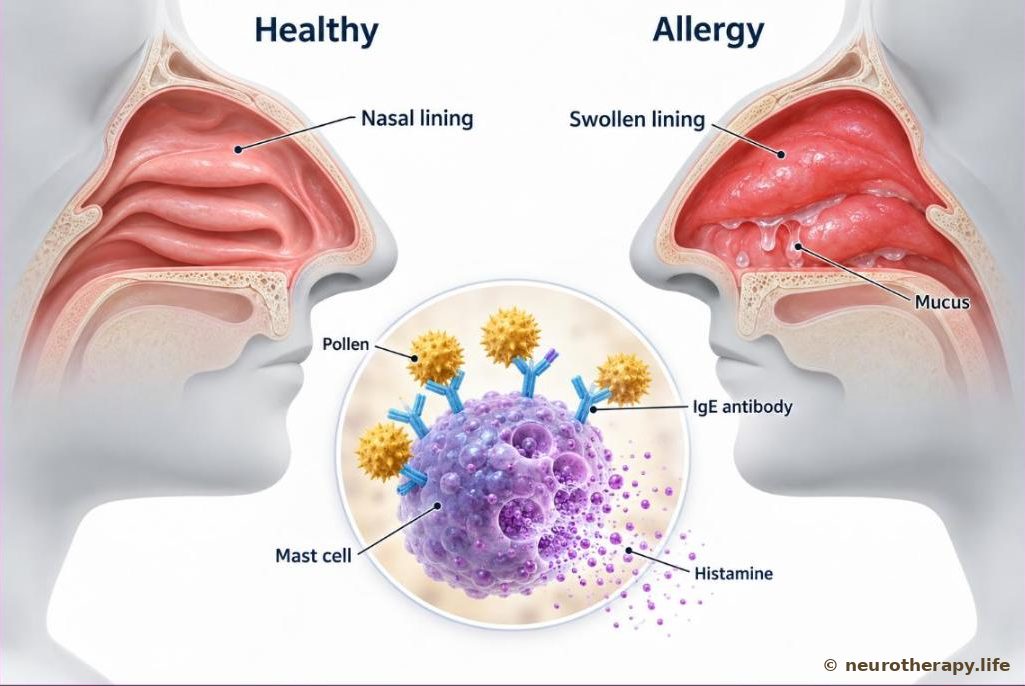
Your immune system guards you against germs. In an allergy it makes a mistake: it treats something harmless — pollen, dust mites, mould, pet dander, a food, an insect sting or a medicine — as an enemy.
It makes antibodies against that thing. The next time you meet it, the antibodies tell certain cells to release chemicals such as histamine. These chemicals cause the sneezing, itching, rash, swelling and running nose.
What are the symptoms?
- Sneezing, with a runny or blocked nose
- Itchy, red, watery eyes
- Itching, hives or a skin rash
- Cough, wheezing or tightness in the chest
- Swelling of the lips, eyes or face
- After a food: stomach cramps, vomiting or loose motions
What causes it, and who is more likely to get it?
Things in the air
- Pollen from trees and grass
- House dust mites and mould
- Hair and dander of cats, dogs and other animals
Food, stings and medicines
- Foods such as peanuts, milk and eggs
- Bee and wasp stings
- Some medicines
Who is more likely
- A parent with allergies, asthma or eczema
- Already having asthma or another allergy
- Childhood — many allergies begin young
How is it found?
An allergy is usually found from your story — what you were near, and what happened — and then confirmed with simple tests.
Skin prick test
A tiny drop of a possible allergen is placed on the skin and the skin is lightly pricked. A small itchy bump shows a reaction.
Blood test
Measures the allergy antibodies (IgE) your body has made against particular things.
Patch test
For skin allergies: small patches stay on the skin for a few days to see which substance causes a rash.
Food diary or elimination diet
A suspected food is left out and later brought back, under a doctor's guidance, to see whether the symptoms follow it.
A neurotherapist presses the two kidney points, Liv° and Mu°, to see which side is painful. They also ask how the stools come (hard, normal or loose), how many days the menses last, and check the blood pressure — these findings decide the treatment.
How Neurotherapy sees Allergy
In LMNT, an allergy is read through the body's acid–alkali balance and the two kidneys. Both kidney points, Liv° (the right kidney) and Mu° (the left kidney), are given in Guruji's teaching for itching, allergy and skin diseases — but they pull the body's chemistry in opposite directions, so the side matters.
Two kinds of allergy, two directions
- Dry kindItch, dry skin, hard stools — part of LMNT's acid picture, which comes with too little water.
- Mu° is painfulMore pain at Mu°, the left-kidney point, and little or none at Liv°.
- Wet kindA nose that runs every morning, with slightly soft stools — part of LMNT's alkaline picture.
- Liv° is painfulPain at Liv°, the right-kidney point, and none at Mu°.
LMNT teaching gives a plain example: a man whose nose streams every morning, with pain at Liv° and none at Mu°, is treated through Liv° — and it is reported that the nose stops running. Treating the other side instead is expected to make him worse. That is why the check comes before the treatment, every time.
If there is no pain in Mu°, then Acid treatment is not to be given!
Neurotherapy treatment for Allergy, step by step
Examine first
The therapist presses Liv° and Mu° to find the painful side, and asks about the stools, the menses and the blood pressure. No treatment is chosen before this.
Mu° strongly painful: ATF, form (b)
The Acid Treatment Formula in the form that ends with Thymus + Chest: (8) Pan, (1) Gal, (3) Mu°, (1) Acid, then (4) Thymus + Chest. LMNT teaching says this ending reduces pain in the body and allergy that has come from an infection.
Liv° painful: the right-kidney side
Where the pain is at Liv° and not at Mu° — often the running-nose kind — Liv° is used instead, and the Acid treatment is not given.
Dry kinds: Kidney Clear
For allergy of the dry kind, Kidney Clear is given — but only when one more finding is also present: hard or normal stools, more pain at Mu° than at Liv° (or equal), menses of four days or more, pain in the left ring finger, or blood pressure normal to low. It is started at the grade the body can take; a frail or elderly person gets Mild Kidney Clear.
Points and formulas used
ATF, form (b)
The Acid Treatment Formula ending with Thymus + Chest — for allergy with strong pain at Mu°.
Open →Kidney Clear
Supports the kidneys and the acid–alkali balance — for the dry kinds of allergy, given in grades I to IV.
Open →Never do this
- Swelling of the lips, tongue or throat, difficulty breathing, blue lips, confusion or fainting after a food, sting or medicine is anaphylaxis — call an ambulance (108/112) at once. It is an emergency, not a treatment session.
- Never give Spl in allergy — LMNT teaching says that in cold, allergy and asthma it does harm. Spl
- No strong pain at Mu°, no ATF. And Mu° is not given to someone whose pain is only at Liv° — treating the wrong side can make the allergy worse. Mu°
- Liv° and Mu° are not stimulated in kidney failure or kidney cancer. The Acid point is not given with loose motions. Kidney failure
- Cancer: if the person has cancer, (10) Pan, Thymus, Pit, Lu + Sh, Rt. Ov / Lt. Ov and (30) Medulla are never given — the therapist changes the plan.
- Keep taking the medicines your doctor prescribed, and carry any emergency medicine you have been given. Neurotherapy works alongside your medical care, never instead of it.
Watch

Shows the Acid Treatment formula step by step: (8) Pan, (3) Gal, (5) Mu°, 3 Acid on the side of the right thigh, (4) Chest Only, and (6) Adr on the upper back, given without breaks. It is used to support the body's acid–alkali balance when acid is raised.
Note: the Acid Treatment formula is given only when the Mu° point is tender, and (6) Adr is not given in high BP, diabetes, cancer or HIV — the therapist checks first.
The Acid Treatment Formula, demonstrated step by step. The video shows the form that ends with (6) Adr; for allergy, LMNT teaching ends it with Thymus + Chest instead — form (b).
From Ayurveda and the kitchen
Test yourself
What research says
- Strong evidence
This review explains the basic mechanism of allergy: IgE antibodies sit on mast cells, and when the allergen links them, the cells release histamine and other chemicals. Repeated exposure can turn this into long-lasting inflammation of the nose, lungs or skin.
Galli SJ, Tsai M, Piliponsky AM. The development of allergic inflammation. Nature. 2008;454:445–454.
No clinical trial of Neurotherapy in allergy has been published yet. Improvements reported by neurotherapists are clinical observations.
For you
Everyone with an allergy
Find your triggers and keep away from them where you can — dust, pollen season, a food. Write down what you ate or touched before each attack.
People with a severe allergy
If you have ever had swelling of the throat or trouble breathing, ask your doctor for an emergency plan and keep it with you.
People with asthma
Allergy and asthma often go together. Keep your inhaler as your doctor told you, and tell your therapist about both.
This page explains; it does not diagnose. Neurotherapy works alongside your medical care — keep taking the medicines your doctor prescribed, and see a doctor for any new or severe symptom.