Uterine prolapse
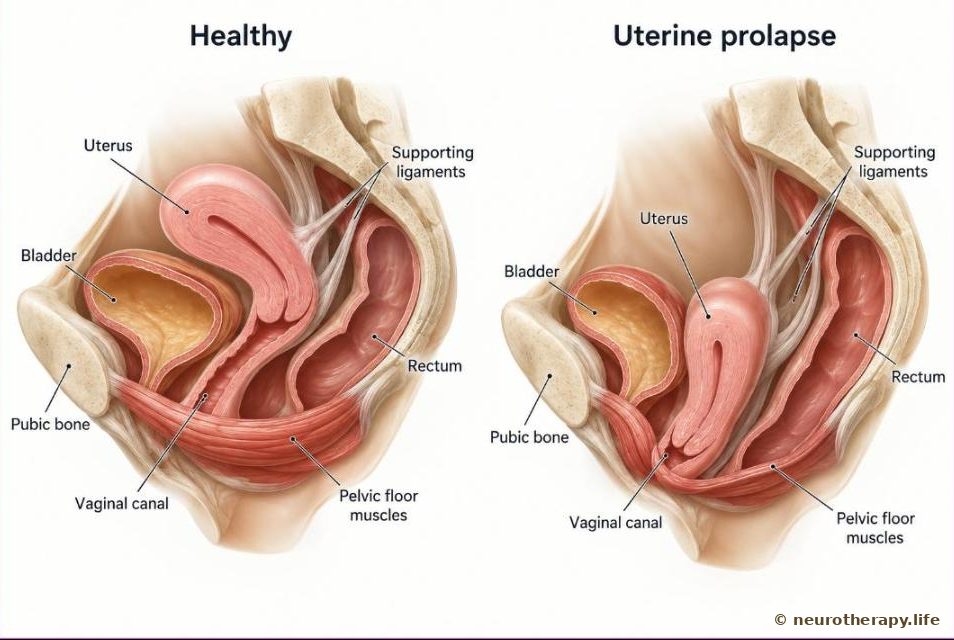
In uterine prolapse the womb (uterus) slips down from its place into the vagina, because the muscles and ligaments that hold it up have become weak or stretched. It is common after childbirth and with age, and it often causes a dragging heaviness low in the belly and back.
- About half of women who have given birth vaginally have some degree of pelvic organ prolapse
- Pelvic organ prolapse is found in about 1 in 10 women aged 20–39 (9.7%) and in about half of women over 80 (49.7%)
- It is common in women over 50
Source: Mayo Clinic Health System; StatPearls (NCBI); NHS
What is Uterine prolapse?
The womb sits in the lower belly, between the bladder in front and the bowel behind. Strong ligaments hang it from the back of the pelvis, and a hammock of muscles — the pelvic floor — holds it from below.
When childbirth, age, loss of hormones after menopause or constant straining weaken these supports, the womb slides down into the vagina. In a mild case it drops a little; in a severe case it can come out through the opening. The bladder or rectum may slip along with it.
What are the symptoms?
- A feeling of heaviness, pressure or dragging in the pelvis — worse after standing or sitting for long
- Pain low in the belly and in the lower back
- A bulge felt or seen in the vagina
- Leaking urine, or needing to pass urine often or urgently
- Constipation or difficulty emptying the bowel
- More vaginal discharge, and pain during sex
What causes it, and who is more likely to get it?
Pregnancy and childbirth
- Vaginal births — the more births, the higher the risk
- A baby weighing more than 9 pounds (about 4 kg)
Age and hormones
- Growing older
- Loss of oestrogen after menopause, which weakens the pelvic tissues
Constant pressure on the pelvis
- Long-standing constipation and straining
- A chronic cough
- Being overweight
- Repeated heavy lifting
Other factors
- Earlier pelvic surgery, such as removal of the womb
- Family history, or conditions that make tissues very stretchy
How is it found?
A prolapse is found with a simple pelvic examination by a doctor. Some women learn of it only during a check-up for something else.
Pelvic examination
The doctor looks and feels for how far the womb has come down, often while you lie down.
Bearing down or coughing
You are asked to push or cough, so the doctor can see how much the womb moves and how strong the pelvic muscles are.
Checking the bladder and bowel
The doctor also checks whether the bladder or the rectum has slipped and is bulging into the vagina.
The four stages of uterine prolapse
Source: Cleveland Clinic (stages of uterine prolapse)
A neurotherapist asks for the sonography report, because in LMNT the P point is given only when sonography shows the prolapse. The therapist checks Liv°, Mu° and Const around the navel, asks about the bowel, about how much and how often you lift, whether urine comes freely — and whether you wish to have more children, because that decides one treatment.
How Neurotherapy sees Uterine prolapse
LMNT teaching puts three conditions side by side: prolapse of the womb, prolapse of the rectum and hernia. All three carry pain at Mu°, and all three happen because the flesh-muscles have become loose. In LMNT this slackness belongs to the acidic side — a body short of water, with hard constipation and daily straining behind it.
How LMNT teaching explains a slipped womb
- Too little waterThe body and the blood run short of water — the acidic side
- Hard constipationThe stool dries in the bowel, and every morning brings straining
- Loose musclesThe flesh-muscles that hold the organs in place grow slack
- The womb slipsAn organ held by loose muscles shifts from its own place
- Pain at Mu°The sign the therapist finds, with the same slackness behind it
So the work is twofold: strengthen the pelvis, and stop the daily straining. LMNT teaching gives the P point, always followed at once by (6) WD; the Triangle for Piles to strengthen the pelvic muscles; (1) or (2) Acid when Mu° is tender; Round Normal and the Round Arrow for the bowel. Ton 'P' is rated very highly in LMNT for a prolapsed womb, but it is not given to a woman who still wishes to have children. Gas Only and (10) Medulla are not given.
The research is still to be done.
Neurotherapy treatment for Uterine prolapse, step by step
Examine first
The therapist reads the sonography report, checks Liv°, Mu° and Const, and asks about the bowel, the urine, heavy lifting and the wish for more children.
P point, then (6) WD at once
Given only when sonography shows the prolapse. The P point loosens the uterine muscles further, so (6) WD must follow immediately — both are written on one line of the card, and P point is never begun at the rushed end of a session.
Lift and strengthen the pelvis
The Triangle for Piles lifts the tissues towards the head and tightens the ring muscles of the bladder, womb and back passage. (1) or (2) Acid is added when Mu° is tender.
Ease the bowel
Round Normal and the Round Arrow, with digestive work for the constipation — a woman straining every morning undoes the pelvic work every morning.
Ton 'P' and Raman — by choice
Ton 'P' is considered only for a woman who does not wish to have more children. Raman is also used in LMNT for problems of the uterus.
Points and formulas used
Never do this
- Never in prolapse of the womb: Gas Only and (10) Medulla. Gas Only
- P point only when sonography shows the prolapse, and always followed immediately by (6) WD — a muscle loosened and left loose is worse than before. P point
- Ton 'P' is not given to a woman who still wishes to have children — it may affect conception. It is not proven to prevent pregnancy either, so it is never called a contraceptive. Ton 'P'
- The Triangle for Piles is not given to those who pass little urine, and its pressure always goes towards the head, never towards the ground. (1) and (2) Acid are not given with loose motions or without pain at Mu°. Triangle for Piles
- See a doctor soon if the womb comes out of the opening, or for any bleeding — especially after menopause. Go the same day if you cannot pass urine at all. The prolapse is reassessed by your doctor, not by the therapist.
- Cancer: if the person has cancer, (10) Pan, Thymus, Pit, Lu + Sh, Rt. Ov / Lt. Ov and (30) Medulla are never given — the therapist changes the plan.
- Keep taking the medicines your doctor prescribed. Neurotherapy works alongside your medical care, never instead of it.
From practice
The woman who wanted one more child
A teaching case — a composite from practice, not one patient's file
29 years · a village health worker · second-degree prolapse on sonography, eight months after her second delivery
- What was found
- Pain below the navel and in the back all day, white discharge, and periods every twenty to forty days. At the door she added: “We want one more child. They are saying operation.” She was tender at Mu° and Const, not at Liv°, constipated since the delivery, cold-handed — and carrying heavy loads every day.
- What was done
- Ton 'P' was not given, and she was told exactly why: it may affect conception, and nobody knows for sure. Instead she received the P point followed at once by (6) WD, the Triangle for Piles, (1) Acid, Raman, and digestive work for the constipation. Within two weeks the back pain settled and her bowel changed; the discharge eased by six weeks; at ten weeks her period came at twenty-nine days. The prolapse itself was reassessed by the doctor who made the report.
- What it teaches
- In the fifth week she stopped improving. Asked not “has anything changed?” but “what do you lift, and how often?”, she said she had gone back to carrying a full water pot up an outside stair four times each morning. Nothing on the card changed. The stair did.
From Ayurveda and the kitchen
Test yourself
What research says
- Strong evidence
447 women with prolapse were divided into two groups. Those who were taught pelvic floor muscle exercises over 16 weeks had fewer prolapse symptoms a year later, and fewer of them went on to seek other prolapse treatment (24% against 50%). Strengthening the pelvic hammock helps.
- Strong evidence
The womb hangs from the back and sides of the pelvis by two ligament systems. When these weaken, it descends. Risk rises with each pregnancy, with extra body weight and, most of all, with age.
No clinical trial of Neurotherapy in uterine prolapse has been published yet. Improvements reported by neurotherapists are clinical observations.
For you
After childbirth
Learn pelvic floor (Kegel) exercises and keep doing them. Avoid heavy lifting in the first months, and do not let constipation settle in.
Every woman
Drink enough water, keep the bowel soft, get a long cough treated, and keep a healthy weight — each of these takes daily pressure off the pelvis.
Women living with a prolapse
Ask your doctor about a support device called a pessary, and about exercises. Tell your therapist if you wish to have more children, and how much you lift each day.
This page explains; it does not diagnose. Neurotherapy works alongside your medical care — keep taking the medicines your doctor prescribed, and see a doctor for any new or severe symptom.