Polio and its after-effects
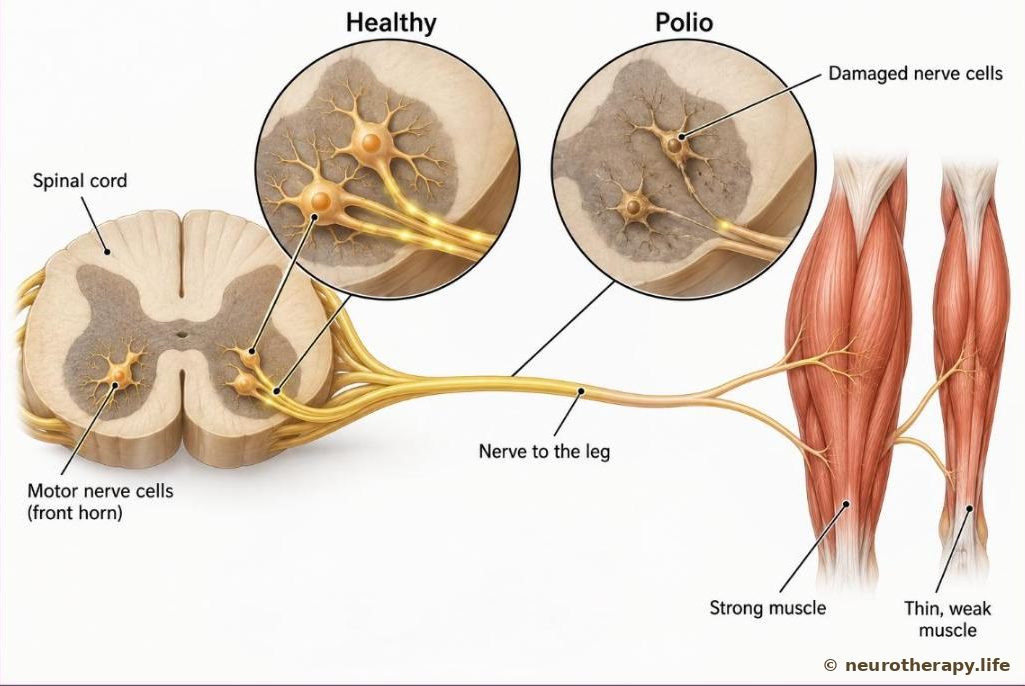
Polio is a virus infection that can damage the nerve cells in the spinal cord that move the muscles, leaving a weak, thin arm or leg. The weakness usually stays for life, but good care can make daily life stronger and easier.
- About 1 in 200 polio infections leads to lasting paralysis
- It mainly affects children under 5 who are not vaccinated
- 25 to 40 of every 100 survivors get new weakness 15 to 40 years later (post-polio syndrome)
Source: World Health Organization; CDC; NHS
What is Polio and its after-effects?
Polio (poliomyelitis) is caused by a virus that spreads from person to person, mostly through hands, food or water soiled with infected stool. Most infected people have no symptoms at all. About 1 in 4 get a flu-like illness for a few days.
In a few, the virus inflames the spinal cord and damages the nerve cells that move the muscles. The muscles those cells served become weak and floppy, and over time thin. No medicine can bring back the lost nerve cells, so care focuses on physiotherapy, exercise, braces and sometimes surgery. Vaccination prevents polio.
What are the symptoms?
- At the start: fever, tiredness, headache, vomiting, a stiff neck and muscle pain
- Sudden weakness or floppiness of a leg or an arm
- Later: a thin, weaker limb, a limp, or a foot that turns
- Joint pain and tiredness from the extra strain
- Years later: new weakness, fatigue or pain (post-polio syndrome)
What causes it, and who is more likely to get it?
The virus
- Poliovirus, spread through stool-soiled hands, food or water
- Less often, through coughs and sneezes
Who is at risk
- Children under 5
- Anyone who has not had all the vaccine doses
Years after polio
- Nerve cells that took on extra work slowly tire out (post-polio syndrome)
- Strain on joints and muscles from years of uneven walking
How is it found?
Old polio is usually known from the history — a fever in childhood followed by weakness. New weakness years later needs a doctor, to rule out other causes.
EMG and nerve conduction
Tests of the tiny electrical signals in the muscles and how fast the nerves carry them.
MRI or CT scan
Pictures of the spine, to rule out other problems such as a worn spine pressing on nerves.
Blood tests
Usually normal in post-polio syndrome; an abnormal result points to another cause.
A neurotherapist asks about immunity (cancer, HIV, serious infection), the heart and the bowel, feels whether both calves are the same temperature and neither is hot or swollen, and checks that you can feel touch and report pain — before the first treatment.
How Neurotherapy (LMNT) sees Polio and its after-effects
LMNT teaching reads the name first. Polio-myelitis: myel is the spinal cord, -itis means inflamed. So polio is treated as an inflammatory disease, with the point that ends inflammation. LMNT does not claim to reverse the paralysis or to fight the virus. It gives each point its own job, in one plan — and it says the limit out loud.
One disease, four jobs
- End the inflammation(6) Adr × 3 treatments — the point for any disease whose name ends in -itis
- Supply the weak limbBlood Supply to Legs — for the weakness and numbness of the legs and thighs
- Hold a group backThymus, Thymus + Chest, Armpit, Lymph, Ton 'P' and Ton 'T' are not given
- Keep one question openSpl — Guruji wrote it as a question: to be tried on polio patients, to see whether they benefit
Rubbing makes a leg willing; using it makes a leg strong. LMNT support may help comfort, stiffness and daily function, and patients report feeling better after the treatment — but the exercises, physiotherapy and braces carry the strength.
In this therapy we do not treat the disease; rather, we improve the body.
Neurotherapy (LMNT) treatment for Polio and its after-effects, step by step
Examine first
The therapist checks Liv° and Mu°, asks about immunity and the heart, and checks that both calves are the same temperature and neither is hot, swollen or tender.
End the inflammation
(6) Adr × 3 treatments is given for polio because it is an inflammatory disease — but only where immunity is sound.
Blood Supply to Legs
Face down, legs loose, toes out. The therapist stands facing your heels and slides the soft middle of the sole gently from hip to knee on the back of each thigh — usually 30 times on each leg.
ITF, over two days
Day one: (30) Medulla, then (6) Adr twice. Day two: (6) Adr three times. Polio is one of the conditions named for it.
Use the limb, and set digestion right
A daily count of stairs and stands, done by the patient, carries the strength. Constipation, if present, is treated alongside.
Points and formulas used
(6) Adr × 3 treatments
The main LMNT treatment for inflammation, given on three separate occasions.
Works through
Open →Never do this
- Thymus, Thymus + Chest, Armpit, Lymph, Ton 'P' and Ton 'T' are not given in polio. Th + Ch
- (6) Adr lowers immunity, so it is not given where immunity is already low — septicaemia, HIV/AIDS, cancer. (6) Adr
- (30) Medulla is not given to heart patients; if needed, (6) Adr is given with the patient seated. (30) Medulla
- Blood Supply to Legs is slid gently so the skin is not hurt. A hot, swollen, painful calf is never rubbed — see a doctor at once. Blood Supply to Legs
- Children get half the adult dose and light treatment only, given by a trained therapist.
- A new fever with a stiff neck and new weakness, or any trouble breathing or swallowing, needs a hospital at once.
- Cancer: if the person has cancer, (10) Pan, Thymus, Pit, Lu + Sh, Rt. Ov / Lt. Ov and (30) Medulla are never given — the therapist changes the plan.
- Keep taking the medicines your doctor prescribed, and keep up the physiotherapy, exercises and braces. Neurotherapy (LMNT) works alongside your medical care, never instead of it.
From practice
The boy with the thin left leg
A teaching case — a composite from practice, not one patient's file
9 years · a left leg that never grew properly after a fever at eighteen months; trouble with the school stairs
- What was found
- The left calf and thigh were thinner, the foot turned slightly in, but feeling was normal and both calves were the same temperature. He was also constipated. His mother was told on day one: the old nerve damage will not be reversed, but a good deal else can improve.
- What was done
- Blood Supply to Legs, 30 on each thigh, with the constipation treated alongside. By week three he managed the stairs without holding the rail at every step; the thin calf did not thicken. At six weeks a daily count of stairs and stands was added, and the later gains came from that.
- What it teaches
- In week nine he slipped back — a teacher had told him he would never play kabaddi, and he stopped his stairs. Say the limit out loud early, give both rubbing and use, and ask the child, not only the parent.
From Ayurveda and the kitchen
Test yourself
What research says
- Strong evidence
Polio mainly affects children under 5 and spreads mostly through the faecal-oral route. One in 200 infections leads to lasting paralysis, and cases have fallen by over 99% since 1988.
World Health Organization. Poliomyelitis — fact sheet. WHO. 2024.
- Strong evidence
Poliovirus inflames the spinal cord and destroys the motor nerve cells in its front horn. At least 15 years later, many survivors develop new weakness, fatigue, poor sleep and pain — post-polio syndrome.
No clinical trial of Neurotherapy (LMNT) for polio or its after-effects has been published yet. Improvements reported by neurotherapists are clinical observations.
For you
Parents
Make sure your child gets every dose of the polio vaccine. If a child has had polio, keep up physiotherapy and daily exercise, and ask the child how they feel about it — morale carries the plan.
Adults who had polio as children
Pace your activity and rest often. Exercise to strengthen, but stop before pain or exhaustion. Report new weakness to your doctor.
Home and daily life
Grab bars, a raised toilet seat and a walking aid where needed save energy and prevent falls.
This page explains; it does not diagnose. Neurotherapy (LMNT) works alongside your medical care — keep taking the medicines your doctor prescribed, and see a doctor for any new or severe symptom.