Low blood pressure
Low blood pressure means the force of your blood in the arteries is lower than usual — often below 90/60. For many people it causes no trouble. It matters when it brings dizziness or fainting, and above all when it falls suddenly, for example after heavy bleeding.
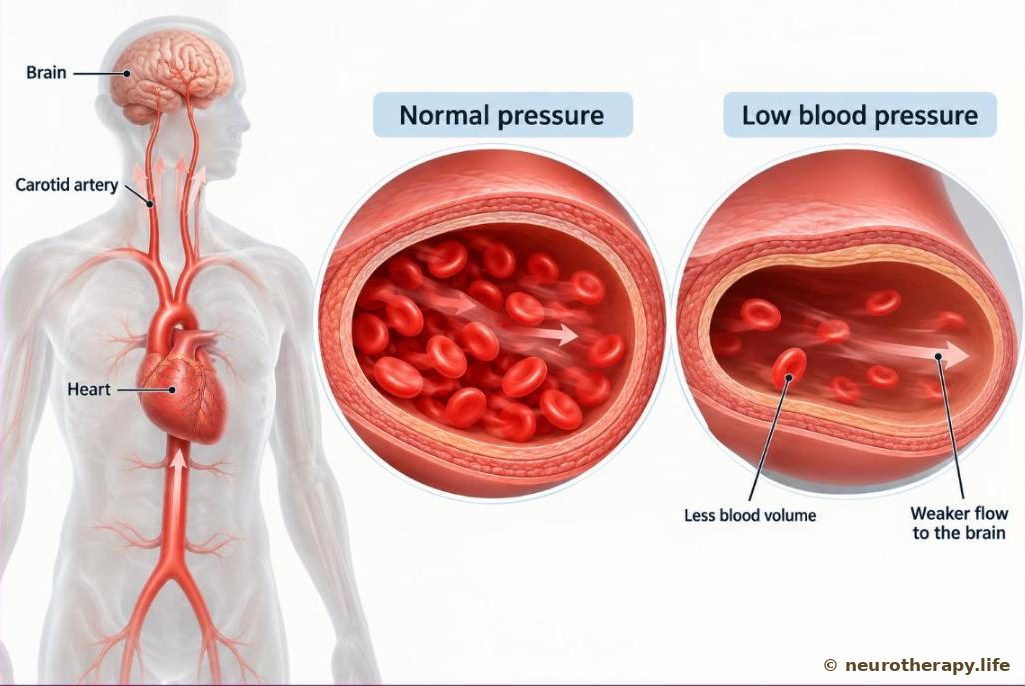
- A reading of 90/60 or lower is usually called low blood pressure
- A fall in pressure on standing up affects about 5% of people at 50 — and more than 30% of people over 70
- Low pressure on its own is often harmless; it is a problem when it causes dizziness, fainting or, at worst, shock
Source: MedlinePlus (US National Library of Medicine); Cleveland Clinic (hypotension); NHS (low blood pressure)
What is Low blood pressure?
Blood pressure is the push of your blood against the walls of your arteries. It is written as two numbers, such as 120/80. When it is lower than about 90/60, it is called low blood pressure, or hypotension. Some fit, healthy people live with low readings all their lives and feel well.
There are two very different pictures. In one, the pressure has been low for years, or drops for a moment when you stand up. In the other, it falls suddenly — because the body has lost a lot of blood or water, or because of a heart problem or a serious infection. The second picture can lead to shock and is an emergency.
What are the symptoms?
- Often no symptoms at all
- Dizziness or light-headedness, especially on standing up
- Fainting
- Blurred vision, nausea, weakness or tiredness
- Confusion
- Signs of shock: cold, sweaty, pale skin, fast breathing and a fast pulse
What causes it, and who is more likely to get it?
Standing up and age
- A drop in pressure when standing up quickly (postural or orthostatic hypotension)
- Growing older — it becomes more common after 50 and after 70
Too little blood or water
Heart and nerves
- An irregular heartbeat or heart failure
- Diseases of the nervous system that affect how blood pressure is controlled
Other causes
- Some medicines, including tablets for high blood pressure
- Pregnancy, alcohol, and great heat
How is it found?
Low blood pressure is found by measuring it. The doctor also asks how it came on — slowly over years, only on standing, or suddenly — because that decides what is looked for next.
Blood pressure cuff
A cuff on the upper arm. Readings may be taken lying down and again after standing up, to see whether the pressure falls on standing.
Blood and urine tests
These look for causes such as a low blood count, dehydration or a sugar problem.
Heart tests
An ECG, and sometimes a tilt-table test, where you lie on a table that is tilted upright while your pressure and pulse are watched.
A neurotherapist presses Liv° and Mu° first, then asks the one question that decides everything: has the pressure been low for years, or did it fall suddenly — after an accident, a miscarriage or very heavy bleeding in a period? Your haemoglobin report matters here.
How Neurotherapy sees Low blood pressure
In LMNT, low blood pressure is two different conditions, and they are treated in opposite ways. Pressure that has been low for years is read as coming from too little water in the blood, or from the acid side of the body. Pressure that has fallen suddenly is read as blood lost, and the body's own answer to that loss not arriving.
When pressure falls suddenly — the chain as Guruji taught it
- Blood lostan injury, an accident, a miscarriage or very heavy periods
- Volume fallsthe quantity of blood in the body drops all at once (hypovolaemia)
- The heart pumps out lessless blood leaves the heart, and the pressure keeps falling
- The body's answerangiotensin II tightens the smaller arteries to hold the pressure up
- When the answer does not comegiddiness on any work, shivering, clenched teeth, no strength to speak, falling temperature and pulse
The acid–alkali account points the same way: in LMNT, Mu° reduces acid and so corrects low pressure, while alkali is the direction that raises pressure. Everything turns on how the low pressure arrived — strip out the word “suddenly” and each rule becomes right half the time and harmful the other half.
This is exactly how it should be. And this itself is the secret of Neurotherapy's success.
Neurotherapy treatment for Low blood pressure, step by step
Examine first
The therapist grades Liv° and Mu°, reads your haemoglobin and BP readings, and asks how the low pressure came on — over years, or suddenly after bleeding.
Sudden fall while still bleeding: hospital, today
Cold and clammy, pale, a fast pulse, faint on sitting up, confused, passing little urine, still bleeding — this person is not treated on the mat. She is taken today to a place with a drip and a blood bank.
After the bleeding has stopped
For the person being built back up after an accident, a miscarriage or heavy periods, LMNT gives only the Angiotensin No. 2 formula. (2) Para is not given to this person.
Low pressure of many years
Here it is the other way round: only (2) Para — the Vasopressin formula — and Multivitamin 4 where there is weakness in the body. The Angiotensin No. 2 formula is not given.
Work on the acid side
Mu° and the Acid point, with (2) Adr, and digestive (undigested-food) work where it is needed. The Acid point is given only when Mu° is tender, and never with loose motions.
Points and formulas used
Angiotensin No. 2
For pressure that fell suddenly after blood loss, once the bleeding has been stopped — helps the body answer the fall. Not for low pressure of many years.
Works through
Open →Vasopressin formula
(2) Para, for low pressure of many years — always below normal, tiring quickly. Not for pressure that fell suddenly.
Works through
Open →Multivitamin formula 4
For low pressure with weakness in the body — the one longer formula in which (2) Para sits.
Works through
Open →Never do this
- Never in low BP: Ku in any form (it raises acid), Gas 'I' and (30) Medulla (they lower blood pressure). (30) Medulla
- The two kinds are never mixed: low BP of many years — no Angiotensin No. 2; low BP that came on suddenly — no (2) Para. (2) Para
- Heparin formulas lower the diastolic pressure, so they may take a low BP lower still — given only after careful thought, if there is need. P. Heparin (plasmin)
- Emergency — call for help at once: fainting with chest pain; black stools, vomiting blood or bleeding that will not stop; confusion or drowsiness; cold, sweaty, pale skin with fast breathing. A woman of childbearing age with belly pain and collapse is an emergency until a doctor says otherwise.
- Cancer: if the person has cancer, (10) Pan, Thymus, Pit, Lu + Sh, Rt. Ov / Lt. Ov and (30) Medulla are never given — the therapist changes the plan.
- Keep taking the medicines your doctor prescribed. Neurotherapy works alongside your medical care, never instead of it.
Watch

A demonstration of the Angiotensin No. 2 formula — (7) Liv, (7) Mu° and (6) Lu + Sh — for low blood pressure that comes on suddenly after very heavy bleeding in a period.
The video suggests using the formula at the moment of fainting. In LMNT teaching, a person who is still bleeding, cold, pale or fainting is taken to hospital first; this formula is for after the bleeding has been stopped. Lu + Sh is not given in cancer.

This video explains the Para point and how (2) Para differs from (4) Para, in relation to low calcium, bone pain and blood pressure.

Shows the Acid Treatment formula step by step: (8) Pan, (3) Gal, (5) Mu°, 3 Acid on the side of the right thigh, (4) Chest Only, and (6) Adr on the upper back, given without breaks. It is used to support the body's acid–alkali balance when acid is raised.
Note: the Acid Treatment formula is given only when the Mu° point is tender, and (6) Adr is not given in high BP, diabetes, cancer or HIV — the therapist checks first.
The Angiotensin No. 2 formula for low BP after heavy bleeding, the difference between (2) Para and (4) Para, and the Acid Treatment formula. Fainting from blood loss is an emergency — hospital first; the formula is for after the bleeding has stopped.
From Ayurveda and the kitchen
Test yourself
What research says
- Strong evidence
An expert consensus that sets the standard definitions for a fall in blood pressure on standing, and for fainting caused by the body's pressure reflexes — the definitions doctors use when they test lying and standing readings.
- Strong evidence
When blood flow to the kidneys falls, the body makes angiotensin II. It tightens the small arteries, releases aldosterone to hold salt and water, and releases vasopressin — the body's own way of raising a fallen pressure, the same mechanism the LMNT account of sudden low BP describes.
No clinical trial of Neurotherapy in low blood pressure has been published yet. Improvements reported by neurotherapists are clinical observations.
For you
If you feel dizzy on standing
Get up slowly — lying, then sitting, then standing. Drink enough water through the day. If dizziness or fainting keeps coming back, see a doctor.
Women with very heavy periods
Giddiness for days after a period can mean a low haemoglobin. Get a blood test, and tell your therapist how heavy the bleeding is.
People on BP tablets and older adults
Blood pressure tablets and some other medicines can bring the pressure too low, and falls on standing are more common after 70. Tell your doctor — never change a dose yourself.
This page explains; it does not diagnose. Neurotherapy works alongside your medical care — keep taking the medicines your doctor prescribed, and see a doctor for any new or severe symptom.