Infertility
Infertility means a pregnancy has not begun after a year of regular unprotected sex. It can come from the woman's side, the man's side, or both — so both partners should be tested.
- About 1 in 6 people of reproductive age worldwide face infertility at some time in their life
- About one-third of cases involve the woman, one-third the man, and one-third both or no cause found
- If the woman is 35 or older, doctors advise testing after 6 months of trying instead of 12
Source: World Health Organization; Cleveland Clinic; MedlinePlus
What is Infertility?
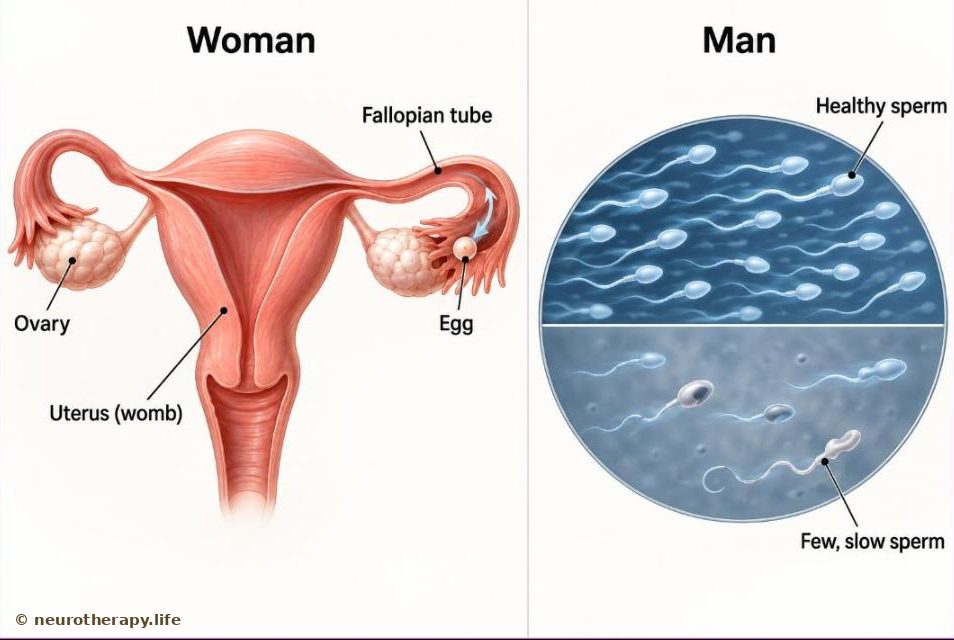
For a pregnancy to begin, the woman's ovary must release an egg, the fallopian tube must be open for the egg and sperm to meet, and the womb must be ready to hold the pregnancy. The man must make enough healthy sperm that can swim well and reach the egg.
A problem at any of these steps can cause infertility. It is a condition of a couple, not a fault of the woman — yet in many homes she is blamed first. Testing both partners early saves time, money and heartache.
What are the symptoms?
- The main sign: no pregnancy after 12 months of regular unprotected sex (6 months if the woman is 35 or older)
- Irregular periods, or periods that stop — a sign the ovary may not be releasing eggs
- Very painful periods or pain in the lower belly, which can come with endometriosis
- Often no other sign at all — especially in men, where a semen test may be the only way to know
What causes it, and who is more likely to get it?
On the woman's side
- The ovary not releasing an egg — often from polycystic ovary syndrome (PCOS) or a hormone imbalance
- Blocked or damaged fallopian tubes, often after an infection
- Fibroids or endometriosis in the womb
On the man's side
- Too few sperm, or sperm that do not move well or are misshapen
- Blocked ducts, or problems releasing semen
- Hormone imbalance
For both
- Age — the woman's egg supply falls with age
- Smoking and heavy drinking
- Being very overweight or very underweight
How is it found?
Both partners are checked. The doctor takes a history and examines, then chooses tests for each.
Semen analysis (for the man)
Counts the sperm and checks how well they move. A simple test, and one that should not be skipped.
Hormone blood tests
Show whether eggs are being released, and check hormones in both partners — thyroid included.
Ultrasound and tube test
An ultrasound looks at the womb and ovaries; an X-ray dye test (HSG) checks whether the tubes are open. Men may have a scrotal ultrasound.
A neurotherapist asks for both partners' reports, checks Liv° and Mu°, feels for pain below the navel at WD, and asks about the cycle and whether the body feels cold. Before certain points, the question is asked plainly and in private: "Are you hoping for a child, now or soon?"
How Neurotherapy (LMNT) sees Infertility
In LMNT, the WD point below the navel is used to increase blood flow in the womb in women, and in the prostate and genitals in men — and infertility is among its uses. Guruji linked (30) Medulla to the body's prostaglandins, which the man's seminal vesicles and the woman's vagina make in greater amounts at the time of intercourse, and he saw great benefit from it in conception.
So the teaching is given in three parts, and all three belong together: the other treatments continue in the clinic; both husband and wife are taught (30) Medulla, not one; and they give it to each other at home. Neurotherapy (LMNT) supports the couple alongside their doctor — it does not replace the tests or the fertility treatment.
The research is still to be done.
Neurotherapy (LMNT) treatment for Infertility, step by step
Both partners, and the doctor's tests
Both husband and wife are tested and both are taught — not one. The fertility doctor's tests and treatment continue.
Examine first
The therapist checks Liv° and Mu°, feels for pain below the navel at WD, and reads the reports — the cycle, the semen test, the ultrasound.
WD — blood flow below the navel
WD is given on the forearms to increase blood flow in the womb, or in the prostate and genitals. There is no pressure on the lower belly itself.
(30) Medulla, taught to both
A gentle treatment on the back of the neck — no instrument, no medicine, no undressing — taught to husband and wife so that they can give it to each other at home, alongside the clinic treatments.
When the picture is more specific
Where the woman's body temperature runs low and her periods have been scanty — both findings together — (6) Medulla with Raman. Where infertility comes from autoimmune antibodies, Lt. Ov.
Points and formulas used
(30) Medulla
Linked in LMNT teaching to the body's prostaglandins; taught to both partners to give each other at home.
Open →Never do this
- Ton 'P' is not given to a woman who wants a child — it may perhaps have some adverse effect on conception. It is not proven to prevent pregnancy either, so it is never to be called a contraceptive. The research is still to be done. Ton 'P'
- Once pregnancy may have begun: Thymus, Thymus + Chest, Ton 'P' and Ton 'T' are not given, nor any treatment that could trouble the child; there is no deep or lasting pressure on the lower belly; and (30) Medulla is not given casually to a pregnant woman. Pregnancy
- (30) Medulla is not given to heart patients. The ovary points are not given in the teenage years, and WD and the ovary points are not given in cancer. (30) Medulla
- Get emergency help for sudden, severe pain on one side of the lower belly with dizziness, fainting or pain at the tip of the shoulder in a woman who may be pregnant — it can be a pregnancy outside the womb (ectopic). See a doctor for bleeding between periods or after intercourse, or a foul or blood-stained discharge.
- Cancer: if the person has cancer, (10) Pan, Thymus, Pit, Lu + Sh, Rt. Ov / Lt. Ov and (30) Medulla are never given — the therapist changes the plan.
- Keep taking the medicines your doctor prescribed. Neurotherapy (LMNT) works alongside your medical care, never instead of it.
From practice
The woman who was told her womb had slipped, and wanted a child
A teaching case — a composite from practice, not one patient's file
29 years · a sonography showing a slipped womb (prolapse), eight months after her second delivery · wanted one more child
- What was found
- Pain below the navel and in the back all day, white discharge, and periods coming anywhere from twenty to forty days apart. Tender at Mu° and Const, not at Liv°; constipated since the delivery; cold hands, and she felt cold when nobody else did. At the door, half turned away: "We want one more child. They are saying operation."
- What was done
- Ton 'P', the treatment described as unmatched for a slipped womb, was not given — and she was told why in full: it may perhaps affect conception, it is not proven to prevent it, and the research is still to be done. Instead she had P point with (6) WD straight after, Triangle for piles, (1) Acid, Raman, and work on her digestion. The back pain and the bowel settled in two weeks, the discharge in six, and at ten weeks her cycle came at twenty-nine days. Her own doctor reassessed the prolapse.
- What it teaches
- In week five her progress stopped. Asked what she lifted each day, she said she was again carrying a full water pot up an outside stair four times every morning. The best treatment for a condition is not always the right one for this patient — and a woman told only "no" goes looking elsewhere for a "yes", so she is told the reason too.
From Ayurveda and the kitchen
Test yourself
What research says
- Strong evidence
A review of how infertility is defined and how common it is: it affects about 8 to 12 in 100 couples worldwide, and men contribute to about half of all cases — which is why both partners need to be checked.
Vander Borght M, Wyns C. Fertility and infertility: Definition and epidemiology. Clin Biochem. 2018.
No clinical trial of Neurotherapy (LMNT) for infertility has been published yet. Improvements reported by neurotherapists are clinical observations.
For you
Couples
See a doctor together after a year of trying — or after six months if the woman is 35 or older. Start the tests for both of you at the same time.
Men
A semen test is simple and often decides the whole plan. Smoking, heavy drinking and a lot of extra weight can all lower fertility.
Women with irregular periods
Irregular or scanty periods can mean the ovary is not releasing eggs. Keep a period diary and take it to the doctor and the therapist.
This page explains; it does not diagnose. Neurotherapy (LMNT) works alongside your medical care — keep taking the medicines your doctor prescribed, and see a doctor for any new or severe symptom.