Enlarged Prostate (BPH)
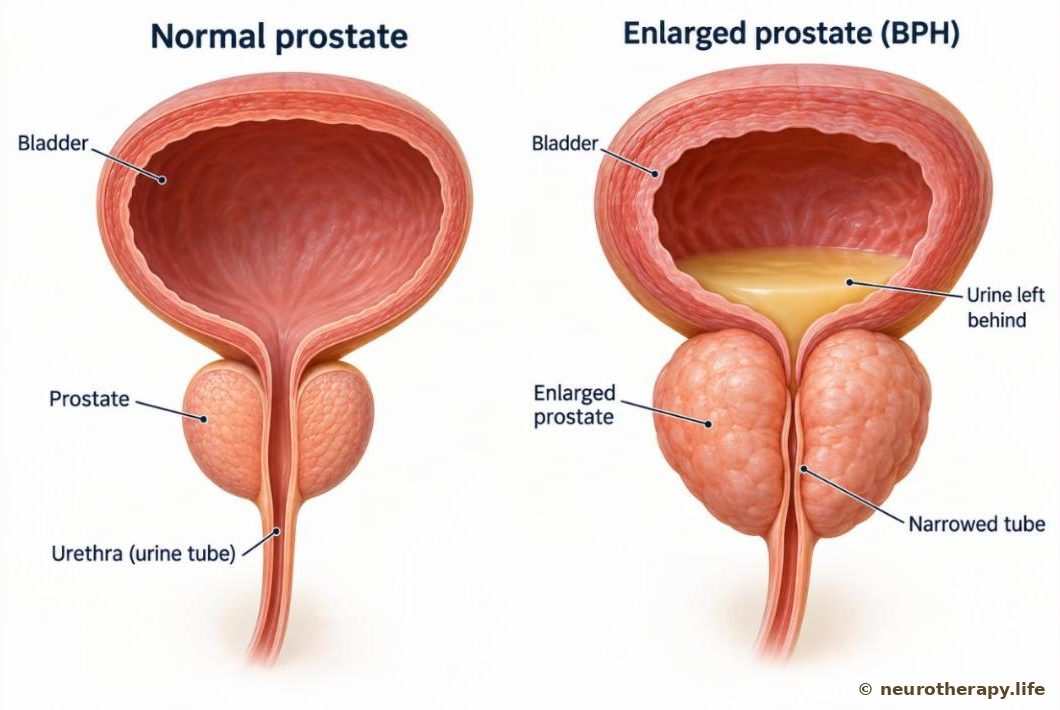
An enlarged prostate is a non-cancerous growth of the prostate gland in older men. It squeezes the urine tube, so urine comes weakly, in stops and starts, and often — especially at night.
- It is not cancer, and it is not thought to raise the risk of prostate cancer
- The most common prostate problem in men over 50 — it rarely causes symptoms before 40
- About 5–6 in 100 men aged 40 to 64, and about 29–33 in 100 men aged 65 and over, have it (US figures)
Source: US National Institute of Diabetes and Digestive and Kidney Diseases (NIDDK); MedlinePlus; Mayo Clinic
What is Enlarged Prostate (BPH)?
The prostate is a small gland just below the bladder that helps make semen. The tube that carries urine out of the bladder, the urethra, runs straight through the middle of it. With age the prostate often grows — this is called benign prostatic hyperplasia, or BPH. Benign means it is not cancer.
As the gland grows, it presses on the urethra. The bladder has to push harder, the stream becomes weak, and some urine stays behind. Urine that stays behind can lead to infections and bladder stones, and in time the pressure can harm the kidneys.
What are the symptoms?
- Needing to pass urine often, or urgently
- Waking up several times at night to pass urine
- Trouble starting, and a weak stream that stops and starts
- Dribbling at the end
- Feeling the bladder has not emptied fully
What causes it, and who is more likely to get it?
Age and hormones
- Hormone changes with ageing — the risk rises with each year after 40
- A father or brother with prostate problems
Other health conditions
Lifestyle
- Too little physical activity — exercise helps lower the risk
How is it found?
A doctor checks the prostate and rules out other causes, especially an infection or cancer, which can give similar urinary trouble.
Rectal examination
The doctor gently feels the size and surface of the prostate with a gloved finger.
PSA blood test
A protein made by the prostate. It can be raised by BPH, infection or cancer, so the doctor reads it with the other findings.
Urine test and ultrasound
The urine test looks for infection or blood. The ultrasound shows the prostate's size and how much urine is left in the bladder afterwards.
Flow tests and cystoscopy
Measure the strength of the stream and how the bladder works, or look inside with a thin scope when needed.
A neurotherapist asks for the doctor's PSA and ultrasound reports, and always asks about diabetes, heart disease and kidney disease — because these decide which points may be given. Pain below the navel at WD, and in the lower back just above the sacrum, is noted.
How Neurotherapy sees Enlarged Prostate (BPH)
Over sixty years of treating many diseases, it was seen in LMNT that practically every disorder of the genital organs shows as pain in the part below the navel. The WD point there covers the uterus in women and the prostate in men, and WD is given to increase blood flow in the prostate. So the New Genes formula — also called the Pan–WD formula — is used for all problems of the prostate gland.
Thymus + Chest is named for an enlarged prostate too — LMNT teaching uses it to dry up excess water in the body — and it is always given with the armpits. Where the pain below the navel is severe and there is no diabetes or autoimmune disease, the formula's tail can change to Thymus + Chest. For urine that comes in stops and starts or drop by drop, (6) Left Swt may perhaps help — Guruji printed that line with his own question mark, and it is not promised to anyone.
Wherever there is a question mark, it is an indication that this is my own thinking, on which other people can now do research.
Neurotherapy treatment for Enlarged Prostate (BPH), step by step
The doctor's check first
A PSA test, a rectal examination and an ultrasound tell BPH from infection or cancer. The therapist also checks Liv° and Mu° and the pain below the navel.
Check the blocks
Diabetes, heart disease, kidney disease and autoimmune disease each rule out certain points. These are marked on the card before any treatment begins.
The New Genes formula
(8) Pan, (6) WD, (8) Ch. Only and the Round Arrow. The last two keep the acid–alkali balance; WD reaches the prostate.
Thymus + Chest, where it is allowed
Given for an enlarged prostate only where none of its bars apply — and always together with the armpits.
Stop-start urine
Where urine comes in stops and starts or drop by drop, (6) Left Swt may be tried — with LMNT's own question mark, never as a promise, and never in diabetes.
Points and formulas used
New Genes formula
The Pan–WD formula, given in LMNT for all problems of the prostate gland and the uterus.
Works through
Open →Th + Ch
Named in LMNT for an enlarged prostate; always given with the armpits, and barred in several diseases.
Open →(6) Left Swt
Opens a narrowed passage; may perhaps help urine that comes drop by drop — with a question mark, not for diabetics.
Open →Never do this
- Thymus + Chest is not given in diabetes, heart disease, kidney disease, rheumatoid arthritis or other autoimmune disease, polio or inflammatory disease. When it is given, the armpits are always given too — and the armpits are not given in lymph-node cancer, polio, diabetes or autoimmune disease. Th + Ch
- (6) Left Swt is not given to people with diabetes, and Swt is not given in heart disease or high blood pressure. Its use for stop-start urine carries LMNT's own question mark — it is never promised. (6) Left Swt
- Only a doctor's tests can tell an enlarged prostate from prostate cancer. WD is not given in cancer, so the PSA and the doctor's opinion come before the first session. WD
- See a doctor the same day if you cannot pass urine at all, if there is blood in the urine, if you have fever or chills with painful urination, or severe pain in the lower belly. Urine obstructed
- Cancer: if the person has cancer, (10) Pan, Thymus, Pit, Lu + Sh, Rt. Ov / Lt. Ov and (30) Medulla are never given — the therapist changes the plan.
- Keep taking the medicines your doctor prescribed. Neurotherapy works alongside your medical care, never instead of it.
Watch
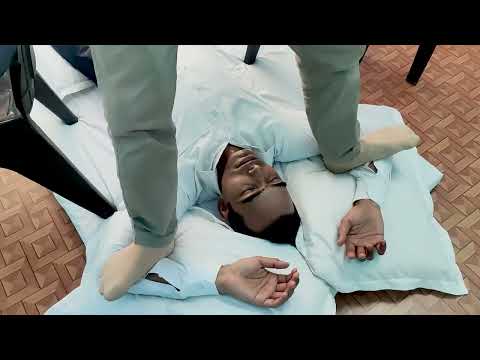
A step-by-step demonstration, in Hindi, of the New Genes formula: (8) Pan at the thigh–hip crease, (6) WD on both forearms, (8) Ch. Only and the Round Arrow, with the patient's position and how each count is kept.
A step-by-step training demonstration of the New Genes formula, in Hindi.
From Ayurveda and the kitchen
Test yourself
What research says
- Strong evidence
A review of how common BPH is: it is one of the most common diseases of ageing men, it rises steeply after 40, and it is linked with metabolic problems such as diabetes and obesity — which is why exercise and diet matter.
Lim KB. Epidemiology of clinical benign prostatic hyperplasia. Asian J Urol. 2017.
No clinical trial of Neurotherapy for an enlarged prostate has been published yet. Improvements reported by neurotherapists are clinical observations.
For you
Men over 50
Getting up at night, a weak stream or dribbling are worth telling your doctor about — they are common, and the checks are simple.
Men with diabetes
Diabetes may raise the risk of BPH. In LMNT, Thymus + Chest and (6) Left Swt are not given to you, so the plan is built around the New Genes formula and WD.
Men with a raised PSA
Keep every follow-up test your doctor asks for. A raised PSA has several possible causes, and only the doctor can sort them out.
This page explains; it does not diagnose. Neurotherapy works alongside your medical care — keep taking the medicines your doctor prescribed, and see a doctor for any new or severe symptom.