HIV/AIDS
HIV is a virus that weakens the immune system by destroying the white cells that fight infection. AIDS is its late stage. Daily antiretroviral medicines (ART) let most people with HIV live long, healthy lives. LMNT does not act on the virus — it is offered only as support alongside ART, which must never be stopped.
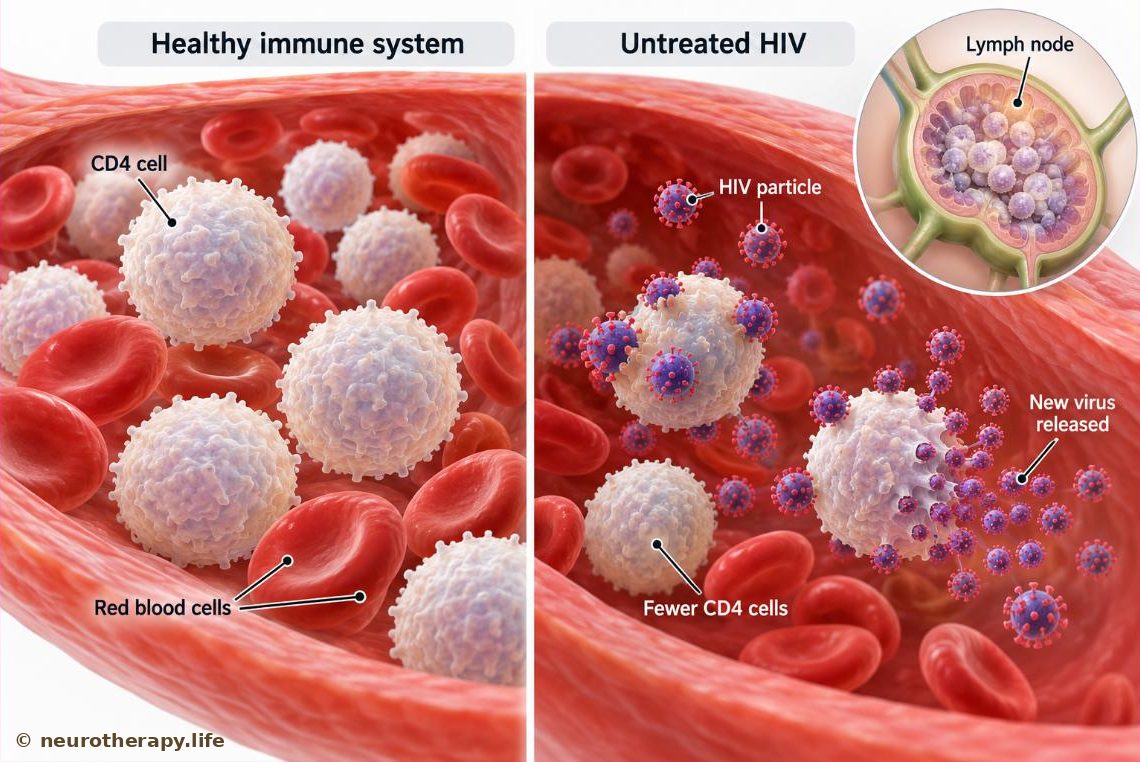
- An estimated 41.0 million people were living with HIV at the end of 2025
- HIV does not spread through hugging, shaking hands, kissing, or sharing food, water or personal objects
- AIDS is diagnosed when the CD4 count falls below 200 cells per cubic millimetre of blood
Source: World Health Organization — HIV and AIDS fact sheet; Cleveland Clinic; MedlinePlus
What is HIV/AIDS?
HIV (human immunodeficiency virus) attacks CD4 cells — white blood cells that lead the body's fight against germs. Without treatment it keeps destroying them over the years, and the body finds it harder and harder to fight off infections.
HIV moves through three stages: a short flu-like illness, a long quiet stage that can last years without symptoms, and AIDS — when the immune system is badly weakened and unusual infections take hold. Not everyone with HIV develops AIDS. Medicines cannot yet remove HIV from the body, but taken every day they keep the virus down so the immune system can recover.
What are the symptoms?
- Early on, a flu-like illness for 2 to 4 weeks — fever, rash, sore throat, swollen glands
- Then often no symptoms at all for years
- Night sweats, fevers and extreme tiredness
- Rapid weight loss
- Mouth sores and infections that keep coming back
What causes it, and who is more likely to get it?
How HIV spreads
- Sex without a condom with a person whose HIV is not controlled by treatment
- Sharing needles or syringes; contact with infected blood
- From mother to baby during pregnancy, birth or breastfeeding — preventable with treatment
How HIV does not spread
- Hugging, shaking hands, sharing food, water, utensils or a toilet
- From a partner on ART whose viral load is undetectable
How is it found?
HIV is found with a blood test. Once it is found, regular tests show how the immune system is doing and how well the medicines are working.
HIV test
A blood test at a clinic or a home test kit. A positive result is always confirmed with a second test.
CD4 count
Counts the CD4 immune cells. Below 200 cells per cubic millimetre means AIDS.
Viral load
Measures how much virus is in the blood. The aim of treatment is to make it undetectable.
A neurotherapist asks, in private, about the latest CD4 count and viral load and the ART being taken, and keeps what is shared confidential. The therapist also asks about the stool, because LMNT checks for undigested food in every long illness.
How Neurotherapy sees HIV/AIDS
In LMNT, HIV and AIDS stand with the conditions in which immunity is already low. So the first rule is what not to give: (6) Adr lowers immunity, and it is never given here. That is also why the Inflammation Treatment Formula (ITF), which contains (6) Adr, is not the answer in HIV.
What LMNT teaching gives instead points the other way — towards the body's own defence. Guruji's teaching holds that the body needs well-digested protein as raw material to make its defence cells and antibodies, so digestion is checked first. Then the Lymph and Thymus points, (2) Pan and (1) point Liv × 6 treatments are given — as support for the body alongside ART, never as treatment for the virus.
It is not enough that one eats protein. The thing that matters is that it is digested.
Neurotherapy treatment for HIV/AIDS, step by step
ART first — every day, never stopped
The HIV doctor stays in charge of the medicines and the blood tests. Neurotherapy is given only alongside ART; stopping or skipping ART is never part of any plan.
Examine first
The therapist checks the diagnostic points Liv° and Mu°, asks about the latest CD4 count and viral load, and asks whether undigested food appears in the stool.
Strike out (6) Adr
(6) Adr lowers immunity, so it is blocked on the card from the first day — and with it ITF, which contains it.
Support the body's defence
(1) Lymph (1) Th. Only × 6 treatments, with Spl added only if the Spl point is painful. (2) Pan, pressed for six seconds, and (1) point Liv × 6 treatments through the day.
Points and formulas used
(1) Lymph (1) Th. Only × 6 treatments
A gentle immunity formula — one Lymph and one Thymus Only, given as six separate treatments. Spl is added only if the Spl point is painful.
Works through
Open →Never do this
- Never stop, skip or reduce ART. Interrupting HIV treatment is dangerous. Neurotherapy does not act on the virus.
- (6) Adr is never given in HIV or AIDS — it lowers immunity, which is already low. For the same reason ITF is not given. (6) Adr
- Spl is added only when the Spl point is painful. Spl
- See a doctor the same day for a fever that will not settle, breathlessness or a new cough, a severe headache or stiff neck, confusion, fast weight loss, or diarrhoea that will not stop.
- Everyone deserves respect and privacy. HIV does not pass through ordinary touch, so hands-on care on healthy skin is safe; the usual clinic hygiene is kept for everyone.
- Cancer: if the person has cancer, (10) Pan, Thymus, Pit, Lu + Sh, Rt. Ov / Lt. Ov and (30) Medulla are never given — the therapist changes the plan.
- Keep taking the medicines your doctor prescribed. Neurotherapy works alongside your medical care, never instead of it.
From Ayurveda and the kitchen
Test yourself
What research says
- Strong evidence
Over about 1,600 couple-years of follow-up, not one partner caught HIV from a partner whose virus was kept undetectable by ART. It shows how powerful daily HIV medicines are — and why they must never be stopped.
No clinical trial of Neurotherapy in HIV or AIDS has been published yet. Improvements reported by neurotherapists are clinical observations.
For you
People living with HIV
Take ART at the same time every day and keep every blood test. Eat well, sleep well, and tell your HIV doctor about any other therapy you take.
Pregnant women
Get tested. With treatment, passing HIV to the baby can be prevented.
Families and friends
Ordinary life together is safe — meals, hugs, a shared home. Support and kindness help a person keep taking treatment.
This page explains; it does not diagnose. Neurotherapy works alongside your medical care — keep taking the medicines your doctor prescribed, and see a doctor for any new or severe symptom.