Watch


Change the arrangement and you change the treatment, not its strength
A formula is a list of point applications in a fixed order, and each carries silently a fifth instruction alongside its place, count, angle and order: the arrangement of the body receiving it. Change the arrangement and you change the angle at which pressure enters, the length and tension of the muscle it enters, and what lies underneath — a different treatment, not a gentler version of the same one.
The four positions, and what the arrangement of the atlas is telling you
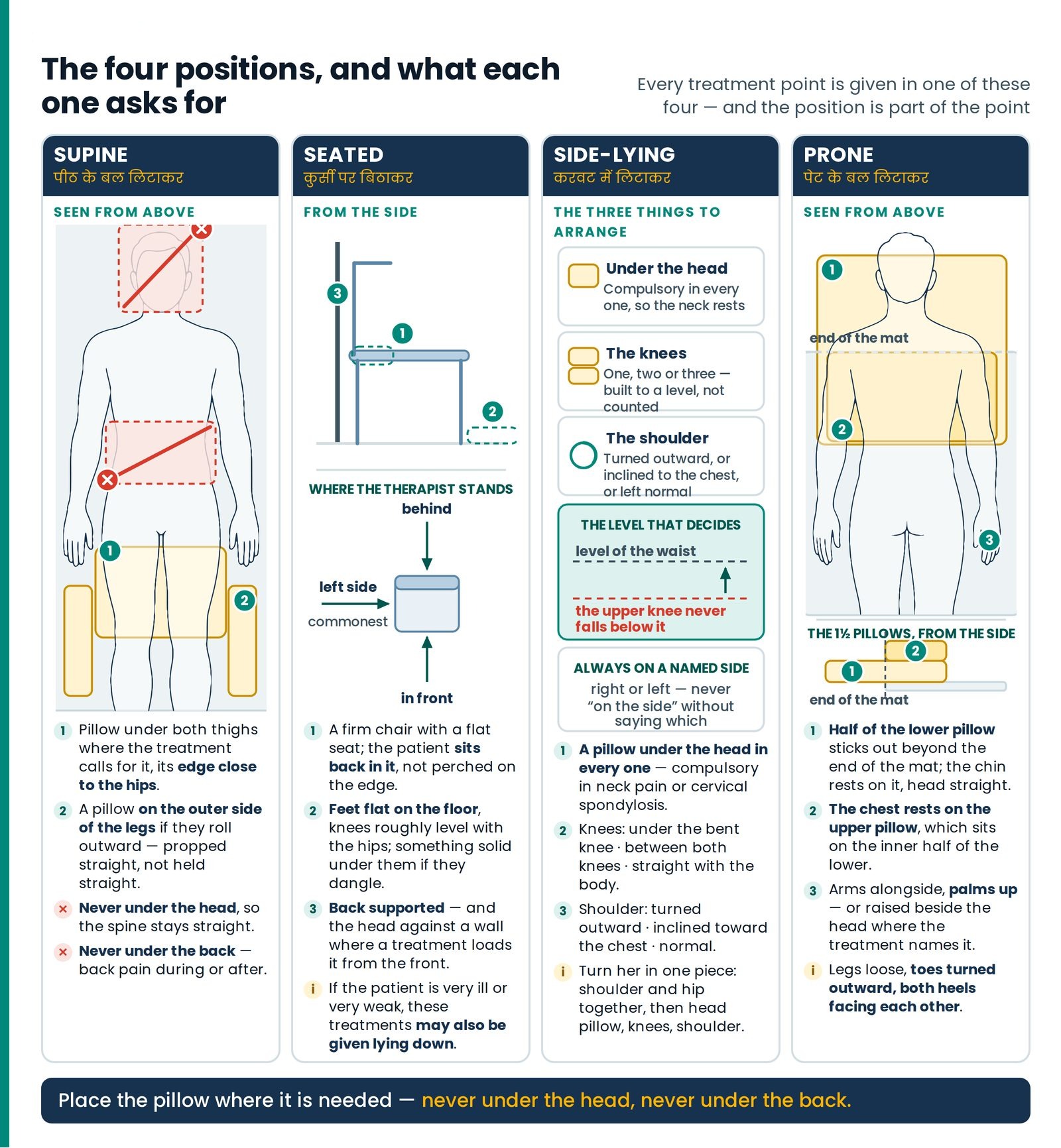
Every treatment point in this therapy is given in one of four positions:
पीठ के बल लिटाकर — supine, laid on the back. Supine कुर्सी पर बिठाकर — seated, on a chair. Seated करवट में लिटाकर — side-lying, laid on one side. Side-lying उलटे यानि पेट के बल लिटाकर — prone, laid face down. Prone
The atlas is filed under these four headings and nothing else, and the reason is practical: turning a patient costs time, comfort and dignity, and in a frail patient more than all three. So a formula is performed as a route through the four positions — everything one position yields is gathered before the patient is moved.
A therapist who reads a card straight down the page and turns the patient at every line has understood the formula, not the session.
The five general rules of giving, before any point is named
1. Pressure may be given either with the hand or with the feet.
If with the feet, lay the patient down between two upturned chairs and, taking your weight on your hands upon the chairs, give the treatment. Place a pillow at the proper place as required.
2. Wherever pressure is to be given, at all such points it is ordinarily held 6 seconds and released.
3. While giving pressure, place your heel or your palm so that the weight falls over a broad surface, not on a single point, and so that the muscles are drawn inward, not outward.
4. When treating very small children, use the soft part of the palms, so laid that the whole palm rests on their thigh and the pressure is not felt as pressure. If the palm is held crooked, or pressure is given with the edge of the palm or with the fingers, they will not bear it and will begin to cry.
5. When giving pressure with the foot or the heel, your body weight must be so directed that the muscles are drawn inward, not outward — otherwise the patient will have a great deal of pain, because it would be against the natural direction of the muscles.
Rules 3 and 5 are the whole physics of this therapy in two words. Broad, and inward. Broad, because the same weight through a wide flat contact is a firm even push and through an edge is a blade. Inward, because a muscle belly sits in a sleeve of tough tissue that already packs it toward the bone: press along that packing and it takes the load as it is built to; press the other way and you are prising the sleeve open sideways. (Figure 15.3)