Tarsal Tunnel Syndrome
Tarsal tunnel syndrome is a squeezed nerve on the inner side of the ankle. It brings burning, tingling, shooting pain or numbness in the sole and toes — often worse after standing or at night.
- Women get it about three times as often as men
- It most often starts between the ages of 40 and 60
- A clear cause of the squeeze is found in about 80% of cases
- It is often missed or mistaken for other heel and sole problems
Source: StatPearls (NIH NCBI)
What is Tarsal Tunnel Syndrome?
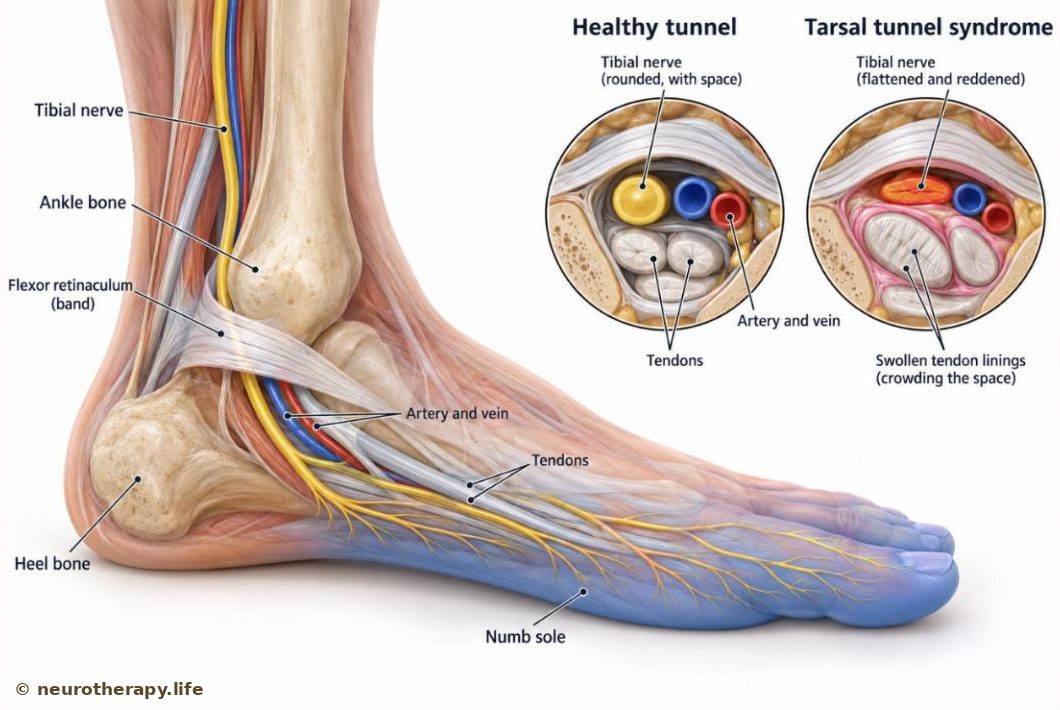
Just behind the bony knob on the inner side of your ankle is a narrow tunnel, roofed by a tough band. Through it run the tibial nerve, an artery, a vein and the tendons that bend the toes. After the tunnel, the nerve branches out to give feeling to the heel and the sole.
When anything crowds this tunnel — swollen tendon linings, a cyst, a bony spur, a flat foot, an old sprain — the nerve gets squeezed. A squeezed nerve also runs short of blood through its own tiny vessels. It is the foot's version of carpal tunnel syndrome in the wrist.
What are the symptoms?
- Pain on the inner side of the ankle that runs into the arch and sole
- Burning, tingling or pins and needles in the sole and toes
- Numbness of the sole
- Worse at night, after long standing or walking; better with rest
- In long-standing cases, weak toes and thinning of the small foot muscles
What causes it, and who is more likely to get it?
Something inside the tunnel
- Swollen tendon linings
- A cyst, a fatty lump or a bony spur
- Swollen, twisted veins in the tunnel
Foot shape and injury
- Flat feet or a heel that tilts inward
- An ankle sprain, fracture or old operation scar
- Tight or badly fitting shoes
Whole-body conditions
- Diabetes
- Arthritis and inflamed joints
- Swelling of the feet, including in pregnancy
- Poor blood supply to the nerve
How is it found?
A doctor examines the foot and ankle, asks where the pain and numbness go, and may order tests to confirm the squeezed nerve and look for its cause.
Tap test (Tinel sign)
The doctor taps over the tunnel; tingling shooting into the sole points to a squeezed nerve.
Nerve conduction test and EMG
Measure how fast and how strongly the nerve carries signals across the ankle.
Ultrasound or MRI
Show a cyst, a swollen tendon lining, swollen veins or other tissue pressing on the nerve.
X-ray
Shows bony spurs, fractures or a foot shape that narrows the tunnel.
The therapist asks where the numbness runs, whether there is diabetes or heart disease, and for any nerve or scan reports, then checks Liv° and Mu° before choosing the formula.
How Neurotherapy sees Tarsal Tunnel Syndrome
LMNT places tarsal tunnel syndrome with the circulation. P. Heparin, the formula for blood flow and clots, lists "intense pain or numbness in the toes of the feet" among its uses, and the Angina / Athero treatment names carpal and tarsal tunnel syndrome among its main illnesses. For the foot, Vasanti is added — stroked from the heel upward, towards the thigh.
LMNT teaching also describes a band above the heel through which the blood vessels, nerves and tendons of the foot pass — the same band that roofs the tarsal tunnel. A sudden movement or a heavy lift can pull these down, and some get caught inside it, bringing pain in the heel or toes. Medical science and LMNT here look at the same narrow passage from two sides.
Whenever there is an obstruction or blockage in the blood circulation of any part of the body, then pain or numbness is felt in that part.
Neurotherapy treatment for Tarsal Tunnel Syndrome, step by step
Examine first
Where does the numbness run, is there diabetes or heart disease? Then Liv° and Mu° — if Mu° is painful and the stool is hard, one part of the treatment changes.
P. Heparin
The parent Heparin formula — (8) Pan, (7) Liv, (8) Ch. Only. LMNT lists intense pain or numbness in the toes of the feet among its uses.
The Angina / Athero treatment
Four parts: (4) Medulla clockwise, the Up Arrow at T1/T2, Raman, (10) Pan and (2) Thrd; then (1) Single point liver twice; then P. Heparin — or Mild ATF where Mu° hurts with hard stools; then A. Heparin. LMNT names tarsal tunnel syndrome among its main illnesses.
Vasanti from the heel towards the thigh
For the foot, Vasanti is given from the heel upward, towards the thigh. In LMNT the direction is the whole instruction — and it differs from the one used for the hand.
Points and formulas used
P. Heparin (plasmin)
The parent Heparin formula — written in LMNT to support blood flow; tarsal tunnel syndrome is on its list of uses.
Works through
Open →Angina / Athero treatment
A four-part circulation treatment written for the heart and arteries; LMNT names carpal and tarsal tunnel syndrome among its main illnesses.
Works through
Open →Never do this
- See a doctor soon for numbness that does not go away, weak toes, thinning foot muscles, or any foot numbness if you have diabetes. A nerve squeezed for too long can be damaged for good. sensation reduced Diabetic foot
- Go to hospital at once for a foot that turns cold, pale or blue, a swollen, hot, painful calf, or sudden weakness of a leg — these are not a squeezed nerve. Thrombosis
- Numbness is not a sign that the treatment is working. If tingling or numbness runs into the hand while Liv is given, the therapist lets go at once and repositions.
- The bars of P. Heparin's own points: Pan never in schizophrenia, and in fits only inside the Heparin formula; Liv not in liver cancer; Ch. Only not in lung cancer. P. Heparin (plasmin)
- Cancer: if the person has cancer, (10) Pan, Thymus, Pit, Lu + Sh, Rt. Ov / Lt. Ov and (30) Medulla are never given — the therapist changes the plan.
- Keep taking the medicines your doctor prescribed. Neurotherapy works alongside your medical care, never instead of it.
Watch

Shows the P. Heparin formula: (8) Pan at the top of the thighs, (7) Liv on the thigh and forearm, and (8) Chest Only with the palms on the chest. In the video it is given as the last part of the Angina treatment, to support circulation.

This video shows the right way to give (4) Medulla, Raman and the T1–T2 point for neck and shoulder pain and numbness.
How P. Heparin is given, and how (4) Medulla, Raman and the T1–T2 point are given — the parts of the Angina / Athero treatment named for tarsal tunnel syndrome.
From Ayurveda and the kitchen
Test yourself
What research says
- Strong evidence
Describes the tunnel behind the inner ankle and what passes through it. When the tibial nerve is squeezed, blood cannot drain from it and its own small vessels fail; the nerve swells, loses its coating and, if the squeeze lasts, is scarred. Reduced blood flow inside the nerve is part of the damage — the circulation side that LMNT works from.
No clinical trial of Neurotherapy in tarsal tunnel syndrome has been published yet. Improvements reported by neurotherapists are clinical observations.
For you
Shoes
Wear well-fitting shoes with good arch support; avoid tight shoes that press on the inner ankle.
Rest the foot
Break up long hours of standing or walking, and raise the feet if they swell by evening.
If you have diabetes
Numb feet need extra care — check them daily and tell your doctor about any new numbness.
This page explains; it does not diagnose. Neurotherapy works alongside your medical care — keep taking the medicines your doctor prescribed, and see a doctor for any new or severe symptom.