Spasticity (stiff, tight muscles)
Spasticity means muscles stay stiff and tight and fight against movement. It is not a disease of the muscle itself — it is a sign that the brain or spinal cord has been damaged, as after a stroke, a spinal injury, or in cerebral palsy or multiple sclerosis.
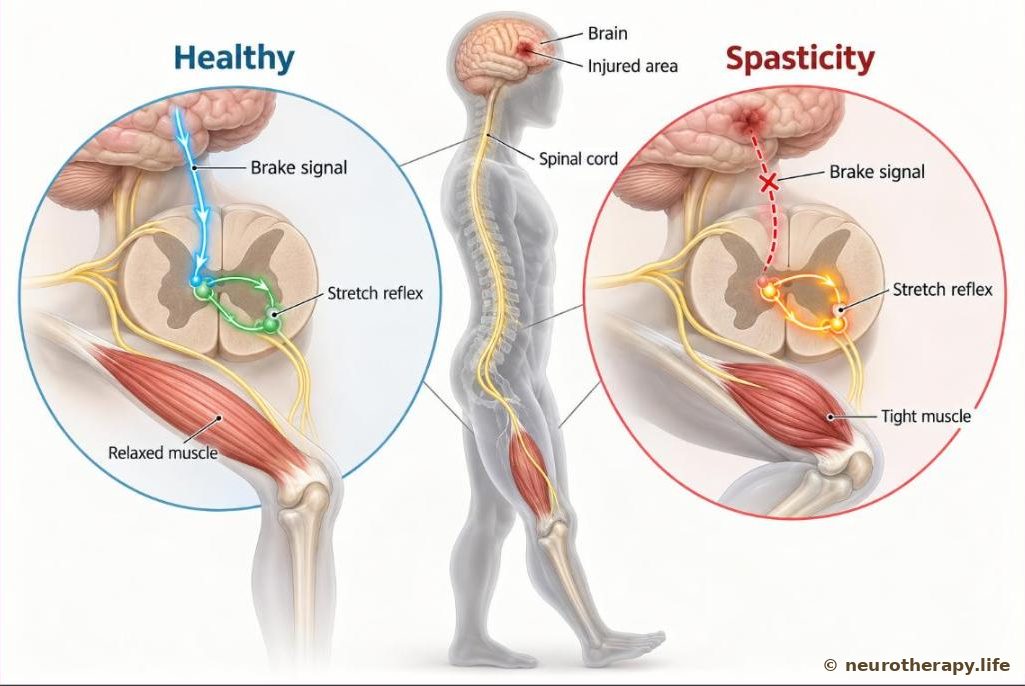
- Not a disease on its own — a sign of damage in the brain or spinal cord
- Common after a stroke or spinal cord injury, and in cerebral palsy and multiple sclerosis
- Constipation, a bladder infection, pain or tiredness can make it worse
- Left for a long time, it can fix a joint in a bent position (contracture)
Source: MedlinePlus; American Association of Neurological Surgeons (AANS); MS Trust
What is Spasticity (stiff, tight muscles)?
Every muscle has a simple reflex in the spinal cord: when it is stretched, it tightens a little to protect itself. The brain keeps this reflex calm by sending a steady 'brake' signal down the spinal cord.
When the brain or spinal cord is damaged, that brake is weakened. The reflex then fires too easily and too strongly. The muscle stays tight, resists being moved, and may jerk or spasm. If a limb is kept bent for months, the muscle can shorten and the joint can become fixed.
What are the symptoms?
- Stiff, tight muscles; movements that are slow and limited
- Sudden spasms, or jerky movements that repeat on their own (clonus)
- Legs that cross like scissors while walking or lying
- An unusual posture — a bent elbow, a clenched hand, a pointed foot
- Pain, tiredness in the muscles, and joints that slowly become fixed
What causes it, and who is more likely to get it?
Damage to the brain
- Stroke
- Cerebral palsy — injury to the growing brain
- Head injury, a brain tumour, or lack of oxygen to the brain (for example near-drowning)
Damage to the spinal cord and nerves
Other causes
- Infections of the brain or nerves
- Lack of vitamin B12, vitamin E or copper
- Some inherited problems of body chemistry, such as phenylketonuria (PKU)
Things that make it worse
- Constipation or a change in bowel habit
- A bladder infection, a skin sore, or any pain
- Tiredness, stress, and being too hot or too cold
How is it found?
Spasticity is found by examination. The doctor asks when it began, which muscles are affected, how bad it is and what makes it worse — and then looks for the cause in the brain or spinal cord.
Physical and nerve examination
The doctor moves each limb to feel the muscle tone, tests the reflexes, and checks how far each joint can bend and straighten.
MRI of the brain or spine
Detailed pictures show where the brain or spinal cord has been damaged.
A search for triggers
When spasticity suddenly gets worse, the doctor looks for a hidden trigger — a urine infection, constipation, a skin sore or pain.
A neurotherapist asks for the doctor's diagnosis — what caused the spasticity — and the list of medicines. The therapist asks how the stools come, and whether food passes undigested; asks a woman about her periods; and asks whether the blood pressure runs low. Then Liv° and Mu° are compared, because in LMNT the treatment follows the examination, not the name of the disease.
How Neurotherapy sees Spasticity (stiff, tight muscles)
Guruji's teaching reads the body in two directions — acidic and alkaline. The acidic body goes slack and dry; the alkaline body goes tight and wet. In LMNT's table, muscles that become hard and tight — spasticity — sit in the alkaline column, together with fits and cerebral palsy, with pain at Liv° on the right. But LMNT teaching warns against deciding from one row: the whole examination decides the direction.
How LMNT teaching reads spasticity
- Tight musclesIn LMNT's table, hard and tight muscles belong to the alkaline side
- The UDF questionIs food coming out undigested? A stomach not making its acid can look like extra alkali
- Digestion firstThe undigested-food work is given for some days, until the stool comes properly
- Then ALTFOnly if Gal, Liv and Liv° are still painful after that
- (4) Ku for stiffnessTo reduce alkali, spasticity and stiffness in the joints
LMNT has two kinds of points. Physical points relax tight muscles, tendons and ligaments, and bring quick relief — but Guruji's teaching says that on their own the effect wears off within hours, or at most days, because the body's inner working has not changed. Chemical points work on the organs and glands, and their counts are given exactly, six seconds each. So a plan for spasticity is mostly chemical work, with a few physical points for comfort.
We do not give treatment for any one disease; rather we treat according to the condition of the body on that day.
Neurotherapy treatment for Spasticity (stiff, tight muscles), step by step
Examine first
The therapist reads the doctor's reports, compares Liv° and Mu°, asks whether food passes undigested, and asks about periods, low blood pressure and any stomach ulcer — because each of these changes what may be given.
The UDF question before ALTF
If Gas is tender or food comes out undigested, the undigested-food work is given first, for some days, with Gas Only. LMNT names Gas Only among the points used in spasticity.
ALTF — only through the gate
When the stool comes properly and the pain at Gas has gone, but Gal, Liv and Liv° are still painful, the Alkali Treatment Formula is given — three rounds, once or twice a day, with a ninety-second rest between rounds. Many patients never need it.
(4) Ku for stiffness
(4) Ku is given at the base of the spine to reduce alkali, spasticity and stiffness in the joints: two count as one, so it is eight presses of six seconds without stopping. Then Mu° is checked; if it is still painful, the Round Arrow is given until that pain clears.
Re-examine every day
Liv° and Mu° are checked again at every visit, as on the first day. As the findings change, the plan changes — a few physical points may be added for comfort, but the counts at the chemical points are never rounded.
Points and formulas used
ALTF (chief form)
The Alkali Treatment Formula — helps the body lower its alkaline side; the form that suits almost everybody, given only after the undigested-food work.
Works through
Open →Never do this
- (4) Ku is never given to a woman during her period, or to anyone with low blood pressure. Both are asked about before the session. If Mu° is still painful after Ku, the Round Arrow is given until it clears. (4) Ku
- Gas Only is not given to anyone with an ulcer in the stomach or duodenum. With constipation, piles or fistula, Gas 'I' is given along with it. Gas Only
- ALTF is given only after the undigested-food work, and never when the examination points to the acid side. Liv° and Mu° are checked before every treatment. ALTF (chief form)
- Stiffness or weakness that comes on suddenly — especially on one side, with a drooping face or slurred speech — needs emergency care first: it may be a stroke. Stiffness after a fall or a neck or back injury, or with loss of bladder or bowel control, also goes to hospital first. Spasticity that keeps getting worse, or a joint that is becoming fixed, needs the doctor. Stroke, or a passing weakness, numbness or loss of vision, within three months
- Spasticity from cerebral palsy, MS or a spinal injury is usually long-term. Neurotherapy may help comfort and daily function, with reported improvement, but it does not undo the nerve damage — keep physiotherapy, stretching and splints going. Children get half the adult dose and light treatment only, given by a trained therapist.
- Cancer: if the person has cancer, (10) Pan, Thymus, Pit, Lu + Sh, Rt. Ov / Lt. Ov and (30) Medulla are never given — the therapist changes the plan.
- Keep taking the medicines your doctor prescribed. Neurotherapy works alongside your medical care, never instead of it.
From Ayurveda and the kitchen
Test yourself
What research says
- Strong evidence
This review explains why spasticity happens: damage to the brain's movement pathways upsets the balance of calming and exciting signals reaching the spinal cord, so the stretch reflex becomes over-active. Keeping a limb still in a shortened position then stiffens the muscle itself — which is why regular movement and stretching matter.
No clinical trial of Neurotherapy in spasticity has been published yet. Improvements reported by neurotherapists are clinical observations.
For you
People living with spasticity
Keep up daily stretching and the exercises your physiotherapist gave you. Watch for triggers — constipation, a urine infection, a skin sore, tiredness — and tell your doctor when stiffness suddenly gets worse.
Carers
Change the person's position often, keep the skin clean and dry, and keep the bowels regular. Bring every report and the medicine list to each Neurotherapy visit.
After a stroke or spinal injury
Start physiotherapy early, as your doctor advises. A limb that is moved every day is less likely to become fixed.
This page explains; it does not diagnose. Neurotherapy works alongside your medical care — keep taking the medicines your doctor prescribed, and see a doctor for any new or severe symptom.