Sore Throat and Hoarseness
A sore throat is pain, scratchiness or irritation of the throat that is often worse on swallowing. Hoarseness is a weak, rough or husky voice. Most come with a cold or another virus and get better within about a week.
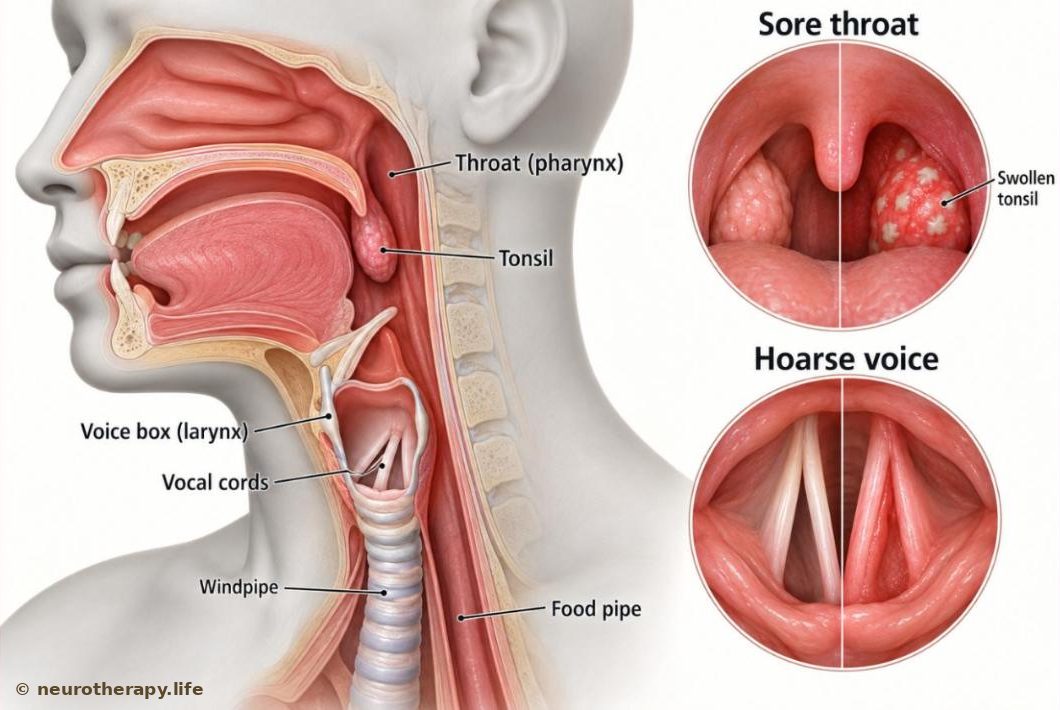
- Most sore throats get better by themselves within a week
- About 3 in 10 children and 1 in 10 adults with a sore throat have strep throat, a bacterial infection
- Hoarseness that lasts more than 2 to 3 weeks in an adult should be checked by a doctor
Source: NHS; CDC; MedlinePlus
What is Sore Throat and Hoarseness?
The throat (pharynx) is the tube behind your mouth and nose that carries food to the food pipe and air to the windpipe. At its sides sit the tonsils, which catch germs coming in with air and food. When a virus or bacteria attacks, the throat and tonsils become red, swollen and sore.
Your voice is made in the voice box (larynx), where two vocal cords vibrate as air passes. If they swell — from a cold, shouting, smoke or acid from the stomach — they cannot vibrate smoothly, and the voice turns rough, weak or husky.
What are the symptoms?
- Pain or scratchiness in the throat, worse on swallowing
- Red, swollen tonsils, sometimes with white patches
- Swollen, tender glands at the front of the neck
- A hoarse, weak or lost voice
- Fever, cough or a runny nose with a cold
- A dry throat and trouble swallowing
What causes it, and who is more likely to get it?
Viruses
- Colds and flu — the most common cause
- Glandular fever (mononucleosis)
Bacteria
- Strep throat — most common in children aged 5 to 15
- Tonsillitis
Strain and irritation
- Overusing the voice — shouting, singing, long hours of talking
- Smoking and alcohol
- A long-lasting cough
Other causes
- Acid coming up from the stomach (reflux)
- Allergies
- Rarely, a growth in the voice box — the reason long hoarseness is checked
How is it found?
A doctor looks at the throat, tonsils and neck glands. Tests are used when strep is likely, or when hoarseness lasts for weeks.
Rapid strep test
A swab from the back of the throat is checked for strep bacteria.
Throat swab culture
The swab is grown in a lab to find which germ is present.
Laryngoscopy
For hoarseness that does not go away: a small mirror or camera looks at the vocal cords.
Blood tests
A blood count can help when glandular fever or another infection is suspected.
A neurotherapist asks about diabetes, rheumatoid arthritis or any autoimmune disease, pregnancy, blood pressure and low immunity — each of these bars one of the throat points. For trouble swallowing there is a four-second question in Guruji's teaching: how is your taste, and how is your voice?
How Neurotherapy sees Sore Throat and Hoarseness
In LMNT teaching, the throat is reached through its glands and its nerves. For a sore throat and tonsils: Ton 'T' — three rubs on the cheek, below the cheek and at the side of the neck — to stimulate the tonsil glands, followed at once by Sangam points; (12) Armpits, which stimulate the lymph nodes of the armpit and are given for tonsils, sore throat and pain on swallowing; (6) Adr for throat pain from the tonsils; and (9) Medulla for the nerves of the tonsils.
Four nerves of the throat, four Medulla counts
- 5th nervetakes the mouthful backwards in swallowing — (5) Medulla
- 9th nervethroat lining, tonsils and taste at the back of the tongue — (9) Medulla
- 10th nervemuscles and lining of the voice box — (10) Medulla
- 12th nervemuscles of the tongue; a voice that has gone — (12) Medulla
For hoarseness, LMNT teaching gives Vocal Point — both palms cupped at the sides of the throat, stroking gently from the middle outward and backward, at least two times, never on the Adam's apple — with (10) Medulla for a hoarse voice and (12) Medulla for a voice that has gone or become heavy. A recorded observation in the therapy's own account: a patient in Chennai given (5) Medulla + (9) Medulla × 3 treatments + Katka reported great relief in the irritation and soreness of the throat, and in his difficulty swallowing and dry mouth.
Whether or not the patient gets immediate benefit from our treatment, let no harm reach him through our carelessness — attend to this.
Neurotherapy treatment for Sore Throat and Hoarseness, step by step
Examine first
The therapist checks Liv° and Mu° and asks about diabetes, rheumatoid arthritis or autoimmune disease, pregnancy, blood pressure and immunity — and, if swallowing is hard, about taste and voice.
The tonsils
Ton 'T': cheek 6 times, below the cheek 12 times, side of the neck 3 times — left side first — and Sangam points immediately after.
Glands and swelling
(12) Armpits stimulate the lymph nodes for a sore throat and pain on swallowing; (6) Adr is given for throat pain from the tonsils.
The nerves of the throat
(9) Medulla for the nerves of the tonsils. If swallowing is hard and taste has gone, (9) Medulla; if the voice is heavy, (10) Medulla.
The voice
For hoarseness: Vocal Point, usually lying down — seated only with a wall behind the head — with (10) Medulla, or (12) Medulla for a voice that has gone.
Points and formulas used
Ton 'T'
Stimulates the tonsil glands — three rubs of the face and neck, always followed by Sangam points.
Open →Sangam Points
Given immediately after Ton 'T': below the elbow, between the thumb and finger, and below the heel bone.
Open →Armpit
Opens small blockages in the armpit lymph nodes — for tonsils, sore throat and pain on swallowing.
Open →Vocal Point
Vocal ghisai — gentle cupped strokes at the sides of the throat, for a bad throat and hoarseness.
Open →Never do this
- Ton 'T' is not given in diabetes, rheumatoid arthritis, autoimmune disease or inflammation, not in pregnancy, and not to young people up to the age of bearing children — especially women. It is always followed at once by Sangam points. Ton 'T'
- (12) Armpits are not given in lymph node cancer, polio, diabetes or any autoimmune disorder. (6) Adr is not given where immunity is low, or in high blood pressure. (6) Adr
- No pressure ever falls on the front of the neck. Vocal Point never touches the Adam's apple; the Ton 'T' rubs stay at the side and back of the neck. A hard, fixed, painless lump in the neck is investigated, not rubbed. Neck
- Emergency — call 108/112: difficulty breathing, not able to swallow your own saliva, drooling, or a high-pitched noise when breathing in. See a doctor the same day for a badly swollen throat with high fever, a muffled voice or trouble opening the mouth. Hoarseness for more than 3 weeks needs a doctor to check the voice box.
- Cancer: if the person has cancer, (10) Pan, Thymus, Pit, Lu + Sh, Rt. Ov / Lt. Ov and (30) Medulla are never given — the therapist changes the plan.
- Keep taking the medicines your doctor prescribed. Neurotherapy works alongside your medical care, never instead of it.
From Ayurveda and the kitchen
Test yourself
What research says
- Strong evidence
The tonsils sit where the airway and the food pipe meet, and they start the body's defence against germs breathed in or swallowed — the reason LMNT works on the tonsil glands and the lymph nodes in a sore throat.
No clinical trial of Neurotherapy for sore throat or hoarseness has been published yet. Improvements reported by neurotherapists are clinical observations.
For you
Children
Strep throat is most common between 5 and 15 years. A child under 5 with a sore throat, or any child who drools or struggles to breathe, needs a doctor.
Teachers, singers and others who use their voice
Rest the voice and avoid shouting while it is hoarse. Hoarseness that lasts more than 3 weeks needs a doctor's check.
Young women, pregnant women and people with diabetes
Tell your therapist — Ton 'T' is not given to you, and (12) Armpits are not given in diabetes. Other points are chosen instead.
This page explains; it does not diagnose. Neurotherapy works alongside your medical care — keep taking the medicines your doctor prescribed, and see a doctor for any new or severe symptom.