Saliva Problems (Dry Mouth and Drooling)
Saliva keeps the mouth wet, helps you chew and swallow, and protects the teeth. Too little makes the mouth dry and sticky; saliva that spills out of the mouth is called drooling.
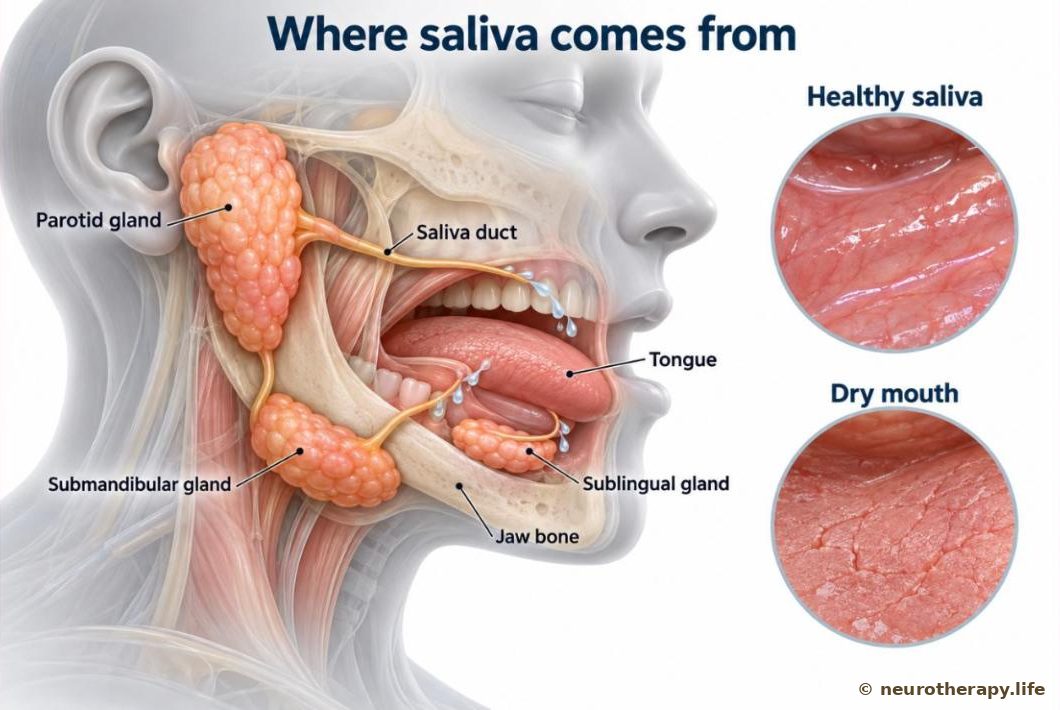
- The salivary glands make about 1 to 2 litres of saliva a day
- Dry mouth affects about 1 in 5 people, more often with age
- Drooling is normal in young children until about age 4
Source: Cleveland Clinic; MedlinePlus; Gandhi et al., CMAJ 2024
What is Saliva Problems (Dry Mouth and Drooling)?
You have three pairs of large salivary glands — in front of the ears, under the jaw and under the tongue — and hundreds of tiny ones in the lining of the mouth. Saliva wets food, starts digesting starch with an enzyme called amylase (also called ptyalin), washes the teeth and fights germs.
A dry mouth (xerostomia) happens when too little saliva is made. Drooling happens when saliva spills out — either because too much is made, or, more often, because the lips, tongue and swallowing muscles do not clear it well.
What are the symptoms?
- A sticky, dry feeling in the mouth; cracked lips
- Trouble chewing, swallowing, tasting or speaking
- Bad breath, mouth sores or more tooth decay
- Saliva spilling from the mouth, wet chin and clothes
- Sore, red skin around the mouth, or coughing and choking on saliva
What causes it, and who is more likely to get it?
Dry mouth
- Side effects of medicines — for blood pressure, allergy, mood or bladder
- Too little water, or breathing through the mouth
- Diabetes, Sjögren's syndrome and some other illnesses
- Radiation or chemotherapy for cancer
Drooling
- Teething in babies — often normal
- Throat or mouth infections, such as tonsillitis or a sore throat
- Nerve and muscle conditions — cerebral palsy, Parkinson's disease, stroke
- A blocked nose, or some medicines
How is it found?
Both problems are found by looking and asking. Tests look for the cause.
Mouth and medicine check
A doctor or dentist looks at the tongue, gums and teeth, and goes through every medicine you take.
Saliva flow test
Measures how much saliva you make in a few minutes.
Blood tests
Blood sugar, and tests for conditions such as Sjögren's syndrome.
Throat and swallowing check
For drooling: the throat, nose and swallowing are checked, and a child's development is looked at.
A neurotherapist checks the blood pressure and asks about heart disease and loose motions before treating drooling, because the two LMNT points for it are barred in those conditions.
How Neurotherapy sees Saliva Problems (Dry Mouth and Drooling)
LMNT treats the two saliva problems in opposite ways. For a dry mouth it uses Medulla — (7) and (9) Medulla, or (15) Medulla — and the Ptyalin treatment, named after the saliva enzyme. LMNT teaching also notes that a dry mouth often travels with hard stools and short sleep: the therapist reads these signs together, because the same complaint can need opposite treatments in two different bodies.
For children who drool all day, LMNT gives (6) Lu + Sh — one of the treatments taught to mothers. Where Lu + Sh has not helped, Gas 'I' does. Both are chosen only after the bars below have been checked.
Every person, from a one-day-old infant up to the age of a hundred years, can take this treatment.
Neurotherapy treatment for Saliva Problems (Dry Mouth and Drooling), step by step
Examine first
The therapist checks the diagnostic points Liv° and Mu°, measures the blood pressure, and asks about stools, sleep, heart disease and every medicine taken.
Dry mouth: Medulla and Ptyalin
(7) and (9) Medulla, or (15) Medulla, with the Ptyalin treatment over the salivary glands.
Drooling in children: (6) Lu + Sh
Taught to mothers, at the child's half dose and light touch. Not in high blood pressure or heart disease.
If Lu + Sh has not helped: Gas 'I'
Gas 'I' is the next choice — but not if there are loose motions.
Points and formulas used
Never do this
- Lu + Sh raises blood pressure — never in high blood pressure, never in heart disease. Lu + Sh
- Gas 'I' is not given if there are loose motions. Gas 'I'
- Children get half the adult dose and light treatment only, given by a trained therapist.
- Nothing is pressed on the front of the throat. A hard, fixed, painless lump in the neck is investigated, not rubbed.
- See a doctor the same day for sudden drooling with high fever, a muffled voice, trouble opening the mouth or swallowing. Go to a hospital at once if a child drools with breathing difficulty, or holds the head in an odd position to breathe.
- Cancer: if the person has cancer, (10) Pan, Thymus, Pit, Lu + Sh, Rt. Ov / Lt. Ov and (30) Medulla are never given — the therapist changes the plan.
- Keep taking the medicines your doctor prescribed — even if one of them dries your mouth, ask your doctor rather than stopping it. Neurotherapy works alongside your medical care, never instead of it.
From Ayurveda and the kitchen
Test yourself
What research says
- Strong evidence
Drooling is normal in typically developing children until about age 4. It affects about 44% of children with cerebral palsy, mainly because of poor control of the mouth muscles, and can lead to sore skin and saliva going into the lungs.
Gandhi K, Strychowsky JE, Chen BA. Pediatric sialorrhea (drooling). CMAJ. 2024.
No clinical trial of Neurotherapy in dry mouth or drooling has been published yet. Improvements reported by neurotherapists are clinical observations.
For you
Older adults
Dry mouth is more common with age and with many medicines. Sip water through the day, keep the teeth clean, and see the dentist regularly.
Parents
Drooling in a teething baby is usually normal. A child who still drools heavily after about age 4, or who chokes on saliva, should see a doctor. Treatment for children is half-dose and light.
People with nerve conditions
In cerebral palsy, Parkinson's disease or after a stroke, keep up speech and swallowing therapy alongside any other care.
This page explains; it does not diagnose. Neurotherapy works alongside your medical care — keep taking the medicines your doctor prescribed, and see a doctor for any new or severe symptom.