Pneumonia
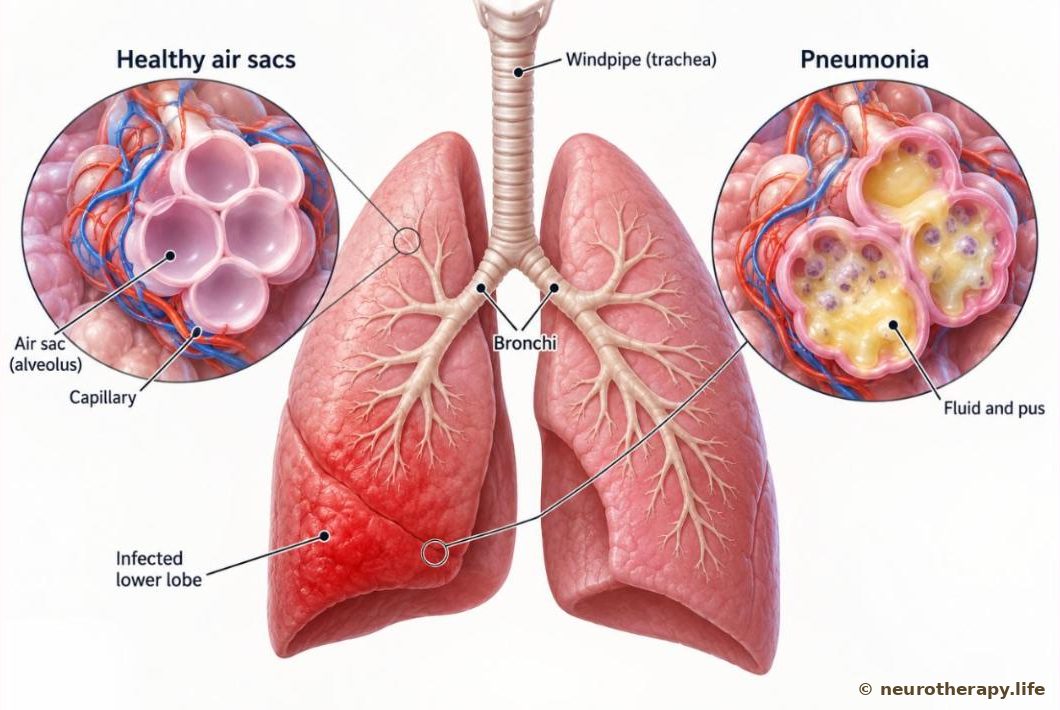
Pneumonia is an infection of one or both lungs. The tiny air sacs fill with fluid or pus, so breathing becomes hard and the body gets less oxygen. It is a serious illness that needs a doctor first — Neurotherapy is given only as support alongside medical care.
- 740,180 children under 5 died of pneumonia in 2019
- That is 14% of all deaths of children under 5
- Children under 2 and adults over 65 are at the highest risk
Source: World Health Organization (pneumonia fact sheet); MedlinePlus
What is Pneumonia?
Deep inside the lungs are millions of tiny air sacs. Oxygen passes from them into the blood. In pneumonia, germs infect these sacs, and they fill with fluid or pus. Less oxygen reaches the blood, and breathing becomes hard work.
Bacteria are the most common cause, but viruses (such as flu) and fungi can cause it too. It can be mild, or it can become life-threatening — especially in small children, older people and those with other long illnesses. When both lungs are affected, people call it “double pneumonia”.
What are the symptoms?
- Fever, with chills or shivering
- Cough, often with thick phlegm
- Shortness of breath or fast breathing
- Chest pain that gets worse when you breathe in or cough
- In small children: the lower chest drawing in with each breath, or not feeding
- In older people: confusion, sometimes with only mild fever or cough
What causes it, and who is more likely to get it?
Germs
- Bacteria — the most common cause
- Viruses, such as flu, common cold viruses, RSV and COVID-19
- Fungi — mostly in people with weak immunity
- Food, drink or vomit going down the wrong way into the lungs
Who is at higher risk
- Children under 2 and adults over 65
- Long illnesses such as diabetes, heart failure or kidney disease
- Weak immunity, a recent cold or flu, or a stay in hospital
Habits and home
- Smoking and heavy drinking
- Smoke from cooking fuel indoors, and crowded homes
- In babies: poor nutrition and not being breastfed
How is it found?
A doctor usually finds pneumonia by listening to the chest and taking a chest X-ray. Other tests show how ill you are and which germ is to blame.
Listening to the chest
With a stethoscope, the doctor listens for crackling or bubbling sounds in the lungs.
Chest X-ray
Shows where the infection is and how much of the lung it covers.
Pulse oximetry
A small clip on the finger measures how much oxygen is in your blood.
Blood and sputum tests
Show whether the body is fighting a serious infection, and which germ is causing it.
A neurotherapist first asks whether a doctor is treating the pneumonia now. Then the therapist checks Liv° and Mu°, the blood pressure and the pulse, reads the kidney report (creatinine and urea), and asks one more question: did you have pneumonia as a child — or did your mother have it while she was carrying you?
How Neurotherapy sees Pneumonia
In LMNT, pneumonia is a hospital illness first, and Neurotherapy stands beside that care, never in its place. LMNT teaching names three supports: (5) Medulla for a hard, painful lung cough; the Angiotensin #2 formula in double pneumonia; and (20) Medulla in pneumonia in children. Hospitals treat very ill pneumonia patients with angiotensin II and dopamine. The Angiotensin #2 formula works the liver, the kidneys and the lungs in turn — the three organs that make angiotensin II — and (20) Medulla is taught to provoke dopamine. Guruji said plainly that these names come from what patients reported, not from laboratory tests.
LMNT teaching also says pneumonia leaves a mark on the kidneys. So a Kidney Clear treatment is given at the grade the body will take that day. And for someone who had pneumonia in childhood and comes years later for any complaint at all, LMNT uses the ADK sequence: A — Angiotensin #2, D — (20) Medulla for dopamine, K — Kidney Clear. The same is used for a child whose mother had pneumonia during or just before the pregnancy. Guruji marked the kidney questions here as still to be tested.
If the stomach, the lungs and the kidneys work properly, then disease simply cannot come.
Neurotherapy treatment for Pneumonia, step by step
Doctor first
Pneumonia is diagnosed and treated by a doctor. Neurotherapy is given only alongside that care — and anyone breathless, blue-lipped or confused goes to hospital, not to the mat.
Examine first
The therapist checks the diagnostic pain points Liv° and Mu°, the blood pressure and pulse, and the kidney report, and asks about pneumonia in childhood or in the mother's pregnancy.
Check what cannot be given
With high blood pressure or heart disease, Lu + Sh and (20) Medulla are left out. Mu° is not stimulated in kidney failure, and Ch. Only is not given in lung cancer.
Support the lungs
(5) Medulla for a hard, painful lung cough. In double pneumonia, alongside hospital care, the Angiotensin #2 formula with (20) Medulla; in a child, (20) Medulla.
The kidneys, and the years after
A Kidney Clear treatment at the grade the body will take. For old pneumonia — in the person, or in the mother's pregnancy — the three-part ADK sequence.
Points and formulas used
Angiotensin No. 2
Works the liver, the left kidney point and the lungs in turn, to do what angiotensin II does — used in LMNT for double pneumonia and for pressure that has suddenly fallen.
Works through
Open →ADK
Three parts in a fixed order — Angiotensin #2, (20) Medulla, Kidney Clear — for a person who had pneumonia long ago, or whose mother had it in pregnancy.
Open →Kidney Clear
Supports the kidneys, at a grade chosen by the condition of the body that day — because, in LMNT teaching, pneumonia affects the kidneys too.
Works through
Open →Never do this
- Pneumonia needs a doctor first. Go to hospital at once for breathlessness or very fast breathing, the chest drawing in with each breath in a child, blue lips or fingertips, confusion or drowsiness, a baby who will not feed, or fever with fainting. Neurotherapy is support alongside medical care, never a replacement.
- Lu + Sh and (20) Medulla are not given with high blood pressure or heart disease. Lu + Sh
- Mu° is not stimulated in kidney failure or kidney cancer, and Ch. Only is not given in lung cancer. Mu°
- Repeated chest infections, coughing or spluttering on liquids, or a wet voice after drinking may mean food and drink are entering the airway — ask the doctor for a swallowing check. Swallowing, difficulty in
- Children get half the adult dose and light treatment only, given by a trained therapist.
- Cancer: if the person has cancer, (10) Pan, Thymus, Pit, Lu + Sh, Rt. Ov / Lt. Ov and (30) Medulla are never given — the therapist changes the plan.
- Keep taking the medicines your doctor prescribed. Neurotherapy works alongside your medical care, never instead of it.
Watch

A demonstration of the Angiotensin No. 2 formula — (7) Liv, (7) Mu° and (6) Lu + Sh — for low blood pressure that comes on suddenly after very heavy bleeding in a period.
The video suggests using the formula at the moment of fainting. In LMNT teaching, a person who is still bleeding, cold, pale or fainting is taken to hospital first; this formula is for after the bleeding has been stopped. Lu + Sh is not given in cancer.
The Angiotensin No. 2 formula — shown here for pressure that fell after heavy bleeding; LMNT gives the same formula in double pneumonia, alongside hospital care.
From Ayurveda and the kitchen
Test yourself
What research says
- Strong evidence
Angiotensin II is made in a chain: the liver releases its raw material, the kidneys release renin to start the change, and an enzyme found mostly in the blood vessels of the lungs completes it. Angiotensin II then tightens blood vessels and helps the body hold salt and water, which raises blood pressure.
- Emerging evidence
Among 1,836 people in hospital with pneumonia, 631 developed sudden kidney injury — including 16–25% of those whose pneumonia was not severe. Those with kidney injury were more likely to die. Pneumonia can strain the kidneys, not just the lungs.
No clinical trial of Neurotherapy in pneumonia has been published yet. Improvements reported by neurotherapists are clinical observations.
For you
Everyone
Ask your doctor about the pneumonia and flu vaccines, wash your hands often, and do not smoke. See a doctor early for a cough with fever and breathlessness.
Parents of small children
Keep up the child's vaccinations, breastfeed only for the first six months, and keep cooking smoke out of the room where the child sleeps. Fast breathing is a reason to see a doctor the same day.
Anyone who had pneumonia long ago
Tell your neurotherapist — and mention it if your mother had pneumonia while carrying you. In LMNT it can change which treatment is chosen, whatever you have come for.
This page explains; it does not diagnose. Neurotherapy works alongside your medical care — keep taking the medicines your doctor prescribed, and see a doctor for any new or severe symptom.