Muscular dystrophy and myopathy
Muscular dystrophy is a group of more than 30 genetic diseases in which the muscles slowly grow weaker. Myopathy is the wider word for any disease of the muscles. These are lifelong conditions, but good, steady care helps people stay active and comfortable for longer.
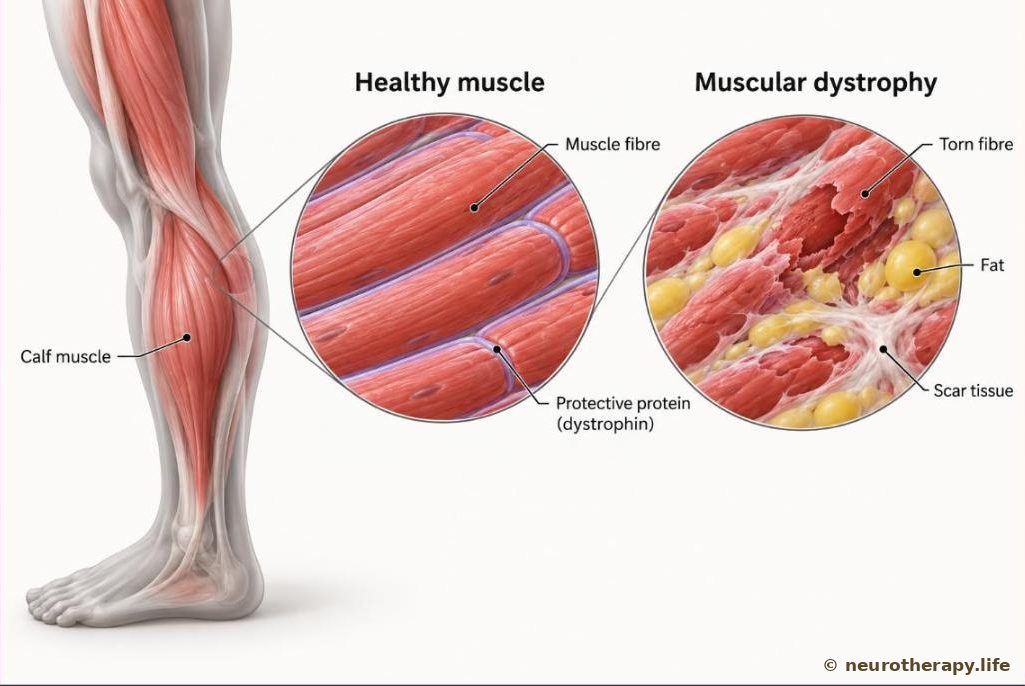
- A group of more than 30 genetic muscle diseases
- Duchenne, the most common childhood form, mostly affects boys and usually starts between ages 3 and 6
- Genetic testing is the main test that confirms it
Source: MedlinePlus; Cleveland Clinic
What is Muscular dystrophy and myopathy?
Muscles need special proteins that strengthen and protect them each time they tighten. In muscular dystrophy, a change in a gene means one of these proteins is missing or faulty. The muscle fibres get damaged with ordinary use, and over the years they are replaced by fat and scar tissue. So the weakness slowly gets worse and makes walking and daily tasks harder.
There are many types. Duchenne is severe and starts in early childhood. Becker is similar but milder and slower, often starting in the teenage years. Congenital types show at birth or before age 2. Facioscapulohumeral (FSH) first weakens the face, shoulders and upper arms. Some types also affect the heart and the breathing muscles.
What are the symptoms?
- Frequent falls and poor balance
- Trouble standing up from the floor — pushing on the thighs with the hands
- Difficulty running, jumping or climbing stairs
- Big-looking calf muscles that are actually weak
- A waddling walk or walking on the toes
- Later: tight joints, a curving spine, and breathing or heart trouble
What causes it, and who is more likely to get it?
The root: a gene change
- A change in a gene that makes a muscle-protecting protein
- Duchenne affects boys far more often than girls
When it starts (by type)
- At birth or before age 2 — congenital types
- Ages 3 to 6 — Duchenne
- The teenage years — Becker and FSH
What it can lead to
- Weak chest muscles: harder breathing and more chest infections
- Heart muscle weakness or an irregular heartbeat
- A curving spine and joints that stay tight (contractures)
How is it found?
Doctors start with a physical examination and the family history, then use blood, nerve-muscle and gene tests to confirm the type.
CK blood test
Damaged muscle leaks an enzyme called creatine kinase into the blood; a high level points to muscle damage.
Genetic test
The main test that confirms MD and tells which type it is.
EMG and muscle biopsy
EMG records the muscle's electrical activity; a small piece of muscle may be looked at under a microscope.
Heart and breathing tests
Because some types affect the heart and chest muscles, these are checked regularly.
A neurotherapist asks for the doctor's diagnosis and type, the heart and breathing reports, the physiotherapy plan and the list of medicines. Then the therapist examines the pain points of the belly and asks about appetite and stools — LMNT teaching warns against giving a familiar formula out of habit without examining first.
How Neurotherapy (LMNT) sees Muscular dystrophy and myopathy
LMNT teaching does not claim to change the gene. It works on the body the gene lives in. Its digestive formulas name muscular dystrophy among their uses, and Guruji's teaching is that every muscle and gland takes its raw material from what digestion delivers. LMNT also places MD with the disorders in which the body's defence cells work more than needed — so the formula of choice is Ajay Normal, which leaves the Spl point out on purpose.
How LMNT teaching reads muscular dystrophy
- A gene changeThe muscle lacks a protein that protects it — this LMNT does not claim to alter
- Digestion feeds muscleEvery muscle and gland works with what digestion supplies
- Spl left outSpl is read as raising the defence cells, so Ajay Normal leaves it out
- Months, not weeksFor myopathy, the Oxygen-Hormonal treatment runs to its own schedule
- Record real gainsWalking, sitting, holding, breathing — not a percentage, not a promise
LMNT names three formulas of one digestive family for MD: Normal, Fast and Ajay Normal — Ajay Normal first. (8) Rt. Parkhoo is named as well. For myopathy, the Oxygen-Hormonal treatment is given daily; for about the first month its hormone part waits and Ajay Normal takes its place, because LMNT teaches that the hormones are not provoked until digestion is fully settled.
In this therapy we do not treat the disease; rather, we improve the body.
Neurotherapy (LMNT) treatment for Muscular dystrophy and myopathy, step by step
Examine first
The therapist reads the doctor's, heart and breathing reports, checks the pain points of the belly, and asks about appetite, stools and sleep. For a frail or long-bedridden person, holds are shorter and never forceful.
Ajay Normal first
(8) Pan (3) Gal (7) Liv (6) Gas 'I' — the Normal formula with Spl left out on purpose, and Gas 'I' added to help the small intestine absorb.
The rest of the family, by the findings
LMNT also names the Normal and Fast formulas for MD. The therapist decides between them from the findings; Ajay Normal stays the first choice.
(8) Rt. Parkhoo
Named for muscular dystrophy in LMNT teaching, given as the findings allow.
Myopathy: Oxygen-Hormonal, on its schedule
Given daily, often taught to the family. For about the first month its hormone part is left out and Ajay Normal is given in its place; the hormone part is added once digestion has settled and undigested food no longer comes in the stool.
Points and formulas used
Ajay Normal
The Normal formula with Spl left out on purpose — the first choice in LMNT for MD and myopathy.
Works through
Open →Normal Treatment Formula
The first and commonest LMNT formula — supports the digestive glands in the order of the large bowel; its card names muscular dystrophy.
Works through
Open →Oxygen-Hormonal treatment
A long, many-part treatment given daily for myopathy; its hormone part waits about a month while Ajay Normal takes its place.
Open →Never do this
- Muscular dystrophy is lifelong and Neurotherapy (LMNT) does not change the gene. It may support comfort, strength and daily function, with reported improvement — alongside the doctor, physiotherapy, braces, breathing care and heart checks, never in place of them.
- Go to a doctor or hospital at once for breathlessness, trouble breathing when lying flat, chest pain, fainting or a racing or irregular heartbeat, choking on food, or a chest infection with fever. Heart disorders
- For the frail and anyone long bedridden: no forceful work, no leverage, shorter holds. Where the person cannot feel the pressure or move away from it, the skin is checked after every session.
- Children get half the adult dose and light treatment only, given by a trained therapist.
- Cancer: if the person has cancer, (10) Pan, Thymus, Pit, Lu + Sh, Rt. Ov / Lt. Ov and (30) Medulla are never given — the therapist changes the plan.
- Keep taking the medicines your doctor prescribed. Neurotherapy (LMNT) works alongside your medical care, never instead of it.
Watch

A demonstration of the Ajay Normal formula: (8) Pan, (3) Gal, (7) Liv and (6) Gas 'I' at the three-point form — the Normal formula with Spl left out.
A demonstration of the Ajay Normal formula — the first-choice digestive formula for MD in LMNT teaching.
From Ayurveda and the kitchen
Test yourself
What research says
- Strong evidence
This expert overview explains the body mechanism: changes in the DMD gene stop the muscle making dystrophin, so the muscle is easily damaged, is slowly lost, and the heart muscle can be affected too. It describes the care that helps people live longer and better.
Duan D, Goemans N, Takeda S, et al. Duchenne muscular dystrophy. Nat Rev Dis Primers. 2021.
No clinical trial of Neurotherapy (LMNT) in muscular dystrophy or myopathy has been published yet. Improvements reported by neurotherapists are clinical observations.
For you
Parents
Watch for frequent falls, trouble with stairs or getting up from the floor, and tell the doctor early. Keep physiotherapy, braces and heart and breathing checks going.
Teenagers and adults with MD
Stay as active as your team advises, report new breathlessness or palpitations quickly, and bring every report to each visit.
Carers
Lift safely, turn a bedridden person often, and check the skin. Tell the therapist what has changed in daily life — eating, sitting, sleeping, holding.
This page explains; it does not diagnose. Neurotherapy (LMNT) works alongside your medical care — keep taking the medicines your doctor prescribed, and see a doctor for any new or severe symptom.