Diarrhoea (loose motions)
Diarrhoea means passing loose or watery stools three or more times a day. Most bouts pass in a few days, but the water and salts the body loses can be dangerous — above all for babies, young children and older people.
- Diarrhoea is 3 or more loose or liquid stools in a day, or more often than is normal for you
- There are nearly 1.7 billion cases of diarrhoea in children every year worldwide
- Diarrhoea kills around 443,832 children under 5 every year — mostly from lost water and salts
- ORS — clean water, salt and sugar — costs a few cents and replaces the water and salts lost in the stools
Source: World Health Organization (diarrhoeal disease fact sheet); MedlinePlus (diarrhea)
What is Diarrhoea (loose motions)?
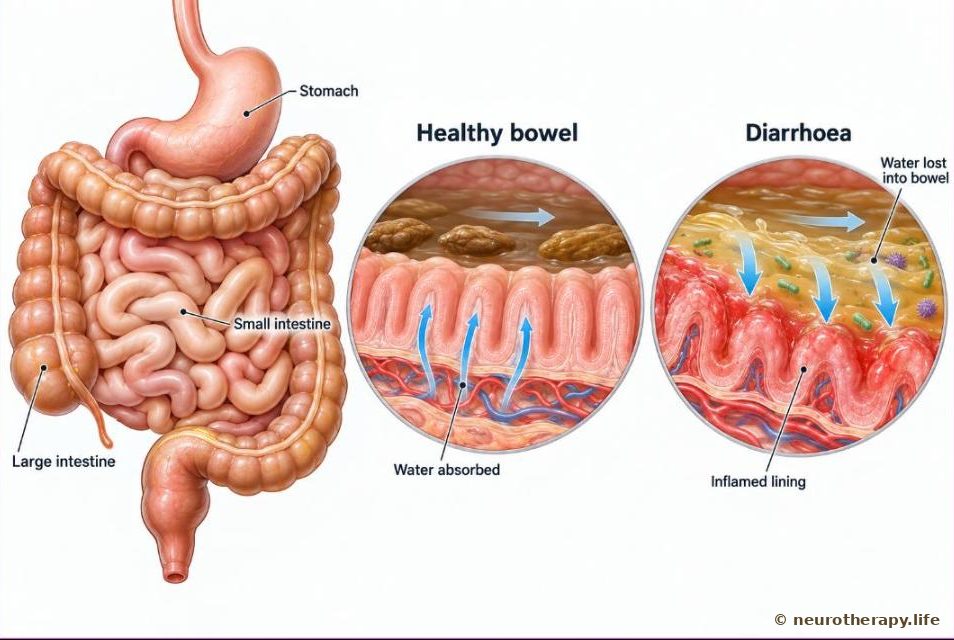
Your intestines normally soak most of the water from food and drink back into the body, so the stool comes out formed. In diarrhoea the bowel is irritated or infected: it takes back less water, pours out more, and moves the contents along too fast.
Short-lived (acute) diarrhoea usually lasts a day or two and settles within about a week; it is mostly caused by germs in food or water. Diarrhoea that lasts four weeks or more is called chronic, and needs a doctor to find the cause.
What are the symptoms?
- Loose, watery stools three or more times a day
- Cramps or pain in the belly, and an urgent need to go
- Nausea or vomiting
- With infection: fever, chills, or blood in the stool
- Signs of dehydration: thirst, dry mouth, little dark urine, dizziness, tiredness
What causes it, and who is more likely to get it?
Germs
- Viruses — rotavirus is the leading cause in children
- Bacteria or parasites in unsafe food or water
Food and medicines
- Food intolerance, such as trouble digesting milk sugar (lactose)
- Some medicines, such as antibiotics and antacids that contain magnesium
Longer-lasting bowel problems
- Irritable bowel syndrome (IBS)
- Inflammatory bowel disease, such as Crohn's disease
- After surgery on the stomach or bowel
How is it found?
Most short bouts need no tests. A doctor looks for the cause when diarrhoea lasts, comes with blood or high fever, or when the person is dehydrated — and first of all judges how much water has been lost.
Examination and questions
How many times a day, for how long, any blood, fever or vomiting, recent food, travel and medicines — and a check for signs of dehydration.
Stool test
Looks for bacteria, parasites or blood in the stool.
Blood tests
Can show infection, lost salts, or a strain on the kidneys from dehydration.
How dehydrated? (WHO signs)
Source: World Health Organization, diarrhoeal disease fact sheet
Before any formula, a neurotherapist asks about water: are you passing urine, is your mouth dry, do you feel dizzy on standing? Then the loose motions are counted, and you will be asked to show every tablet you take — especially one for blood pressure.
How Neurotherapy sees Diarrhoea (loose motions)
LMNT treats loose motions with respect for the bowel's own wisdom. The gut has its own nervous system, and a bowel that has speeded up has usually decided to empty something it wants out. So every treatment that slows it is given with a limit, and the number of loose motions — nothing else — decides which treatment is chosen.
Count the motions — the APR way of choosing
- Counthow many loose motions, with belly pain, in a day
- Up to 4–5: class Ainflammation work and bowel work in the same session
- More than 5–6: class Bmore inflammation work first; the bowel points wait until the motions answer
- Formed like a bananathe slowing treatment stops as soon as the stool is formed
- Back to normalNAN or FAN for at least one day, then examine again from the beginning
The reasoning behind class B is one sentence of Guruji's teaching: more loose motions mean a stronger infection and more inflammation — and until the inflammation is finished, there is no meaning in provoking the other organs of the abdomen.
We cannot provoke the organs in an order of our own choosing.
Neurotherapy treatment for Diarrhoea (loose motions), step by step
Examine first — water before formulas
The therapist checks urine, mouth and dizziness on standing, counts the motions, asks about every tablet, and presses the points around the navel, including Mu and Dys.
Belly pain with loose motions: APR
Class A for up to four or five motions a day, class B for more. Both begin with inflammation work — (30) Medulla, (6) Adr and (6) Swt, which slows the bowel — and reach the bowel points only later.
Soft motions two or three times a day: Ulta Normal
The Normal digestive formula given in reversed order, to slow the bowel. A line is drawn under the reversed points, and you are asked about your motions every day.
Dys — only with its finding, only briefly
Dys is given only if there is pain above and to the right of the navel, and for a day or two at most, because it works against the bowel's natural movement.
When the stool is formed
The slowing treatment stops at once, and NAN or FAN is given for at least one day to bring the bowel back to its normal rhythm. Then the whole examination is done again.
Points and formulas used
Ulta Normal
The Normal formula in reverse, to slow the bowel — for soft motions two or three times a day. Stopped as soon as the stool is formed.
Works through
Open →APR class A, revised
For belly pain with up to four or five loose motions a day — calms the inflammation first, then supports the bowel.
Works through
Open →APR class B, revised
For belly pain with more than five or six loose motions — more inflammation work, repeated as needed; the bowel points wait until the motions answer.
Works through
Open →Never do this
- Never with loose motions: Gas 'I' and Const. The Acid point, (1) or (2) Acid, is not given while there are loose motions. Const
- (6) Adr, part of APR, is not given when blood pressure is high or immunity is already low. (30) Medulla is not given with low blood pressure or heart disease — so the therapist asks about every tablet first. (6) Adr
- Ulta Normal and Dys are short courses. Given after the stool is formed, they cause constipation — so the motions are asked about every day. Ulta Normal
- Keep drinking, and take ORS (oral rehydration solution) as soon as loose motions begin — for children, from the very first loose motion.
- See a doctor quickly for: signs of dehydration — little or no urine for many hours (a baby with no wet nappy for three hours), sunken eyes, a drowsy or floppy child; blood or black colour in the stool; fever of 102°F (39°C) or more; severe belly pain; or diarrhoea lasting more than two days in an adult or a day in a child.
- Cancer: if the person has cancer, (10) Pan, Thymus, Pit, Lu + Sh, Rt. Ov / Lt. Ov and (30) Medulla are never given — the therapist changes the plan.
- Keep taking the medicines your doctor prescribed. Neurotherapy works alongside your medical care, never instead of it.
Watch

A demonstration of the Ulta Normal formula for loose motions: (8) Pan on both thighs, then Spl before Gal and Mu before Liv — the Normal formula's order reversed to slow the bowel.
The video's counts ((3) Spl, (3) Gal, (5) Mu, (7) Liv) differ from LMNT teaching, which gives (1) Spl, (1) Gal, (1) Mu – 3 points and (1) Liv – 3 points. Ulta Normal is stopped as soon as the stool is formed, and the Normal formula is given for at least one day.
How the Ulta Normal formula — the Normal formula in reversed order — is given for loose motions.
From practice
The bus conductor and the tablet he did not mention
A teaching case — a composite from practice, not one patient's file
41 years · bus conductor · cramping belly pain and six or seven loose motions a day for eleven days
- What was found
- Mu was very tender, Liv and Gas tender; the belly was soft, with no fever. Before anything else he was asked about water — he was passing urine, his mouth was not dry and he was not dizzy. His stool report showed no blood or organisms. Asked whether anyone had said his blood pressure was high, he said no.
- What was done
- More than five or six motions meant APR class B. On the second day he mentioned a BP tablet his doctor had started — to him, the tablet meant the pressure was no longer high. The card was stopped at once, because (6) Adr is not given in high BP, and his physician was asked for the reading. Meanwhile he was given what LMNT writes for exactly this patient: Ulta Normal with (6) Swt. The motions fell to twice, then once, and were formed on day five. Ulta Normal was stopped, NAN given for one day, and he was examined again from the beginning.
- What it teaches
- The count chooses the class; the safety questions decide whether it may be given — and both are asked before the card is written. Don't ask “has anyone told you your BP is high?” Ask what tablets he takes, and ask to see the strip.
From Ayurveda and the kitchen
Test yourself
What research says
- Strong evidence
The wall of the gut carries its own network of nerves — the enteric nervous system — which controls how the bowel moves, what it secretes and its blood flow, working together with the brain. This is the “second brain” LMNT teaching asks the therapist to respect before slowing a bowel.
- Strong evidence
In children with diarrhoea, the lower-salt ORS used today worked better than the older WHO formula: fewer children needed an unplanned drip, stool output was lower and there was less vomiting.
No clinical trial of Neurotherapy in diarrhoea has been published yet. Improvements reported by neurotherapists are clinical observations.
For you
Babies and children
Give ORS from the first loose motion and keep feeding. In LMNT, the toe-finger (TF) work is given in reverse order for a child's ordinary loose motions. A drowsy child, sunken eyes or no wet nappy for three hours means a doctor now.
People with long-standing constipation
If you are loose today, tell your therapist before the session — the Const point for constipation is not given on a day with loose motions.
Older adults and people on BP tablets
Water loss hits older people harder and can drop the blood pressure. Keep drinking, and show your therapist the strip of every tablet you take.
This page explains; it does not diagnose. Neurotherapy works alongside your medical care — keep taking the medicines your doctor prescribed, and see a doctor for any new or severe symptom.