ITP (low platelets)
In ITP the body's own immune system destroys its platelets — the tiny blood cells that stop bleeding. With too few platelets, a person bruises and bleeds easily. It needs a doctor's care first.
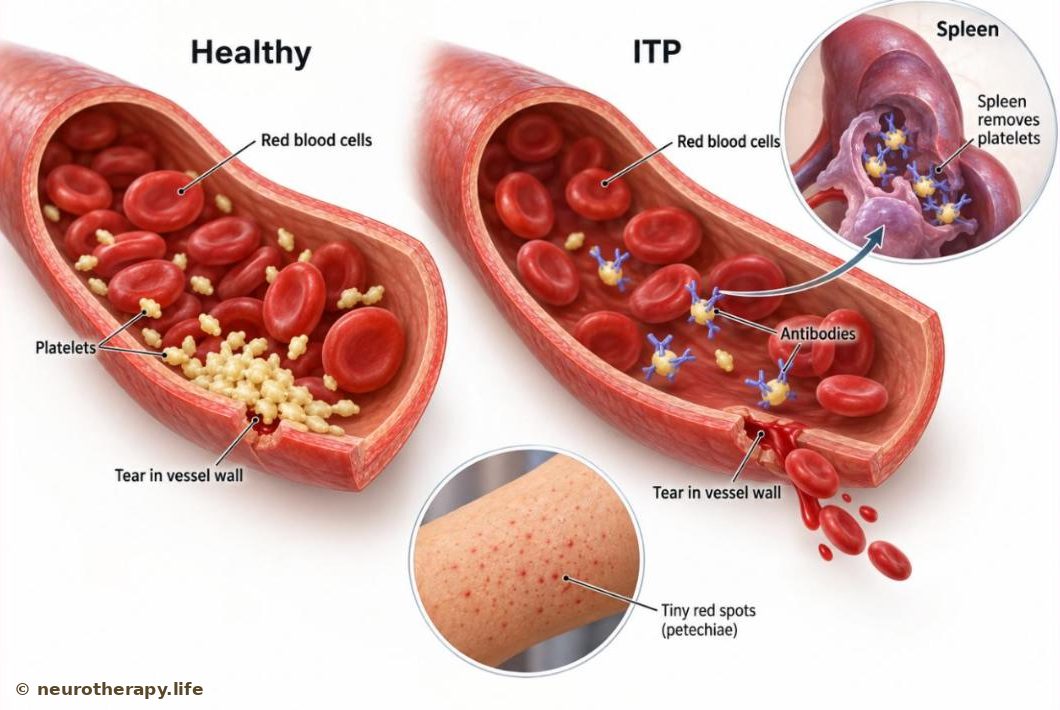
- Normal blood has 150,000–350,000 platelets per microlitre; ITP is diagnosed below 100,000
- Most children recover within 3 to 6 months, with or without treatment
- ITP lasting 12 months or longer is called chronic; it affects women two to three times more often than men
Source: StatPearls (Pietras et al., 2024); NHLBI; MedlinePlus
What is ITP (low platelets)?
Platelets are tiny pieces of cells made in the bone marrow. When a blood vessel is cut, they rush to the spot and stick together to plug it. Each platelet lives only about a week, so the marrow keeps making new ones.
In ITP the immune system makes antibodies against the body's own platelets. The marked platelets are removed, mainly in the spleen, faster than the marrow can replace them. In children it often follows a viral infection and passes; in adults it is more often long-lasting.
What are the symptoms?
- Bruising easily, often without a knock
- Tiny red or purple dots on the skin (petechiae)
- Nosebleeds or bleeding from the gums
- Unusually heavy periods
- Sometimes no symptoms — found only on a blood test
What causes it, and who is more likely to get it?
The immune system
- Antibodies against the body's own platelets
- Other immune disorders, such as lupus
Triggers
- A viral infection, especially in children
- Certain medicines
- Pregnancy
Often no clear reason
- "Idiopathic" in the old name meant exactly this — cause unknown
How is it found?
ITP is found with blood tests. The doctor also rules out other reasons for a low platelet count.
Complete blood count (CBC) with platelet count
Normal is 150,000–350,000 platelets per microlitre. In ITP the count is below 100,000, while the white cells and haemoglobin are normal.
Blood smear
A drop of blood is looked at under a microscope, to check the platelets and the other cells.
Bone marrow test, sometimes
Only when the doctor needs to rule out other blood diseases.
A neurotherapist asks for the latest platelet count before every course of treatment, and asks about any bleeding since the last visit.
How Neurotherapy (LMNT) sees ITP (low platelets)
In LMNT, ITP stands with the autoimmune disorders — the conditions where the body's own defence is already misbehaving. So the first rule is what not to do: none of the points that stir the immune system is given. Guruji's teaching names a low platelet count, as in ITP, among the conditions for which the long, twelve-part Oxygen-Hormonal treatment has been found very useful.
And that treatment carries its own order: until the abdomen is completely right, the hormones are not provoked. For the first month or so, the hormone part is held back and Ajay Normal — a digestion formula — is given in its place. Every gland takes its raw material from digestion, so digestion comes first.
We cannot provoke the organs in an order of our own choosing.
Neurotherapy (LMNT) treatment for ITP (low platelets), step by step
Examine first
The therapist checks the diagnostic points Liv° and Mu°, reads the latest platelet count, and asks about bruises, nosebleeds and periods.
The doctor stays in charge
A haematologist decides whether ITP needs watching or treatment. Neurotherapy (LMNT) is given only alongside that care, and the platelet count is followed by the doctor.
Digestion first — Ajay Normal
For the first month or so, the hormone part is not given. Ajay Normal is given in its place, until the stomach and digestion are right and undigested food has stopped appearing.
The longer treatment — checked against the autoimmune bar
LMNT teaching names ITP among the conditions where the twelve-part Oxygen-Hormonal treatment has been found useful. Because ITP is autoimmune, a senior therapist checks every part against the autoimmune bar before it is given.
Points and formulas used
Never do this
- ITP is autoimmune, so the whole autoimmune bar applies: Th, Th + Ch, Lymph, Armpits, Ton 'P', Ton 'T' and Spl are never given — where the immune system is already misbehaving, it is not stimulated. Spl
- The hormones are not provoked until the abdomen is completely right — for the first month or so, Ajay Normal is given instead of the hormone part. Ajay Normal
- Tell the therapist your latest platelet count. With very few platelets even ordinary pressure can leave bruises — if new bruises appear after a session, stop and show them to your doctor.
- Go to hospital at once for bleeding that does not stop with pressure, blood in the urine, stool or vomit, very heavy periods, a sudden severe headache, confusion or drowsiness.
- Children get half the adult dose and light treatment only, given by a trained therapist.
- Cancer: if the person has cancer, (10) Pan, Thymus, Pit, Lu + Sh, Rt. Ov / Lt. Ov and (30) Medulla are never given — the therapist changes the plan.
- Keep taking the medicines your doctor prescribed. Neurotherapy (LMNT) works alongside your medical care, never instead of it.
Watch

A demonstration of the Ajay Normal formula: (8) Pan, (3) Gal, (7) Liv and (6) Gas 'I' at the three-point form — the Normal formula with Spl left out.
Ajay Normal, the digestion formula given first. In ITP the milder form is used — (8) Pan, (1) Gal, (2) Liv at 3 points, (1) Gas 'I' at 6 points — with light pressure.
From Ayurveda and the kitchen
Test yourself
What research says
- Strong evidence
In ITP, antibodies coat the platelets and the spleen clears them faster than usual. ITP is defined by a count below 100,000 per microlitre, and most children recover within 3 to 6 months.
No clinical trial of Neurotherapy (LMNT) in ITP has been published yet. Improvements reported by neurotherapists are clinical observations.
For you
Parents of a child with ITP
Most children get better within months. Avoid rough play and contact sports while the count is low, and keep every blood test the doctor asks for.
Women
Very heavy periods can be a sign of low platelets. Tell your doctor, and tell them if you are pregnant or planning to be.
Anyone with low platelets
Do not start or stop any tablet — including pain-killers — without asking your doctor, as some affect bleeding.
This page explains; it does not diagnose. Neurotherapy (LMNT) works alongside your medical care — keep taking the medicines your doctor prescribed, and see a doctor for any new or severe symptom.