Hole in the heart
A hole in the heart is an opening, present from birth, in the wall between the heart's chambers or between two big blood vessels. Many small holes close by themselves; larger ones need a heart specialist's care.
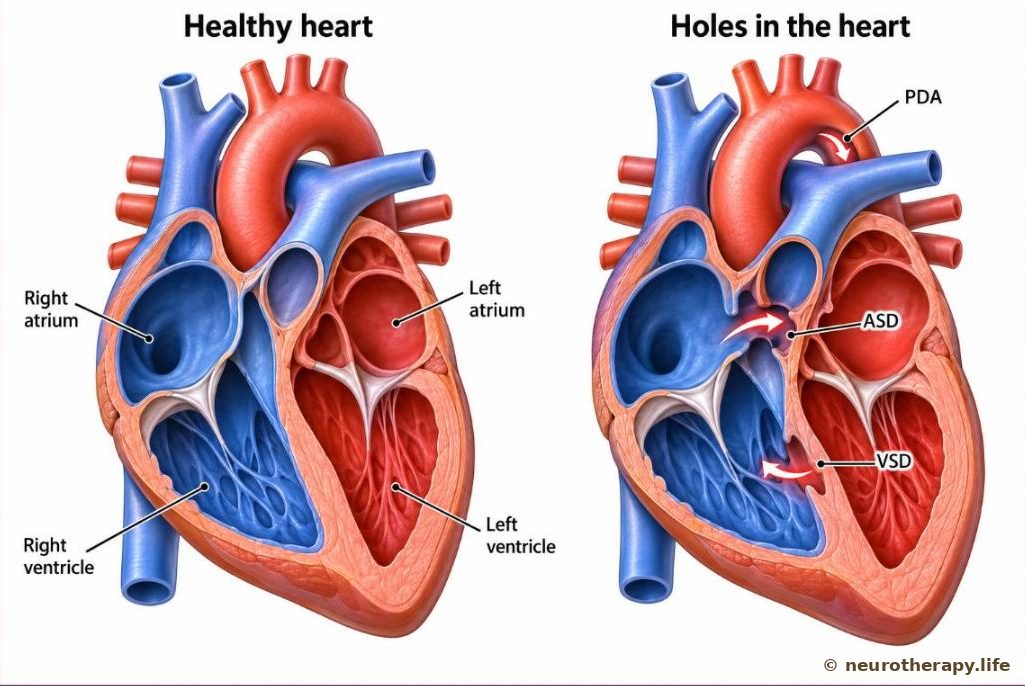
- Heart defects present from birth are the most common type of birth defect
- A hole between the lower chambers (VSD) is found in nearly half of all children born with a heart defect
- About 85–90% of small VSDs close on their own within the first year of life
Source: MedlinePlus; StatPearls (Alahmadi & Oliver, 2024)
What is Hole in the heart?
Your heart has four chambers — two on top (atria) and two below (ventricles). A wall keeps the right side, which carries used blood to the lungs, apart from the left side, which pumps fresh blood to the body. Before birth, a small vessel link lets blood skip the lungs; it should close soon after birth.
A hole in the heart is a gap that did not close while the heart was forming. ASD is a gap between the upper chambers, VSD between the lower chambers, and PDA is the vessel link that stayed open. Blood leaks across, so the heart and lungs work harder than they should.
What are the symptoms?
- Often none at all — a small hole may be found only as a heart murmur
- Fast or hard breathing, and getting breathless easily
- Sweating while feeding, and slow weight gain
- Paleness and tiring quickly
- A bluish colour of the lips, fingers or nails
- Frequent chest infections
What causes it, and who is more likely to get it?
During pregnancy
- Diabetes in the mother, especially in the first three months
- Rubella (German measles) infection in the mother
- Smoking or breathing others' smoke
- Some medicines taken in pregnancy
Family and genes
- A heart defect in the family
- Some genetic conditions
Often no clear reason
- In many children, no single cause is ever found
How is it found?
A hole in the heart is often first suspected when a doctor hears a murmur, or on a scan in pregnancy. The size and place of the hole decide what is done.
Echocardiogram (heart ultrasound)
The main test. It shows the hole, its place and its size in millimetres, and how blood flows across it. Painless.
Pulse oximetry
A small clip on a finger or toe measures the oxygen in the blood — used to screen newborns.
ECG and chest X-ray
Show the heart's rhythm and whether the heart or the lung vessels have been strained.
A neurotherapist asks for the echocardiogram report with the size of the hole. For a small child, LMNT also examines the mother's vitamin points, because the child cannot say where it hurts.
How Neurotherapy (LMNT) sees Hole in the heart
LMNT noticed something careful: in children with a hole in the heart — ASD, VSD or PDA — pain has been found at the Folic acid point. It does not say the hole comes from a shortage of folic acid. It is an observation about the body, and it decides the treatment: the Folic acid formula, with (10) Pan and (8) Rt. Parkhoo.
The folic acid supply line — every link must work
- Green leafy vegetablesare where folic acid comes from — but eating them is not enough
- Stomachmakes acid and pepsin so that protein is digested — Gas Only
- Intestinedigests and absorbs what comes out of it — Gas 'I'
- Ascending colonwhose bacteria make folic acid as the body needs it — Rt. Ov.
Guruji's teaching adds one more link: whatever vitamin the mother was short of in pregnancy, the child will be short of too. So for a small child, the therapist examines the mother's Folic acid point, and treats the child by her finding.
It is not enough that one eats protein. The thing that matters is that it is digested.
Neurotherapy (LMNT) treatment for Hole in the heart, step by step
Examine first — the child and the mother
The therapist reads the echo report, checks Liv° and Mu°, and — for a small child — examines the mother's vitamin points on both sides of the waist. Pain on the right side points to folic acid.
The heart specialist stays in charge
The cardiologist decides whether the hole needs watching, a procedure or surgery. Neurotherapy (LMNT) is given alongside, never in place of that care.
The Folic acid formula
Three stations — Gas Only on the thighs, Gas 'I' on the calves, and Rt. Ov. — to digest protein, absorb it, and let the colon's bacteria do their work.
(10) Pan and (8) Rt. Parkhoo
LMNT names (10) Pan for hole in the heart, and (8) Rt. Parkhoo — the right-hip folic acid point, given lying on the left side — within the folic acid treatment.
Months, measured by the echo
This is slow work over months. Progress is judged by the cardiologist's echo — the size of the hole in millimetres — not by feelings.
Points and formulas used
Folic acid formula
Supports the body's own supply line for folic acid — protein digestion, absorption, and the colon's bacteria.
Works through
Open →(10) Pan
The pancreas point at the count that stimulates insulin — named in LMNT for hole in the heart (ASD, VSD, PDA).
Open →Rt. Parkhoo
The right-hip folic acid point — used for children with a hole in the heart from birth, within the folic acid treatment.
Open →Never do this
- Pan is not given in fits, convulsions or seizures, nor to anyone with schizophrenia. A child who is very hyperactive may become more so on (10) Pan — the therapist watches for it. Pan
- Gas Only is not given with an ulcer in the stomach or duodenum. Rt. Ov. is not given to children being treated to increase height. Gas Only
- Before any folic acid treatment given for months, the therapist also asks about vitamin B12 — folic acid can improve the blood while a B12 shortage goes on harming the nerves. B₁₂
- Go to a doctor or hospital at once for blue lips or fingers, breathlessness at rest, fainting, poor feeding with sweating, or a baby who is not gaining weight.
- Children get half the adult dose and light treatment only, given by a trained therapist. Never promise that a hole will close — keep every cardiology check-up.
- Cancer: if the person has cancer, (10) Pan, Thymus, Pit, Lu + Sh, Rt. Ov / Lt. Ov and (30) Medulla are never given — the therapist changes the plan.
- Keep taking the medicines your doctor prescribed. Neurotherapy (LMNT) works alongside your medical care, never instead of it.
From practice
The girl whose fingers turned blue, and the question asked of her mother
Recorded in the therapy's own account — a case from Guruji's teaching; the child's name was not recorded
A young girl · a documented hole in the heart · her fingers turned blue on the slightest effort
- What was found
- A small child cannot say whether a point hurts. So the mother was examined instead — and she had a great deal of pain at the Folic acid point.
- What was done
- The folic acid treatment, chosen by the mother's finding, was given to the child for five to six months. The girl said she felt very good right after the first treatment. The sonography afterwards reported the hole at 4 mm, down from 9 mm.
- What it teaches
- The examination was done on the mother, because the pregnancy is where the story began. The change was measured by a scan no one in the room could influence — and nothing else was stopped: the child stayed with the doctors who first found the hole. One child's scan is a reported observation, not proof, and many small holes also close on their own.
From Ayurveda and the kitchen
Green leaves for the mother-to-be
The old food texts gave leaf vegetables (shāka) a special place in the month-by-month diet of pregnancy, with milk and ghee. They had no word for folate — yet they pointed to the very food it comes from.
Test yourself
What research says
- Strong evidence
An isolated VSD makes up about 37% of heart defects in children. About 85–90% of small ones close on their own in the first year, and a heart ultrasound (echo) is the main test.
Alahmadi MH, Oliver TI. Ventricular Septal Defect. StatPearls. 2024.
- Strong evidence
WHO advises all women to take folic acid daily from the time they start trying to conceive until 12 weeks of pregnancy, to prevent defects of the baby's spine and brain.
No clinical trial of Neurotherapy (LMNT) for a hole in the heart has been published yet. Improvements reported by neurotherapists are clinical observations.
For you
Parents
Keep every echo and cardiology visit, and bring the reports to the therapist. Watch feeding, weight and breathing, and know the signs that need the doctor the same day.
Women planning a pregnancy
Start folic acid daily before you conceive, not after. If you have had an affected pregnancy before, have diabetes or take medicine for fits, ask your doctor — you may need more.
This page explains; it does not diagnose. Neurotherapy (LMNT) works alongside your medical care — keep taking the medicines your doctor prescribed, and see a doctor for any new or severe symptom.