Insomnia (sleeplessness)
Insomnia means trouble falling asleep, staying asleep, or waking too early — and feeling tired the next day. A few bad nights are common; when it goes on for months, it needs attention.
- About 1 in 3 adults worldwide have symptoms of insomnia
- About 1 in 10 adults have long-term (chronic) insomnia
- Women get insomnia more often than men
Source: Cleveland Clinic; MedlinePlus
What is Insomnia (sleeplessness)?
Short-term insomnia often follows stress — a work problem, a family worry, a loss — and lasts days or weeks. Insomnia is called chronic when it happens at least three nights a week for three months or more.
Most long-term insomnia has something behind it: worry or low mood, pain, another sleep problem, tea or coffee late in the day, or a medicine. Poor sleep then affects mood, memory, work and even safety on the road.
What are the symptoms?
- Lying awake a long time before falling asleep
- Waking in the night and not getting back to sleep
- Waking too early in the morning
- Feeling tired and unrefreshed during the day
- Irritability, poor concentration and forgetfulness
What causes it, and who is more likely to get it?
Mind and stress
- Stress about work, health, money or family
- A loss or other major life event
- Worry and low mood
Habits
- Going to bed at a different time each night, and long daytime naps
- Screens in bed
- Tea, coffee, tobacco or alcohol, especially late in the day
- A heavy meal late at night
Schedule
- Night shifts
- Travel across time zones
Body and medicines
- Long-lasting pain
- Other sleep problems, such as sleep apnoea or restless legs
- Some medicines
- Older age
How is it found?
Insomnia is diagnosed mostly from your sleep story. The doctor asks when you go to bed, how long it takes to fall asleep, how often you wake, and how you feel in the day.
Sleep history and sleep diary
Writing down bedtime, waking time, naps, tea and coffee for two weeks often shows the pattern.
Physical examination and medicine review
To look for pain, other illnesses or medicines that may be keeping you awake.
Sleep study, sometimes
Used when another sleep problem, such as sleep apnoea, is suspected.
A neurotherapist asks about the sleep, the day, the tea and the tablets — and measures the blood pressure, because the sleep treatment is not given when blood pressure is high.
How Neurotherapy sees Insomnia (sleeplessness)
Neurotherapy looks at sleep through serotonin, the body's chemical that is needed for bringing sleep. When (8) Medulla is given, the person often begins to fall into deep sleep within a short while. From that observation, the treatment is held to stimulate serotonin.
LMNT teaching names four things that control how much serotonin is released: stress, not sleeping at the right time, the level of sugar in the blood, and exercise. A disturbance in even one of them is enough to upset it. So the treatment on the neck goes together with the day that the person lives.
The patient has to try it for himself and see. Every single thing will not have the same effect on every person.
Neurotherapy treatment for Insomnia (sleeplessness), step by step
Examine first
The therapist checks Liv° and Mu°, and asks about bedtime, naps, tea and coffee, worries, pain and every tablet you take.
Check that it is safe
Blood pressure is measured. (8) Medulla is not given in high blood pressure, in inflammation, or in cancer.
(8) Medulla — the serotonin treatment
Seated. Eight applications on both sides of the neck, just below the ears. The person often feels drowsy soon after.
Look after what serotonin needs
Less stress, sleep at the same right time every night, regular meals so the blood sugar stays steady, and daily exercise — the four things LMNT teaching says control serotonin.
Points and formulas used
Never do this
- (8) Medulla is not given in inflammation, in cancer, or in high blood pressure. (8) Medulla
- Loud snoring with pauses in breathing or gasping at night, or falling asleep while driving or at work: see a doctor soon — these can be signs of sleep apnoea. Do not drive when you are very sleepy.
- If sleepless nights come with deep sadness or thoughts of harming yourself, get help today — from a doctor or a crisis helpline (India: Tele-MANAS 14416). extreme sadness Depression
- Cancer: if the person has cancer, (10) Pan, Thymus, Pit, Lu + Sh, Rt. Ov / Lt. Ov and (30) Medulla are never given — the therapist changes the plan.
- Keep taking the medicines your doctor prescribed. Neurotherapy works alongside your medical care, never instead of it.
Watch

Shows a five-minute self-routine before bed: (8) Medulla below the ears three times, pressure while sitting in Vajrasana, massage just below the knees and at the back of the head, plus tips on screens and dim light. It is shared to support better sleep.
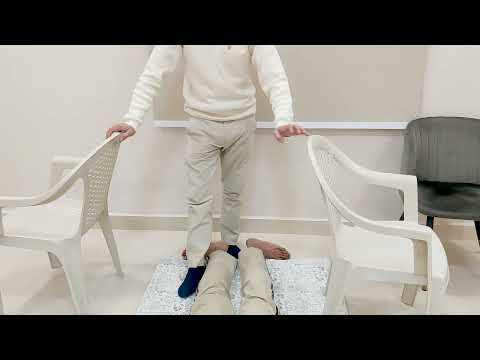
Shows the Serotonin treatment for sleep: (8) Medulla below the ears, 1 Gas 'I' at six points on the shin, (6) Adr on the upper back, and gentle massage behind the knees and at the back of the head. It is given to support deep, natural sleep.
Note: (8) Medulla is not given in high BP, inflammation or cancer; (6) Adr is not given in high BP, diabetes, cancer or HIV.
From Ayurveda and the kitchen
Test yourself
What research says
- Strong evidence
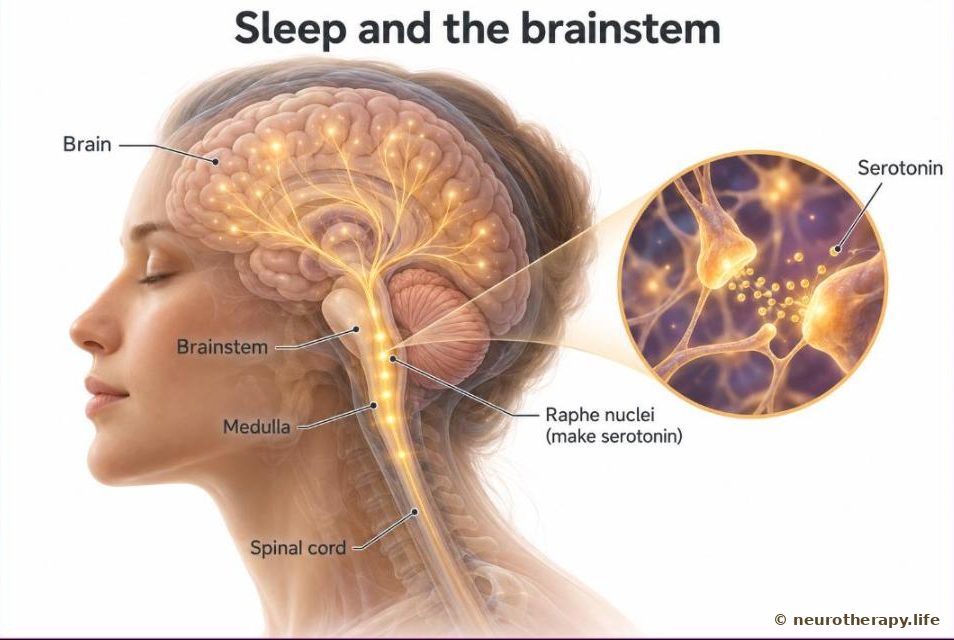
Serotonin is made in the raphe nuclei of the brainstem and in cells of the gut lining — the gut makes about 90% of it. It is built from tryptophan, an amino acid from food, and it is the raw material for melatonin, a key sleep hormone.
Bamalan OA, Moore MJ, Al Khalili Y. Physiology, Serotonin. StatPearls. 2023.
No clinical trial of Neurotherapy in insomnia has been published yet. Improvements reported by neurotherapists are clinical observations.
For you
Older adults
Sleep gets lighter with age, and waking earlier is common. Daytime activity, some morning light and fewer long naps help. Tell your doctor about every medicine you take.
Shift workers and travellers
Keep the same sleep time on as many days as you can, and make the room dark and quiet when you sleep in the day.
People taking sleeping tablets
Do not stop them suddenly on your own. If sleep improves, ask your doctor how and when to change them.
This page explains; it does not diagnose. Neurotherapy works alongside your medical care — keep taking the medicines your doctor prescribed, and see a doctor for any new or severe symptom.