Uterine Fibroids
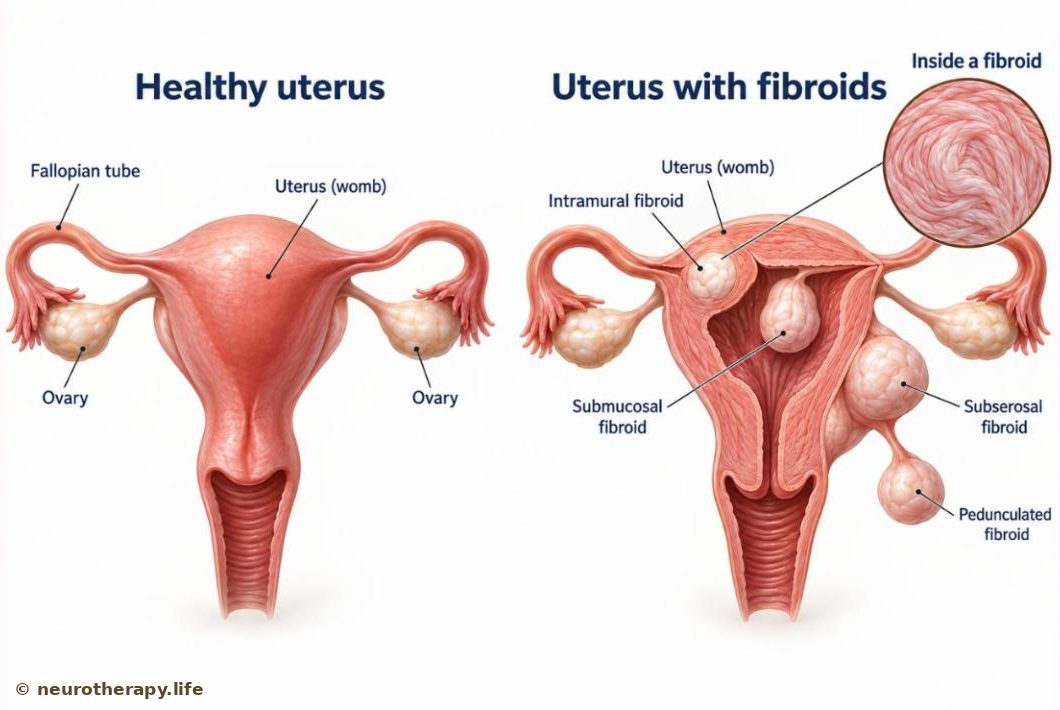
Fibroids are lumps of muscle tissue that grow in or on the womb. They are almost never cancer. Many women never know they have them, but some get heavy or painful periods, pressure in the lower belly, or trouble getting pregnant.
- Between 20 and 80 out of every 100 women develop fibroids by the age of 50
- They are found most often between the ages of 30 and 50
- Almost always harmless growths — fewer than 1 in 1,000 turns out to be cancer
Source: US Office on Women's Health; Cleveland Clinic; StatPearls
What is Uterine Fibroids?
The womb has a thick wall of muscle. A fibroid starts when one muscle cell in that wall begins to grow more than it should, packed in a tough web of fibre. It can stay the size of a seed or grow as big as a fruit, and a woman can have one or many.
Fibroids feed on the female hormones oestrogen and progesterone, so they mostly grow in the years when periods come. Where a fibroid sits decides the trouble: one inside the womb's cavity tends to make periods heavy; a big one on the outside can press on the bladder or the bowel.
What are the symptoms?
- Heavy or long periods, sometimes with clots
- Pain in the periods, or bleeding between periods
- A feeling of fullness, pressure or swelling in the lower belly
- Passing urine often, or constipation, when a fibroid presses on the bladder or the bowel
- Low back pain, or discomfort during intercourse
- Tiredness and breathlessness from blood loss (anaemia), or difficulty getting pregnant
What causes it, and who is more likely to get it?
Hormones
- Oestrogen and progesterone help fibroids grow — so they mostly appear in the years of periods
- Periods that started early (before about 10 or 11), or a late menopause (after 55)
Family and age
- A mother or sister with fibroids
- Age — they are commonest between 30 and 50
- Never having been pregnant
Body and daily life
- Being overweight
- Low vitamin D
How is it found?
Fibroids are often found by chance, during a check-up or a scan done for something else. When there are symptoms, a doctor examines the belly and the pelvis and then asks for a scan to see how many fibroids there are, where they sit and how big they are.
Pelvic ultrasound
The main test. It shows the number, size and place of the fibroids. Keep every report — the next scan is compared with it.
Examination by a gynaecologist
The doctor feels the belly and the pelvis; a large fibroid can often be felt this way.
MRI, or a look inside the womb
When more detail is needed: an MRI scan, a saline ultrasound, or hysteroscopy — a thin camera passed into the womb.
Haemoglobin
A blood test to see whether heavy periods have caused anaemia.
A neurotherapist asks privately — by a woman where one is available — about the periods, the ultrasound report and the side of the fibroid. The Liv° and Mu° points are compared, and the haemoglobin and the doctor's latest scan are read before anything is given.
How Neurotherapy sees Uterine Fibroids
In LMNT, tumours, fibroids and cysts sit on the alkaline side of the body's balance — among the conditions that have a tendency to grow. So the work starts with the Alkali Treatment Formula (ALTF). Then (2) Pan, given for exactly six seconds, and Anti F. Heparin — the Heparin formula meant for a blockage made by unwanted growth. For a fibroid in the womb, Thymus + Chest is added, and the ovary point on the side of the fibroid, to increase the blood supply there.
LMNT teaching is plain about its limits: a woman with a fibroid keeps every appointment already made — the scan, the gynaecologist, the surgeon. Neurotherapy supports the body alongside that care. What changed is shown by the next scan, not promised in advance.
Whether or not the patient gets immediate benefit from our treatment, let no harm reach him through our carelessness — attend to this.
Neurotherapy treatment for Uterine Fibroids, step by step
Examine first
The therapist compares Liv° and Mu°, and reads the ultrasound report — how many fibroids, how big, and on which side — along with the haemoglobin and the dates of the last few periods.
The alkali side — ALTF
ALTF is given only after the question of undigested food has been answered: if food comes out in the stool looking as it went in, the undigested-food treatment comes first, for some days.
(2) Pan and Anti F. Heparin
(2) Pan is given for exactly six seconds — in LMNT teaching it calms what is overactive. Anti F. Heparin is the Heparin formula with Pan lowered to 2, written for a blockage made by unwanted growth. Like every Heparin formula, it pauses while the flow is heavy.
Thymus + Chest and the ovary point for the side
For a fibroid in the womb, Thymus + Chest — and whenever it is given, the armpits are given too. Lt. Ov. for a fibroid on the left, Rt. Ov. for one on the right, to increase the blood supply there.
On the heavy days
If the periods are heavy, the period rules take over: (4) Para for heavy flow, and at home at least three-quarters of a litre of lukewarm milk a day — never hotter, because heat can increase the bleeding — with a dried date (chhuhārā) soaked overnight in milk and boiled with it in the morning.
Points and formulas used
ALTF (chief form)
The Alkali Treatment Formula — for the alkaline side, given only after the undigested-food question has been answered.
Open →(2) Pan
Pan for exactly six seconds — in LMNT teaching it calms what is overactive; not for children being treated for height.
Open →Anti F. Heparin (anti-fibrin)
The Heparin formula with Pan lowered to 2 — for a blockage made by unwanted growth; never while the flow is heavy.
Works through
Open →Never do this
- While the flow is heavy, no Heparin formula of any kind is given — Anti F. Heparin included — because heparin keeps blood from clotting and the flow will increase. The course pauses and restarts after the period. Anti F. Heparin (anti-fibrin)
- (2) Pan is given for exactly six seconds, and never to children who are short or being treated for height — they get (4) or (10) Pan. The ovary points (Lt. Ov., Rt. Ov.) are not given in cancer or in the teenage years. (2) Pan
- Thymus + Chest is not given in pregnancy, heart disease, diabetes, rheumatoid arthritis or other autoimmune disease, kidney disease, polio or inflammatory disease. When it is given, the armpits must be given too. Th + Ch
- A fibroid is followed by a doctor. Keep every scan and every appointment with the gynaecologist or surgeon — this treatment is never a reason to miss one.
- See a doctor urgently for very heavy bleeding with dizziness or fainting, sudden severe pain in the lower belly or pelvis, bleeding between periods, or any bleeding after menopause.
- Cancer: if the person has cancer, (10) Pan, Thymus, Pit, Lu + Sh, Rt. Ov / Lt. Ov and (30) Medulla are never given — the therapist changes the plan.
- Keep taking the medicines your doctor prescribed. Neurotherapy works alongside your medical care, never instead of it.
Watch

A demonstration, in Hindi, for period pain where a fibroid is present: (30) Medulla, then (3) WD on both forearms, and Thymus + Chest.
A fibroid must be followed by a doctor. (30) Medulla is not given to heart patients; Thymus + Chest is not given in pregnancy, diabetes, heart, kidney or autoimmune disease; WD is not given in cancer.
A training demonstration in Hindi from @neurotherapylife for period pain where a fibroid is present. It uses (30) Medulla and (3) WD, which are not in the LMNT fibroid treatment on this page — read the note under the video.
From Ayurveda and the kitchen
Test yourself
What research says
- Strong evidence
A medical reference review: fibroids grow from the womb's own muscle cells, are driven mainly by oestrogen, and are packed with a thick web of collagen and other fibre. They are found in 50–70% of women by menopause, and about a quarter to a third of women with them have symptoms that need treatment.
No clinical trial of Neurotherapy for fibroids has been published yet. Improvements reported by neurotherapists are clinical observations.
For you
Women with heavy periods
Ask for a haemoglobin test and an ultrasound. Tiredness that the family calls laziness may be blood loss. Any Heparin course pauses while you bleed heavily.
Women hoping to become pregnant
Some fibroids make it harder to conceive; talk to a gynaecologist about yours. Tell the therapist at once if you might be pregnant — Thymus + Chest is not given in pregnancy.
Women near or after menopause
Fibroids depend on the hormones of the period years. Any bleeding after periods have stopped must be checked by a doctor before any other treatment.
This page explains; it does not diagnose. Neurotherapy works alongside your medical care — keep taking the medicines your doctor prescribed, and see a doctor for any new or severe symptom.