Diabetes
Diabetes means the sugar in your blood stays too high, because the body cannot make enough insulin or cannot use it well. Over the years, high sugar harms the nerves, the eyes, the kidneys, the heart — and the feet.
- About 830 million people were living with diabetes in 2022
- About 1 in 7 adults has diabetes (14% in 2022)
- More than 95% of people with diabetes have type 2
Source: World Health Organization (diabetes fact sheet)
What is Diabetes?
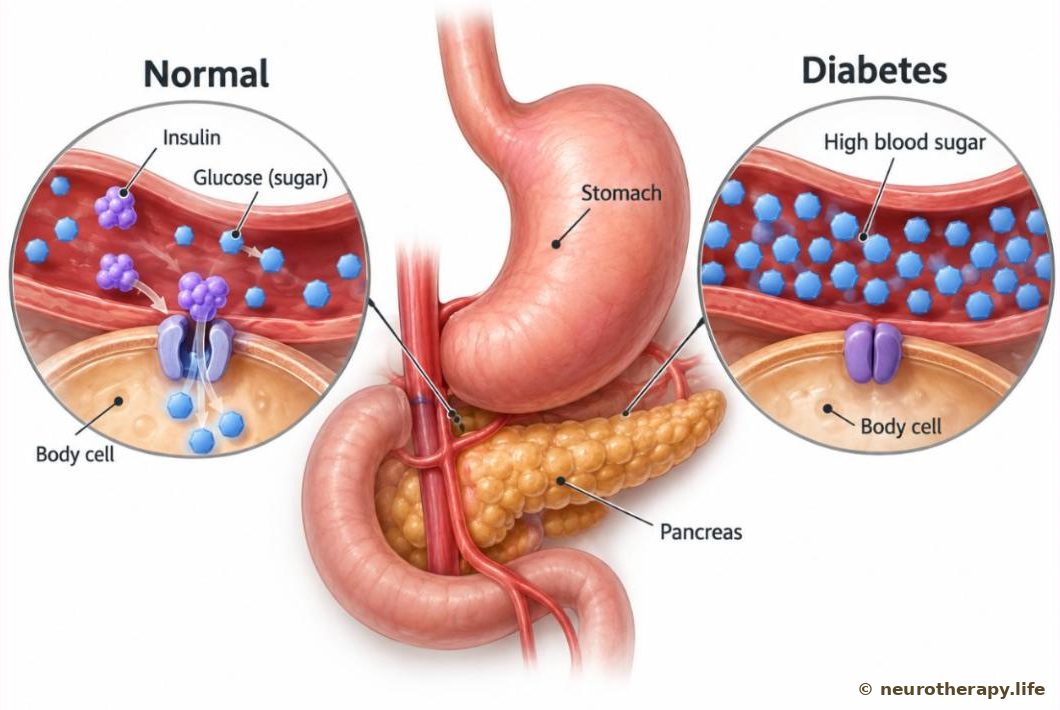
Food is broken down into glucose, a sugar that travels in the blood. Insulin, a hormone made by the pancreas, opens the body's cells so glucose can go in and be used for energy.
In type 1 diabetes the body's own defence system destroys the cells that make insulin, so very little is made. In type 2 — by far the most common — insulin is still made, but the cells stop answering it well. Gestational diabetes appears during pregnancy.
What are the symptoms?
- Feeling very thirsty, and passing urine often — even at night
- Feeling hungry and tired much of the time
- Blurred vision
- Numbness, tingling or burning in the feet or hands
- Cuts and sores that heal slowly
- Losing weight without trying — though type 2 often causes mild or no symptoms for years
What causes it, and who is more likely to get it?
Body and family
- Family history of diabetes
- Age over 35 (for type 2)
- Being overweight
- Prediabetes — sugar higher than normal, but not yet diabetes
Habits
- Little physical activity
- A diet heavy in sugar and saturated fat
- Smoking
Pregnancy
- Diabetes in an earlier pregnancy
- Having given birth to a baby weighing 9 pounds (about 4 kg) or more
Other conditions
- High blood pressure
- Polycystic ovary syndrome (PCOS)
- In type 1: the immune system attacking the pancreas
How is it found?
Diabetes is found with simple blood tests. Because type 2 can be silent for years, many people learn they have it from a routine check.
Fasting blood sugar
Taken after not eating overnight. Below 100 mg/dl is normal, 100–125 is prediabetes, and 126 or more means diabetes.
Random blood sugar
Taken at any time of day. A reading of 200 mg/dl or more, together with symptoms, points to diabetes.
Foot check
Can you feel a light touch on your soles? Nerve damage can take the feeling away without any pain, so the feet are checked, not just asked about.
HbA1c — your average sugar over about three months
Source: Cleveland Clinic (diabetes diagnosis values)
A neurotherapist asks for your HbA1c, your kidney report and your home sugar diary, checks with your eyes closed whether you can feel your soles, and writes the diabetes list of barred points on your card before the first treatment.
How Neurotherapy (LMNT) sees Diabetes
Neurotherapy (LMNT) does not give “a treatment for sugar”. It asks which organ is misbehaving on the day you come — often the bowel and the digestion. The point (10) Pan is used to stimulate insulin and help the body keep its sugar level.
Just as important is what is not given. Several points raise blood sugar — Pit, (4) Adr, (4) Pan and (10) Medulla — and others stir the immune glands. In diabetes these are blocked on the card before the first treatment, and (10) Pan is given in their place.
Whether or not the patient gets immediate benefit from our treatment, let no harm reach him through our carelessness — attend to this.
Neurotherapy (LMNT) treatment for Diabetes, step by step
Examine first
The therapist checks the diagnostic pain points Liv° and Mu° and the navel points, reads the HbA1c and kidney report, and tests the feeling in both soles.
Write the blocked list
Before a single point is chosen, the diabetes list of barred points is written on the back of the card, with the reason for each — so that any therapist who treats you that day can see it.
Digestion first
Because (10) Medulla is barred, the digestive work for a diabetic starts with (1) Gas Only – 6 points, given twice, or the eight-stage treatment written for diabetics with poor digestion.
(10) Pan for insulin
(10) Pan stimulates insulin. It is given to diabetic patients to help maintain the sugar level, in place of the points that would raise it.
Follow the body, week by week
Depending on the findings, LMNT teaching also uses P. Heparin, the New Genes variant with the Round Arrow kept to L1–L5, and (4) Thrd. The plan changes when the body changes — for example, when hard stools turn loose.
Points and formulas used
Diabetics, the basic treatment for
The simplest digestive start for a diabetic — (1) Gas Only – 6 points, twice — used where there is little else to go on.
Open →Diabetics and poor digestion, the eight-stage treatment for
A fuller eight-stage digestive treatment written for diabetics with poor digestion, with the barred point left out.
Open →P. Heparin (plasmin)
The parent Heparin formula, written as one that can be given to all patients; used for circulation and clotting.
Works through
Open →New Genes, the uncertain variant
The New Genes variant for diabetes when it cannot be said whether an auto-immune disorder is present — the Round Arrow kept to L1–L5.
Works through
Open →Never do this
- Never in diabetes: Th, Th + Ch, Spl, Lymph, Armpits, Ton 'P', Ton 'T', Pit, (4) Adr, (6) Adr, (4) Pan and (10) Medulla — the last not even inside the undigested-food treatment, because it raises blood sugar. (10) Medulla
- The Round Arrow only as far as L1–L5. On an injury, (8) Ch. Only (20) Round Arrow is given in place of Th + Ch. Round Arrow
- Where the feet have lost feeling: light hand contact only — never body weight, never prolonged — in BOF, Big Toe Gas or the foot stage of the calf ghisai. Look at the skin before and after. BOF
- Any blister, ulcer, red patch, new change in shape, or hot swollen foot — or a foot wound that is not healing — must be seen by a doctor the same day. sensation reduced Diabetic foot
- No long fasting on your own. If you take insulin or sugar-lowering tablets, a fast is a question for your doctor first.
- Cancer: if the person has cancer, (10) Pan, Thymus, Pit, Lu + Sh, Rt. Ov / Lt. Ov and (30) Medulla are never given — the therapist changes the plan.
- Keep taking the medicines your doctor prescribed, exactly as set, and keep checking your sugar. Neurotherapy (LMNT) works alongside your medical care, never instead of it.
Watch

Shows how to find the Pan (pancreas) point in the fold at the top of both thighs, and how to give 1 Pan, 2 Pan, 2 Pan × 6 and 8 Pan with the feet, holding chairs for support. It is used to support the pancreas in diabetes and indigestion.

Shows how to give yourself the Pan (pancreas) point in the fold at the top of the thighs: 8 Pan, 2 Pan, and 2 Pan × 6 with a one-minute gap, counting so that each press lasts six seconds.

A practical demo by Dr. Diwakar Shukla on how to give 1, 2 and 8 Pan — the pancreas point — to support a weak pancreas.

Shows the P. Heparin formula: (8) Pan at the top of the thighs, (7) Liv on the thigh and forearm, and (8) Chest Only with the palms on the chest. In the video it is given as the last part of the Angina treatment, to support circulation.
How P. Heparin — the parent Heparin formula — is given.
From practice
The bank clerk whose treatment changed on Thursday
A teaching case — a composite from practice, not one patient's file
54 years · diabetes for nine years, and constipation “since always”
- What was found
- His sugar was not coming down even after his tablet was increased. At the navel he was tender at Const and at Pan — which surprised him: “But my problem is sugar.” His HbA1c, kidney report and home sugar diary mattered more than any single reading in his folder.
- What was done
- Not “a treatment for diabetes”. Several days of digestive work came first. On the fourth visit his motions were loose, so the plan changed that day — a plan for a bowel that will not move is the wrong plan for a bowel that will not stop. Both plans helped bring his sugar down; neither was aimed at the sugar.
- What it teaches
- In week six his readings climbed with nothing changed in the plan. Asked to show what he had swallowed the day before, he admitted he had stopped his diabetes tablet on his own. He was told plainly: we give no medicine, and we never tell you to stop yours.
From Ayurveda and the kitchen
Test yourself
What research says
- Strong evidence
Type 2 diabetes comes from two faults together: the insulin-making beta cells of the pancreas do not release enough insulin, and the body's tissues stop responding to it properly.
- Strong evidence
Between 19% and 34% of people with diabetes get a foot ulcer in their lifetime. When nerve damage takes away the warning pain, injuries go unnoticed — and about 40% of healed ulcers come back within a year.
Armstrong DG, Boulton AJM, Bus SA. Diabetic Foot Ulcers and Their Recurrence. N Engl J Med. 2017.
No clinical trial of Neurotherapy (LMNT) in diabetes has been published yet. Improvements reported by neurotherapists are clinical observations.
For you
Everyone with diabetes
Look at your feet every day for cuts, blisters and red patches. Wear well-fitting footwear, and tell your doctor about any sore that does not heal within days.
People on insulin or tablets
Never stop or change them yourself, and bring your sugar diary to every visit. Tell your therapist about every tablet you take.
People at risk
If diabetes runs in your family, or you are overweight or over 35, ask your doctor for a sugar test. Regular activity and a healthy weight help prevent or delay type 2.
This page explains; it does not diagnose. Neurotherapy (LMNT) works alongside your medical care — keep taking the medicines your doctor prescribed, and see a doctor for any new or severe symptom.