Coma
A coma is deep unconsciousness — the person cannot be woken, even by pain or a loud voice. It is always an emergency: call 108/112 and get to a hospital now.
- A coma usually lasts from a few minutes to one or two weeks
- Doctors score alertness on the Glasgow Coma Scale, from 3 to 15 — a score of 8 or below usually means coma
- The body holds blood pH in a very narrow band — about 7.35 to 7.45
Source: Cleveland Clinic; MedlinePlus; StatPearls (Hopkins, Sanvictores & Sharma)
What is Coma?
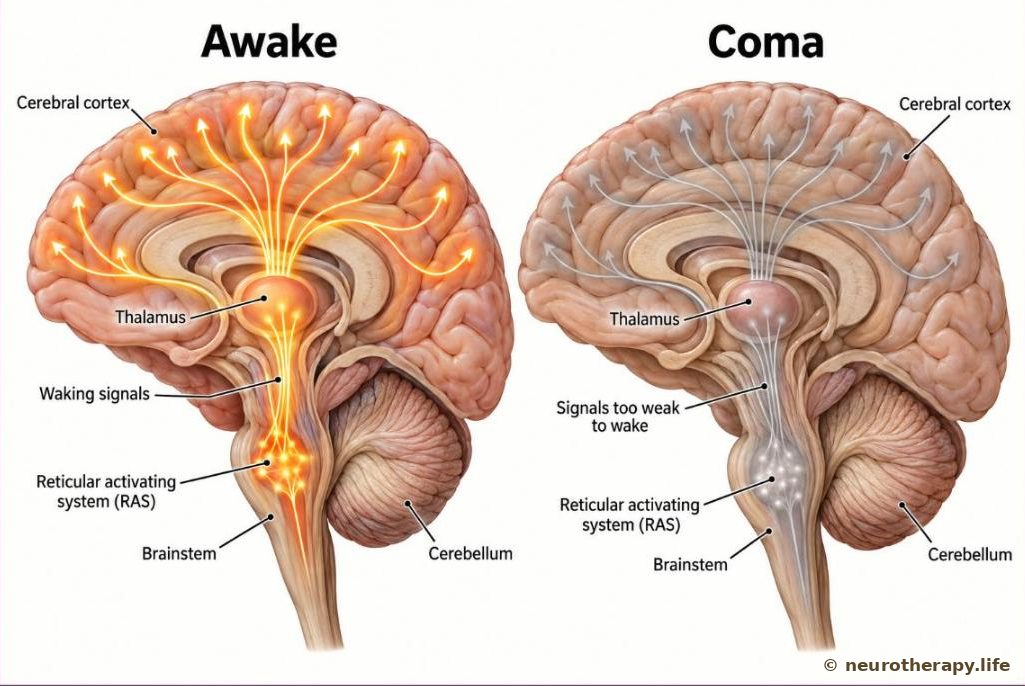
Staying awake is not automatic. A network of nerve cells deep in the brainstem, called the reticular activating system (RAS), keeps sending “wake up” signals to the rest of the brain. Both halves of the brain must be able to receive them.
When an injury, a stroke, an infection, a poison or a big change in the body's chemistry disturbs this system, alertness drops. First comes confusion and drowsiness. Coma is the deepest level — the person cannot be woken and cannot respond.
What are the symptoms?
- Eyes closed; the person cannot be woken
- No response to pain, touch or a loud voice
- No speech and no sign of awareness
- No movement except reflexes
- Breathing may be irregular
- Warning signs before it: growing confusion, heavy drowsiness, being hard to wake
What causes it, and who is more likely to get it?
Brain
- Head injury
- Stroke — a blocked or burst blood vessel in the brain
- Infection of the brain or its coverings (meningitis, encephalitis)
- Seizures, or a brain tumour
Body chemistry and organs
Poisons and temperature
- Drug overdose, heavy alcohol, or toxic gas
- Heat stroke, or a body far too cold
How is it found?
In coma, doctors treat and test at the same time — keeping breathing and blood pressure safe while they search for the cause.
Glasgow Coma Scale
A bedside score of how the eyes, movements and speech respond, from 3 to 15.
Blood and urine tests
Sugar, salts, kidney and liver function, oxygen and acid levels in the blood, and a check for drugs or poisons.
CT or MRI scan
Pictures of the brain to look for bleeding, a stroke, swelling or a tumour.
EEG and ECG
EEG records the brain's electrical activity; ECG checks the heart's rhythm.
A person in coma belongs in hospital, not on a treatment mat. If a trained neurotherapist is later asked to help alongside the doctors, the first thing read is the kidney report — the creatinine — because in LMNT it decides which points must be left out.
How Neurotherapy (LMNT) sees Coma
LMNT reads coma through two lenses: the brain's waking system, and the body's acid–alkali balance. Guruji's teaching points out that blood is held between pH 7.36 and 7.44. At the acid end the body slows, dulls and shuts down — and a pH that falls far enough brings coma. Anything near those numbers is a hospital emergency, never a patient waiting on the mat.
Three clocks guard the blood's pH
- Buffers in the bloodsoak up extra acid within seconds
- Lungsbreathe out carbon dioxide within minutes
- Kidneysreclaim the body's own antacid and send acid out in the urine, over hours and days
- Blood pHstays near 7.4 when all three work
- Braindulls towards coma when the blood turns far too acidic
The one coma treatment in Guruji's teaching is a stripped-down acid formula. It is taught not for general use, but as the clearest example of a formula changed to suit the organs of the person in front of you — given only alongside hospital care.
Neurotherapy (LMNT) treats according to the condition of the body.
Neurotherapy (LMNT) treatment for Coma, step by step
Hospital first
Call 108/112. A person who cannot be woken is treated by doctors first. Neurotherapy (LMNT) is never first aid for coma.
Read the kidney report
Before anything is given, the therapist reads the creatinine and the kidney findings. When both kidneys have failed, the kidney points Liv° and Mu° are left out.
The coma treatment
(8) Pan (1) Gal (2) acid (4) Lt. Ch. Only — an acid formula with Mu° left out. Given only by a trained therapist, alongside the doctors' care.
The waking system
In LMNT, (8) Medulla is named for when the brain's waking system (the RAS) is disturbed — but never where there is inflammation, cancer or high blood pressure.
After an adrenaline injection
Where the adrenal gland is running too fast, as after an adrenaline injection, LMNT names the Thymus point. The therapist decides this with the full picture.
Points and formulas used
Coma treatment — (8) Pan (1) Gal (2) acid (4) Lt. Ch. Only
A light acid formula, changed for failed kidneys — the kidney point Mu° is left out on purpose.
Works through
Open →Never do this
- Coma is an emergency. Call emergency services (108/112) immediately. LMNT works best alongside your existing medical care — always call emergency services first. Stay with the person until help arrives.
- Any LMNT treatment is given only alongside hospital care, by a trained therapist, with the doctors' agreement — never instead of it, and never at home by the family.
- Kidney failure: the kidney points Liv° and Mu° are not stimulated. Read the creatinine report first. Mu°
- (8) Medulla is never given where there is inflammation, cancer or high blood pressure. (8) Medulla
- The coma treatment is not a formula for general use. It was changed for one person's organs, and is taught as an example of how to do that.
- Cancer: if the person has cancer, (10) Pan, Thymus, Pit, Lu + Sh, Rt. Ov / Lt. Ov and (30) Medulla are never given — the therapist changes the plan.
- Keep taking the medicines your doctor prescribed. Neurotherapy (LMNT) works alongside your medical care, never instead of it.
From practice
The patient in coma whose kidneys had failed
Recorded in the therapy's own account, in Guruji's own words — the patient's name was not recorded
An adult · in coma · both kidneys failed, creatinine very high
- What was found
- The kidney report came first. Because both kidneys had failed, the kidney point Mu° was left out of the acid formula.
- What was done
- The coma treatment — (8) Pan (1) Gal (2) acid (4) Lt. Ch. Only — was given twice. The recorded blood pH moved from 7.32 to 7.4.
- What it teaches
- Guruji himself added the honest line: this patient had gone into coma from some other cause. No claim is made that the formula woke him. The habit to copy is reading the kidney report before deciding what to leave out.
From Ayurveda and the kitchen
Test yourself
What research says
- Strong evidence
Blood pH is normally held between 7.35 and 7.45. The enzyme carbonic anhydrase in red cells joins carbon dioxide and water; the lungs adjust pH within minutes and the kidneys over days.
Hopkins E, Sanvictores T, Sharma S. Physiology, Acid Base Balance. StatPearls. 2022.
- Strong evidence
The reticular activating system — the brain's waking network, which LMNT links to (8) Medulla — is responsible for arousal, attention and the sleep–wake cycle.
Arguinchona JH, Tadi P. Neuroanatomy, Reticular Activating System. StatPearls. 2023.
No clinical trial of Neurotherapy (LMNT) in coma has been published yet. Improvements reported by neurotherapists are clinical observations.
For you
Families
Ask the doctors what caused the coma and keep every report — the kidney report above all. Tell any therapist who is asked to help exactly what the hospital has found.
People with diabetes
Blood sugar that is far too low or far too high can lead to coma. Know the warning signs — confusion, heavy drowsiness — and get help early.
People with kidney or liver disease
When these organs fail, waste builds up and can dull the brain. Keep your follow-ups, and tell your therapist about every report.
This page explains; it does not diagnose. Neurotherapy (LMNT) works alongside your medical care — keep taking the medicines your doctor prescribed, and see a doctor for any new or severe symptom.