Cerebellar ataxia (loss of balance)
Ataxia means the body's movements lose their smooth aim. Walking becomes unsteady, hands grow clumsy and speech may slur. Cerebellar ataxia comes from trouble in the cerebellum — the part at the back of the brain that coordinates movement and balance.
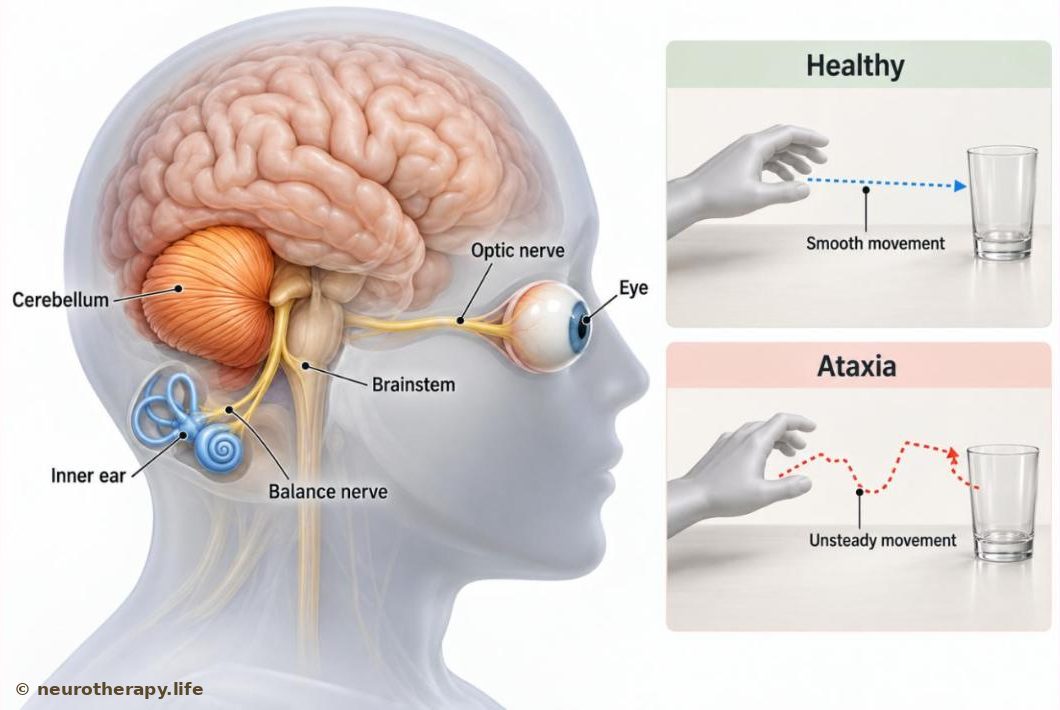
- Ataxia is not one disease — it is a loss of coordination, most often from damage to the cerebellum
- In young children, sudden ataxia often follows a viral illness such as chickenpox, and usually clears within months
- Friedreich's ataxia is the most common inherited type
- Unsteadiness that starts suddenly needs urgent medical care
Source: NHS; MedlinePlus; NINDS
What is Cerebellar ataxia (loss of balance)?
The cerebellum is a fist-sized part at the back of the brain. It does not make the muscles strong — it makes them accurate. It compares what the body meant to do with what the eyes and the inner ear report, and corrects each movement as it happens.
When the cerebellum or its pathways are damaged, strength and intention are still there, but the steering between them is lost. Ataxia may come on suddenly — after a stroke, an injury, an infection or poisoning — or slowly over years, as in inherited ataxias. It is not weakness, and it is not the shaking that happens at rest.
What are the symptoms?
- An unsteady, wide-legged walk, swaying and frequent falls
- Clumsy hands — trouble writing, eating, doing buttons; the hand overshoots when reaching
- Slow, slurred or jerky speech
- Jerky eye movements, blurred or double vision
- Trouble swallowing in some people
What causes it, and who is more likely to get it?
Sudden causes
- A stroke or bleeding in the brain
- A head injury
- An infection, or the after-effect of a viral illness such as chickenpox (mostly in young children)
- Alcohol or drug poisoning
Slower causes
- Multiple sclerosis or a brain tumour
- Lack of vitamins such as B12 or E
- Long-term heavy drinking
How is it found?
Doctors first find out whether the ataxia came on suddenly or slowly, then look for the cause with an examination, scans and tests.
Nerve examination
The doctor watches the walk, asks the person to touch finger to nose, and checks the eyes, speech and reflexes.
MRI or CT scan of the head
Shows a stroke, bleeding, a tumour, or shrinking of the cerebellum.
Blood tests
Look for infection and for missing vitamins.
Genetic test and spinal tap
A genetic test can confirm an inherited ataxia; a spinal tap checks the fluid around the brain for infection or inflammation.
A neurotherapist first asks how the unsteadiness began. If it came on suddenly, or with vomiting, headache, double vision or slurred speech, the person is sent to hospital that day, not treated on the mat. Otherwise the therapist reads the doctor's reports, checks the blood pressure, and asks about any inflammation or cancer, because these decide whether (8) Medulla may be given.
How Neurotherapy (LMNT) sees Cerebellar ataxia (loss of balance)
In LMNT, ataxia is worked through the Medulla family — treatments given at the back of the neck, below the ears, each number reaching a different nerve of the head. For cerebellar ataxia Guruji's teaching gives two: (2) Medulla and (8) Medulla. Balance needs signals from the eyes, carried by the 2nd cranial nerve, and from the balance organ of the inner ear, carried by the 8th — so both numbers are given.
How LMNT teaching reads balance
- The eyesSignals from the eyes travel along the 2nd cranial nerve
- The inner earSignals of balance travel along the 8th cranial nerve
- The cerebellum and brainstemTogether they keep the body upright and its movements steady
- GABALMNT teaching infers that (2) Medulla raises GABA, which stops unnecessary movements of the limbs
- Serotonin for the legs(8) Medulla is given because serotonin is needed to stimulate the legs
Guruji's teaching reports that patients with ataxia have obtained considerable relief from (2) Medulla, and parents of children with ataxia report a real improvement in the quality of daily life. It also marks its own open questions: whether this treatment reaches the pons of the brain is, in its own words, still being researched.
Whether or not the patient gets immediate benefit from our treatment, let no harm reach him through our carelessness — attend to this.
Neurotherapy (LMNT) treatment for Cerebellar ataxia (loss of balance), step by step
Sudden or slow? Decide first
Unsteadiness that came on suddenly, or with vomiting, headache, double vision or slurred speech, goes to hospital that day. Only long-standing ataxia, already seen by a doctor, comes to the mat.
Examine first
The therapist reads the doctor's reports, does the usual navel examination (Liv° and Mu°), checks the blood pressure, and asks about inflammation and cancer.
(2) Medulla, in rounds
Given seated, at both sides of the neck below the ears — two applications of six seconds. '× 6 treatments' means six rounds, with one and a half minutes of rest between them, not twelve presses in a row.
Then the back of the head, for eyes and speech
Where the eyes or speech are affected, the rubbing (ghisai) of Brodmann's areas 17 and 18 at the back of the head follows the (2) Medulla — always after it, never alone.
(8) Medulla, where it is allowed
(8) Medulla is added for the cerebellum, the balance nerve and serotonin — only if there is no high blood pressure, inflammation or cancer.
Points and formulas used
(2) Medulla
The smallest Medulla — for the 2nd cranial nerve from the eyes; LMNT teaching reports considerable relief from it in ataxia and Parkinson's.
Open →(8) Medulla
For the 8th cranial nerve of hearing and balance, the cerebellum and the making of serotonin.
Open →Brodmann's Area 17 & 18 Ghisai
Rubbing at the back of the head, given right after (2) Medulla where the eyes or speech are affected.
Open →Never do this
- (8) Medulla is never given where there is inflammation, cancer or high blood pressure. The therapist changes the plan. (8) Medulla
- Unsteadiness that comes on suddenly — or comes with vomiting, headache, double vision, slurred speech, or weakness of one side — is a matter for a hospital that day, not for a Neurotherapy (LMNT) mat. It may be a stroke or bleeding in the brain. Stroke, or a passing weakness, numbness or loss of vision, within three months
- Inherited and slowly worsening ataxias are lifelong. Neurotherapy (LMNT) does not reverse them; it may support comfort, balance and daily function, with reported improvement. Keep the doctor, physiotherapy, occupational therapy and speech therapy going — never in place of them.
- A person with ataxia falls easily. Treat seated or lying, with someone close by when getting up.
- Children get half the adult dose and light treatment only, given by a trained therapist.
- Cancer: if the person has cancer, (10) Pan, Thymus, Pit, Lu + Sh, Rt. Ov / Lt. Ov and (30) Medulla are never given — the therapist changes the plan.
- Keep taking the medicines your doctor prescribed. Neurotherapy (LMNT) works alongside your medical care, never instead of it.
From Ayurveda and the kitchen
Test yourself
What research says
- Emerging evidence
This review pooled 18 trials with 398 people. Physiotherapy — especially balance training, combined training programmes and aerobic exercise such as cycling — was safe and reduced ataxia a little, but the certainty of the evidence was very low. It is a reason to keep exercising, and a reminder that more research is needed.
No clinical trial of Neurotherapy (LMNT) in cerebellar ataxia has been published yet. Improvements reported by neurotherapists are clinical observations.
For you
People living with ataxia
Keep up balance exercises every day, as your physiotherapist shows you. Make the home safe — good light, hand rails, no loose rugs — and use a stick or frame if advised.
Parents
If a child becomes suddenly unsteady — even after a simple viral illness — see a doctor the same day. Tell the therapist about every change you notice in walking, writing and speech.
Everyone
Avoid heavy drinking, and have vitamin levels checked if your doctor advises. Sudden unsteadiness is always an emergency until proved otherwise.
This page explains; it does not diagnose. Neurotherapy (LMNT) works alongside your medical care — keep taking the medicines your doctor prescribed, and see a doctor for any new or severe symptom.