Stammering (stuttering) and lisping
Stammering is when the flow of speech keeps getting broken — sounds are repeated, stretched or get stuck. It usually starts in early childhood, and most children grow out of it.
- 5 to 10 of every 100 children stammer at some point
- About 75% of children who stammer get better as they grow
- Boys are 2 to 3 times as likely to stammer as girls
Source: NIDCD (US National Institutes of Health); MedlinePlus; StatPearls (Hussain & Lui, 2024)
What is Stammering (stuttering) and lisping?
Stammering (also called stuttering) is a speech problem in which the smooth flow of words keeps breaking. A person may repeat a sound (“b-b-ball”), stretch it (“sssun”), or get stuck with no sound coming out at all — this is called a block.
Most stammering begins in young children while they are learning to talk, and most of them grow out of it. Less often it starts in an adult after a stroke or a head injury. A lisp is different: a sound such as “s” comes out wrong — for example “th” in place of “s” — because of where the tongue is placed.
What are the symptoms?
- Repeating a sound, a syllable or a whole word
- Stretching a sound for too long
- Getting stuck, with no sound coming out (a block)
- Blinking fast, trembling lips or a nod while trying to speak
- Worse when tired, excited, rushed or on the phone
- Avoiding certain words or speaking in a group
What causes it, and who is more likely to get it?
Growing up
- Young age, while speech and language are still developing
- Being a boy
Family and brain
- Stammering in the family — genes play a part
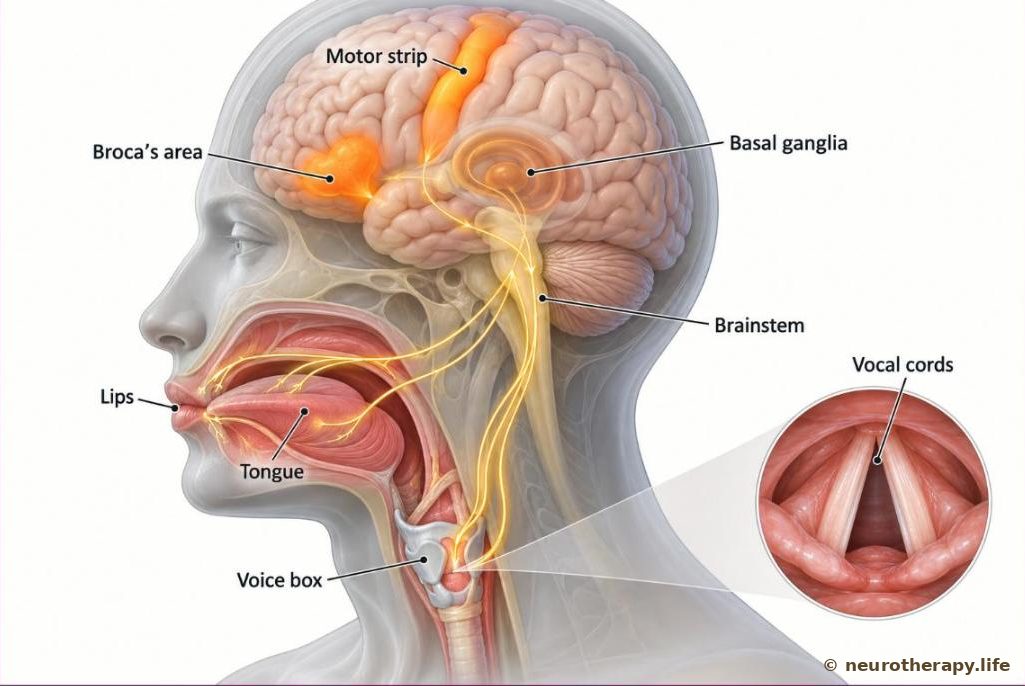
- Small differences in how the brain's speech areas work together
Starting later in life
How is it found?
Stammering is assessed by a speech and language therapist, who listens to the person speak and asks about the history.
Speech assessment
The therapist counts and notes the repeats, stretches and blocks while the person talks and reads, and sees how much it affects daily life.
History
When it began, whether it has lasted more than six months, whether anyone in the family stammers, and whether there are other speech problems.
When to get a child checked
If a child has stammered for 3 to 6 months, struggles or strains while speaking, or has stammering in the family.
A neurotherapist looks first at digestion: how the stools come, and whether the Gas point and the kidney points Liv° and Mu° are painful. In LMNT the speech work waits until digestion has been set right.
How Neurotherapy sees Stammering (stuttering) and lisping
In LMNT, stammering is not treated at the mouth first. Guruji's teaching gives the Alkali Treatment Formula (ALTF) for stammering and lisping — but only after the undigested-food (UDF) treatment has been given, the stool comes properly, and the pain at the Gas point has gone.
The order LMNT follows
- DigestionUndigested food is cleared first with UDF.
- Stool and GasThe stool must come properly and the Gas point must stop hurting.
- BalanceOnly then is ALTF given, on the alkali side.
- SpeechLMNT's speech work — Hammering on the left forehead — supports the brain's speech area.
The left side is chosen on purpose. LMNT teaching places speech on the left side of the brain, in Broca's area, and so for impaired speech the tapping and the Speech point are given above the left temple — the same side that modern brain science links to speech.
The coming of UDF is itself a chief cause of the coming of the great diseases.
Neurotherapy treatment for Stammering (stuttering) and lisping, step by step
Examine first
The therapist checks the diagnostic points Liv° and Mu°, the Gas point, and asks how the stools come. For a child, ask for the speech therapist's assessment too.
Set digestion right: UDF
The undigested-food treatment comes first, until the stool comes properly and the pain at the Gas point has gone.
Then ALTF
The Alkali Treatment Formula — Guruji's formula for stammering and lisping — is given only after the digestion step is done.
Speech support on the left side
For impaired speech, LMNT gives Hammering — light tapping through a towel — especially on the left side of the forehead, and the Speech point above the left temple, to stimulate Broca's area. (2) Medulla followed by Brodmann ghisai at the back of the head is also taught for problems of speech.
Points and formulas used
ALTF (chief form)
The Alkali Treatment Formula, given in LMNT for stammering and lisping once digestion is right.
Open →Hammering
Light tapping on the head to improve blood flow in the brain — on the left forehead for speech.
Open →(2) Medulla
Followed by Brodmann's area 17 & 18 ghisai — taught in LMNT for problems of the eyes and of speech.
Open →Never do this
- Speech that suddenly becomes slurred, thick or stuck in an adult — especially with a drooping face or a weak arm — can be a stroke. Call an ambulance (108/112) at once; minutes matter.
- ALTF is not given until UDF has been given, the stool comes properly and the pain at the Gas point has gone. ALTF (chief form)
- Hammering is light, through a cloth, with the pads — never the nails — and never over the ear. It is not given after a recent head injury, over a plate, shunt or skull defect, or where fits are poorly controlled. Hammering
- Children get half the adult dose and light treatment only, given by a trained therapist.
- Cancer: if the person has cancer, (10) Pan, Thymus, Pit, Lu + Sh, Rt. Ov / Lt. Ov and (30) Medulla are never given — the therapist changes the plan.
- Keep taking the medicines your doctor prescribed, and keep up speech therapy. Neurotherapy works alongside your medical care, never instead of it.
Watch

A step-by-step demo of the full UDF (undigested food) treatment: 15 Medulla, Parkhoo at both hips, Half Kundli, 10 Medulla with 1 Gas Only and 1 Gas 'I', then the Gal, Spleen, Liver and Mucus points and Ajay Normal on the thighs and forearms. It is given to support digestion when food passes through undigested.
The UDF treatment for undigested food — the step LMNT gives before ALTF in stammering.
From Ayurveda and the kitchen
Test yourself
What research says
- Strong evidence
Developmental stammering affects 5–10% of preschool children, and 65–87% of young children recover. Only about 1% of adults keep stammering. When stammering comes from brain damage, the left side of the brain — the side that usually handles language — is affected more often than the right.
Hussain SAS, Lui F. Stuttering (Stammering). StatPearls. 2024.
No clinical trial of Neurotherapy in stammering has been published yet. Improvements reported by neurotherapists are clinical observations.
For you
Parents
Listen calmly, give your child time, and do not finish their words for them. If it lasts more than 3 to 6 months, see a speech therapist.
Children
Only light treatment at half the adult dose, from a trained therapist — alongside speech therapy, not instead of it.
Adults
Stammering that starts suddenly in adult life needs a doctor first, to look for a cause in the brain.
This page explains; it does not diagnose. Neurotherapy works alongside your medical care — keep taking the medicines your doctor prescribed, and see a doctor for any new or severe symptom.