Avascular necrosis (AVN)
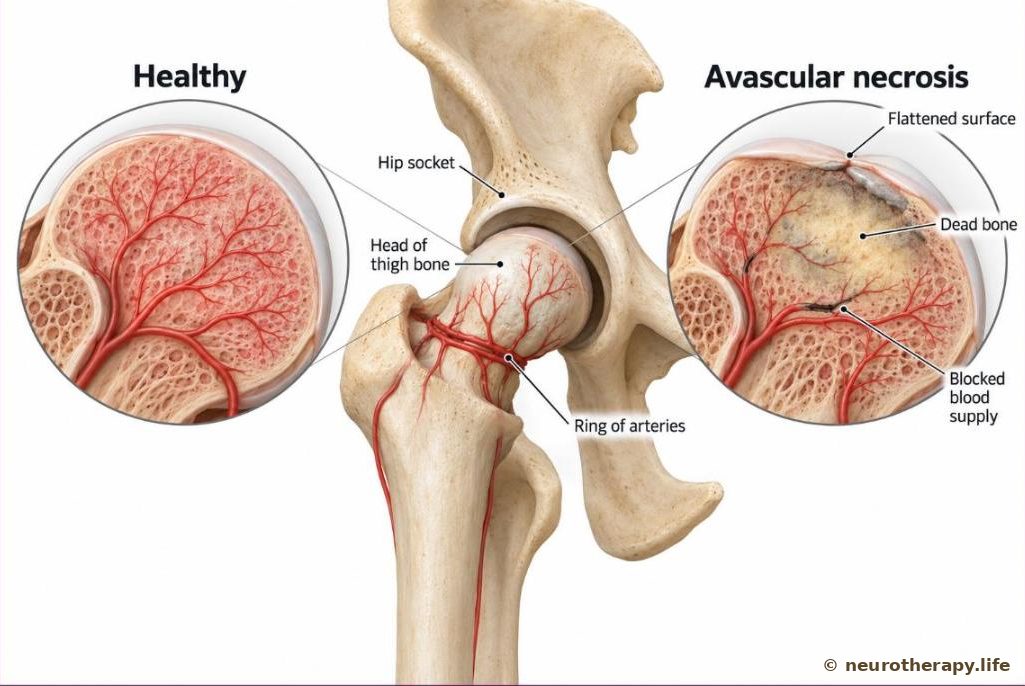
In avascular necrosis, part of a bone stops getting enough blood and slowly dies. It most often hits the ball of the hip joint, and can lead to the bone collapsing.
- About 10,000 to 20,000 new cases of hip AVN are reported each year in the United States alone
- Men are affected 3 to 5 times more often; most people treated are in their 30s
- Long-term steroids and heavy alcohol are behind more than 80% of cases not caused by injury
Source: StatPearls — Femoral Head Avascular Necrosis (Barney, Piuzzi & Akhondi, 2023); Cleveland Clinic; MedlinePlus
What is Avascular necrosis (AVN)?
Bone is living tissue and needs a steady blood supply. In AVN — also called osteonecrosis — the blood flow to one part of a bone is blocked. Without blood, the bone cells in that part die.
The ball of the hip joint is the most common place, followed by the shoulder and knee. At first there may be no pain. Over months, the dead bone can crack and the ball can flatten, and the joint wears out.
What are the symptoms?
- Often no symptoms in the early stage
- Pain in the groin, hip or thigh, worse on walking and climbing stairs
- Later, pain even at rest
- Stiffness and less movement in the joint
- A limp
What causes it, and who is more likely to get it?
Medicines and habits
- Long-term or high-dose steroid medicines
- Heavy alcohol use
- Smoking
Injury
- A broken hip or thigh-bone neck
- A dislocated joint
Blood and other conditions
- Sickle cell disease and blood-clotting disorders
- Lupus and HIV
- Radiation, chemotherapy or transplant medicines
- Sometimes no cause is found
How is it found?
AVN is found with imaging. An early X-ray can look normal, so a doctor who suspects it will usually ask for an MRI.
MRI
The best test. It shows dead bone early, before the X-ray changes, and how much of the ball is affected.
X-ray
Often normal at first. Later it shows the flattened ball and the worn joint.
Bone scan or CT
Used in some cases to see blood flow and cracks in the bone.
A neurotherapist asks for the MRI report and about every steroid tablet or injection you have taken. Before choosing a formula, the therapist checks the pain point Mu° — the answer decides which formula is given.
How Neurotherapy sees Avascular necrosis (AVN)
LMNT teaching reads AVN as a blood-supply problem: the bone is dying because blood is not reaching it. So the work is not aimed at the hip itself but at the blood — its flow, and the small clots that block it. AVN is named among the conditions where P. Heparin, the formula for blood circulation, gives benefit.
But a named disease does not choose the formula by itself — the pain point does. Many people with AVN have pain at Mu°. Where Mu° is tender, LMNT gives A. Heparin instead of P. Heparin.
Whenever there is an obstruction or blockage in the blood circulation of any part of the body, then pain or numbness is felt in that part.
Neurotherapy treatment for Avascular necrosis (AVN), step by step
Check Mu° first
The therapist presses the pain point Mu° before choosing anything, and reads the MRI report and your list of medicines.
No pain at Mu°: P. Heparin
(8) Pan, (7) Liv and (8) Ch. Only — the Heparin formula for blood circulation and small clots.
Pain at Mu°: A. Heparin
The same base with the Acid point and (6) Adr added — given instead of P. Heparin when Mu° is tender.
Points and formulas used
Never do this
- No Heparin formula while a wound is open — for example, after an operation, until it has healed.
- Pan is not given in fits, convulsions or seizures except inside a Heparin formula, and never to people with schizophrenia. Liv is not given in liver cancer; Ch. Only not in lung cancer. Pan
- If you feel pins and needles, tingling or numbness running into the hand during Liv, say so — the therapist releases at once and repositions. Numbness is not a sign the point is working. Liv
- A. Heparin contains (6) Adr, which is not given in high blood pressure or where immunity is already low (septicaemia, cancer, AIDS). (6) Adr
- Sudden severe hip pain, pain after a fall, or not being able to put weight on the leg: see a doctor the same day.
- If you take steroids, never stop them on your own — sudden stopping can be dangerous. Tell your doctor and your therapist.
- Cancer: if the person has cancer, (10) Pan, Thymus, Pit, Lu + Sh, Rt. Ov / Lt. Ov and (30) Medulla are never given — the therapist changes the plan.
- Keep taking the medicines your doctor prescribed. Neurotherapy works alongside your medical care, never instead of it.
Watch

Shows the P. Heparin formula: (8) Pan at the top of the thighs, (7) Liv on the thigh and forearm, and (8) Chest Only with the palms on the chest. In the video it is given as the last part of the Angina treatment, to support circulation.
How P. Heparin is given — (8) Pan, (7) Liv and (8) Ch. Only.
From Ayurveda and the kitchen
Test yourself
What research says
- Strong evidence
The head of the thigh bone gets its blood mainly from a ring of small arteries around its neck, with little back-up. When that supply fails, the bone dies. Long-term steroids and alcohol cause more than 80% of cases not due to injury; MRI is the best test.
Barney J, Piuzzi NS, Akhondi H. Femoral Head Avascular Necrosis. StatPearls. 2023.
No clinical trial of Neurotherapy in avascular necrosis has been published yet. Improvements reported by neurotherapists are clinical observations.
For you
People on long-term steroids
New hip or groin pain is worth reporting to your doctor early. Do not stop the steroids yourself.
After a hip fracture or dislocation
AVN can appear months later. Keep your follow-up visits and scans.
People who drink heavily
Alcohol is one of the two biggest causes. Cutting down protects the other hip too.
This page explains; it does not diagnose. Neurotherapy works alongside your medical care — keep taking the medicines your doctor prescribed, and see a doctor for any new or severe symptom.