Asthma
Asthma is a long-term lung condition in which the small airways swell and narrow, causing wheezing, cough, chest tightness and breathlessness. Attacks can come slowly or suddenly, and a severe one is an emergency.
- About 363 million people had asthma in 2023
- It caused about 442,000 deaths that year — most in low- and lower-middle-income countries
- The most common long-term disease among children
Source: World Health Organization; MedlinePlus
What is Asthma?
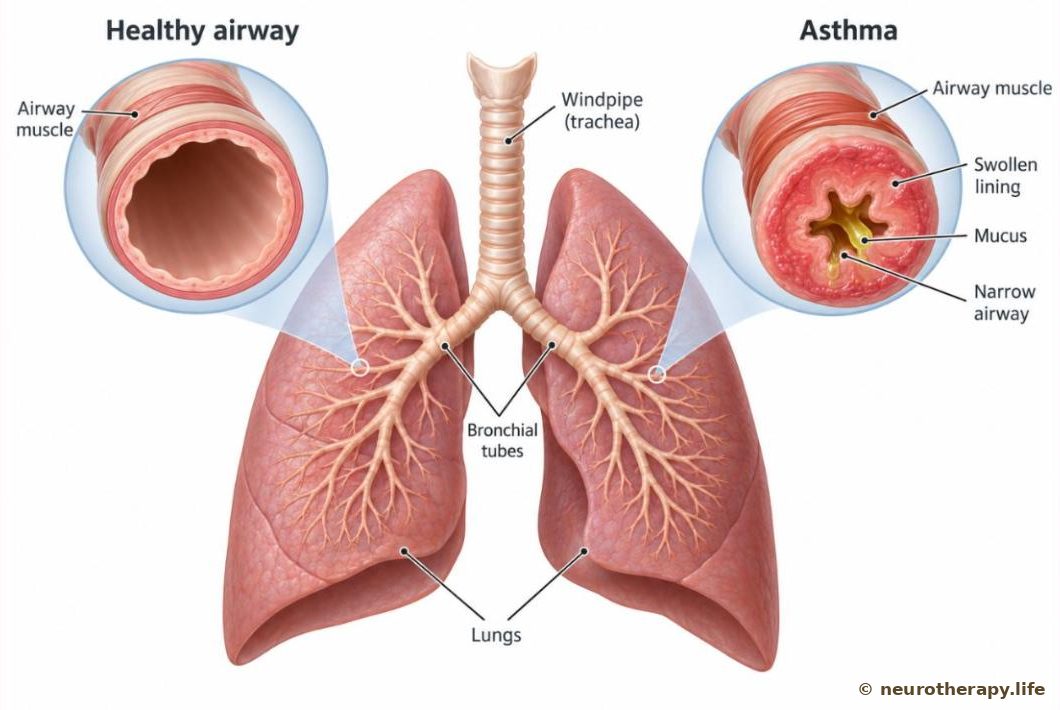
Air reaches your lungs through a tree of tubes that get smaller and smaller. In asthma, the lining of these airways is inflamed and over-sensitive. When it meets a trigger — dust, smoke, cold air, a cold — the lining swells, the muscle around the tube tightens, and sticky mucus is made.
All three make the tube narrower. Air must squeeze through, which gives the whistling sound called a wheeze, and breathing out becomes hard work. Between attacks, many people feel quite normal.
What are the symptoms?
- Wheezing — a whistling sound when breathing out
- Cough, especially at night or early morning
- Shortness of breath
- Tightness in the chest
- Symptoms worse with exercise, cold air or a cold
What causes it, and who is more likely to get it?
Allergy triggers
- House dust mites and mould
- Pollen and pet fur
Air and weather
- Cold air and changes in weather
- Tobacco smoke, fumes, air pollution and strong perfumes
Family and body
- A parent with asthma
- Other allergies, and being overweight
- Smoke around a child before or after birth
How is it found?
Asthma is diagnosed from your symptoms, an examination and breathing tests.
Spirometry
You blow hard into a tube; it measures how much air you can breathe out and how fast.
Peak flow
A small hand meter for the fastest breath out — useful for tracking asthma at home.
FeNO test
Measures a gas in your breath that rises when the airways are inflamed.
Allergy tests
Skin or blood tests to find what sets off your asthma.
A neurotherapist asks about your inhaler, and also about blood pressure, sugar and the heart — because each of these changes which points may be given. Breathlessness from a weak heart ("cardiac asthma") is not asthma, and needs a heart doctor.
How Neurotherapy (LMNT) sees Asthma
In Neurotherapy (LMNT), an asthma card is not an empty card — but it starts with what is not given. Spl, Thrd and Gal are blocked, because with them the trouble has been seen to increase. Then the breath is reached from the back, the neck and the arm rather than from the chest: (6) Left Swt to open narrowed passages, (30) Medulla for quick relief, and Electrical Waves and Stretch to relax the neck muscles.
How a chest infection becomes an asthma problem
- Infectiongerms settle in the lungs
- Eosinophilsthese white blood cells rise in number
- Chemicalsthey release substances that tighten the airways
- Narrow airwayswheeze, cough and breathlessness follow
For this bronchial kind of asthma — bronchitis — LMNT teaching gives (6) Right Swt. The side is part of the point: Guruji taught that Right and Left Swt do opposite things, so a card that says "Swt" without a side is sent back.
Neurotherapy (LMNT) treats according to the condition of the body.
Neurotherapy (LMNT) treatment for Asthma, step by step
Examine first
The therapist checks Liv° and Mu°, asks about your inhaler, blood pressure, sugar and heart, and about the bowel — many asthma patients are also constipated.
Mark what is blocked
Spl, Thrd and Gal are written off on the card before anything else. (1) Single point liver × 6 treatments is given along with the other treatments.
Open the airways
(6) Left Swt, beside the spine, opens narrowed passages and is given for difficulty in breathing. (30) Medulla is recorded as giving immediate relief, and (5) Medulla is used for the asthma cough.
From the neck and the arm
Electrical Waves — stroking down the side of the neck from behind the ear — and Stretch, from the fingertips, both relax the neck muscles. Both are named excellent for asthma.
Bronchial asthma
Where asthma comes with bronchitis, (6) Right Swt is given — face down, with one and a half pillows under the chest.
Points and formulas used
(6) Right Swt
For bronchial asthma (bronchitis): six presses with the edge of the hand beside the T6–T12 beads of the back, on the right side.
Open →Never do this
- Spl, Thrd and Gal are not given — with Spl and Thrd the trouble increases, and Gal can increase inflammation in the lungs. Gal
- (4) Thrd is not given — the cough increases. (4) Thrd
- (6) Left Swt is not given to people with diabetes. (6) Right Swt is not given to people with high blood pressure. (6) Left Swt
- Electrical Waves runs downward behind the big strap muscle of the neck — never forward onto its front edge, over the great artery to the brain. Electrical Waves
- An asthma attack that is getting worse, or not easing with the reliever inhaler, is an emergency — call 108/112. Breathlessness that wakes you at night, stops you lying flat, or comes with swollen ankles may be the heart: see a doctor soon.
- Cancer: if the person has cancer, (10) Pan, Thymus, Pit, Lu + Sh, Rt. Ov / Lt. Ov and (30) Medulla are never given — the therapist changes the plan.
- Keep taking the medicines your doctor prescribed, and keep your inhaler with you. Neurotherapy (LMNT) works alongside your medical care, never instead of it.
Watch

This video shows the LMNT Oxygen formula, shared as support alongside medical care for asthma, breathlessness and low oxygen.
Note: keep your inhaler with you and use it as your doctor advised.
From practice
The blocks that came off in November
A teaching case — a composite from practice, not one patient's file
38 years · asthma for eleven years, worst every monsoon, and constipation
- What was found
- In June her card blocked Spl, Thrd and Gal for the asthma, and Gas Only, (10) Medulla and Dys for the constipation, with each reason written beside it. (1) Single point liver × 6 was given with the other treatments. Six weeks in, the bowel had changed completely — the chest had not.
- What was done
- The therapist added no force and no points. She re-examined from the beginning and asked about the room, the bedding and the sleep: a mattress aired once a year, and a bedroom window kept shut at night for years. By September she went through the monsoon without a night she could not lie down; by November she needed her inhaler far less.
- What it teaches
- The asthma line was not rubbed off the card. A new, dated line was written under it: Gal un-blocked for the skin and bowel work, Spl and Thrd still blocked pending review. A block is lifted with care, and in writing.
From Ayurveda and the kitchen
Test yourself
What research says
- Strong evidence
Eosinophils, a kind of white blood cell, release substances that inflame the airways and make their muscle contract — the chain LMNT teaching describes for bronchial asthma.
No clinical trial of Neurotherapy (LMNT) in asthma has been published yet. Improvements reported by neurotherapists are clinical observations.
For you
Children
Asthma is the most common long-term disease in children. Keep the reliever inhaler at school, and keep smoke away from the home.
People with diabetes or high blood pressure
Tell your therapist — it changes which Swt point can be given: not Left Swt in diabetes, not Right Swt in high blood pressure.
Everyone with asthma
Look at the room you sleep in: air the mattress and bedding in the sun, and let fresh air in at night.
This page explains; it does not diagnose. Neurotherapy (LMNT) works alongside your medical care — keep taking the medicines your doctor prescribed, and see a doctor for any new or severe symptom.