Angina (heart chest pain)
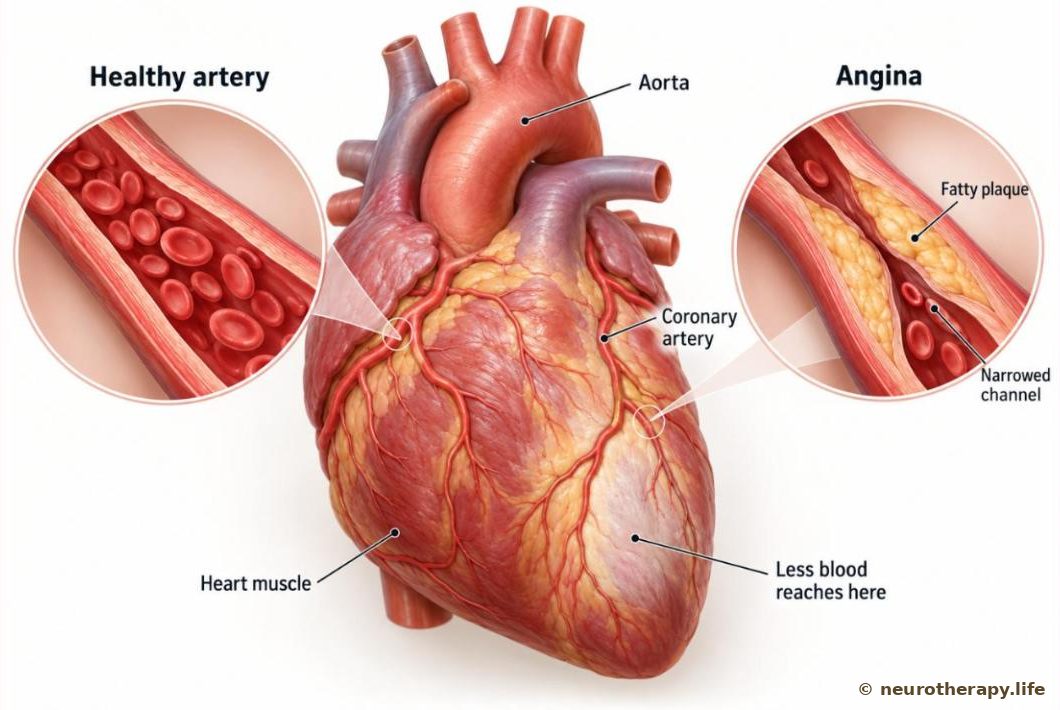
Angina is chest pain or pressure that comes when the heart muscle does not get enough blood, usually because its arteries have narrowed. It is a warning sign of heart disease — and chest pain that does not settle may be a heart attack.
- About 19.8 million people died of heart and blood-vessel diseases in 2022 — about 32% of all deaths worldwide
- 85% of these deaths were from heart attacks and strokes
- More than three-quarters of them happen in low- and middle-income countries
Source: World Health Organization (cardiovascular diseases fact sheet)
What is Angina (heart chest pain)?
The heart is a muscle, and like any muscle it needs its own blood supply. That comes through the coronary arteries on its surface. When fatty plaque narrows these arteries, enough blood gets through at rest — but not when the heart has to work harder. The muscle then runs short of oxygen and hurts. That pain is angina.
Stable angina follows a pattern: it comes with effort, lasts a few minutes and goes with rest or medicine. Unstable angina breaks the pattern — it comes at rest, lasts longer or does not ease — and it means a heart attack may be close. That is an emergency.
What are the symptoms?
- Pressure, tightness, squeezing or a dull ache in the chest
- Pain spreading to the arms, neck, jaw, shoulders or back
- A burning, indigestion-like feeling
- Breathlessness, sweating, nausea or dizziness with the pain
- Brought on by effort, cold wind, a heavy meal or strong emotion
What causes it, and who is more likely to get it?
The heart's arteries
- Narrowing by fatty plaque — coronary artery disease
- Disease of the tiny vessels of the heart
- A sudden spasm that tightens a heart artery
Health conditions
- High blood pressure
- High cholesterol
- Diabetes
- Being overweight, severe anaemia, kidney disease
Habits
- Smoking or tobacco, and too much alcohol
- Too little activity, and food heavy in salt, sugar and fat
Age and family
- Men over 45 and women over 55
- Heart disease in the family
How is it found?
Chest pain is always checked by a doctor first. The doctor asks when the pain comes and how long it lasts, examines you and orders tests of the heart.
ECG
Stickers on the chest record the heart's electrical signals. It can show strain or damage, often in a few minutes.
Blood tests
A troponin test looks for a protein that leaks out of damaged heart muscle. Cholesterol and sugar are also checked.
Coronary angiography
A dye is put into the heart arteries through a thin tube, and X-rays show where they are narrowed.
Heart scans
CT or MRI scans, or a nuclear scan, show the heart and how well blood reaches its muscle.
A neurotherapist does not decide whether chest pain comes from the heart — a doctor does. The therapist asks for your discharge summary, ECG and reports, and about every heart tablet, because the word "angina" on a report changes which points may be given at all.
How Neurotherapy sees Angina (heart chest pain)
In Neurotherapy, a heart patient's card starts with what is not given. The heart list is blocked first, and most blocks carry a substitute. Then comes the Angina / Athero treatment, in four parts, which begins at the neck and the T1/T2 beads of the upper back.
Why an angina treatment begins at the neck
- The heartshort of blood, its nerves send a pain signal
- Upper back segmentsthe signal enters the spinal cord at the upper thoracic level
- Shared cellsthe same cells also carry feeling from the chest wall and inner arm
- Chest, jaw, left armso the heart's pain is felt there
- T1/T2 and Sulta UltaLMNT works on that same segment and the arm it shares
This is support for a stable, medically managed heart patient — alongside the cardiologist and the medicines, never instead of them. Chest pain that is new, worse or at rest is not treated on the mat at all.
Whether or not the patient gets immediate benefit from our treatment, let no harm reach him through our carelessness — attend to this.
Neurotherapy treatment for Angina (heart chest pain), step by step
Examine first — and rule out an emergency
The therapist checks Liv° and Mu°, reads the discharge summary and ECG, and asks about the pain: when it comes, how long it lasts, whether it is new or worse. Any chest pain or suffocation during a session stops the session.
Write the heart blocks on the card
Before any plan: the heart list is blocked, with its substitutes beside it — (2) Thrd for (4) Thrd, (10) Left Medulla for (10) Medulla, J. or P. Heparin for (30) Medulla and G. Heparin, and (1) Single point liver × 6 treatments for (3) Gal (7) Liv.
Part I — the neck and T1/T2
(4) Medulla clockwise with the gathered fingers, then the Up Arrow at T1/T2, then Raman over the shoulders, and (10) Pan with (2) Thrd.
Parts II to IV
(1) Single point liver × 2 treatments; then P. Heparin with Sulta Ulta — or Mild ATF instead, where Mu° hurts and the stool is hard; then A. Heparin with Sulta Ulta.
Sulta Ulta at 135°
Sulta eases pain at the front of the chest, Ulta at the back behind it. In angina the arms are kept a little upward, at 135° — not level with the shoulders — and the left side is given first, the right afterwards.
Points and formulas used
Angina / Athero treatment
The four-part heart treatment — neck and T1/T2, the single liver point, then P. Heparin and A. Heparin, each with Sulta Ulta at 135°.
Works through
Open →P. Heparin (plasmin)
The parent Heparin formula — part III of the Angina treatment, and the one given in heart patients in place of G. Heparin.
Works through
Open →Never do this
- Emergency: chest pain or pressure that lasts more than a few minutes, spreads to the arm, neck, jaw or back, or comes with sweating, breathlessness, nausea or faintness — call 108/112 at once. LMNT is never first aid for a heart attack.
- Angina that is new, worse than before, coming more often, lasting longer or coming at rest needs a doctor the same day — it is not treated on the mat. Breathlessness that wakes you at night, stops you lying flat or comes with swollen ankles needs a heart doctor soon.
- Never in heart patients: (10) Medulla on both sides, (20) Medulla, (30) Medulla, G. Heparin, Lu + Sh, Swt, Katka, Loveleen, Thymus and (4) Thrd. (4) Thrd
- Sulta Ulta only with the arms raised to 135° and one side at a time, left first — never flat, and never both sides together. Sulta Ulta
- The Vater formula waits: a heart patient first gets the Angina treatment only, for two to four days, and only when he is a little better is the heart form of Vater given. Vater Treatment
- Cancer: if the person has cancer, (10) Pan, Thymus, Pit, Lu + Sh, Rt. Ov / Lt. Ov and (30) Medulla are never given — the therapist changes the plan.
- Keep taking the medicines your doctor prescribed, and never stop or cut down a heart medicine on your own. Neurotherapy works alongside your medical care, never instead of it.
Watch

This video shows the right way to give (4) Medulla, Raman and the T1–T2 point for neck and shoulder pain and numbness.

Shows the P. Heparin formula: (8) Pan at the top of the thighs, (7) Liv on the thigh and forearm, and (8) Chest Only with the palms on the chest. In the video it is given as the last part of the Angina treatment, to support circulation.
Parts of the Angina treatment: (4) Medulla, Raman and T1/T2 (part I), and P. Heparin (part III).
From practice
The stent that wrote the plan
A teaching case — a composite from practice, not one patient's file
61 years · retired bus conductor · angina for three years, with one stent · came for weakness and legs that swell by evening
- What was found
- Tiredness, hard stools every third day for years, a coated tongue and marked pain at Mu° made one picture in the acid direction. The evening ankle swelling and the heart history were not folded into it — in a man with known heart disease they belong to his physician as well.
- What was done
- Before anything was planned, the heart list was written on his card, with each substitute beside it: (2) Thrd, (10) Left Medulla, J. or P. Heparin, (1) Single point liver × 6 in place of (3) Gal (7) Liv, and Sulta Ulta at 135° in place of Loveleen. An old kidney report was asked for again through his own doctor, and the ECG he had been carrying in fear was talked through with him.
- What it teaches
- In a heart patient, the discharge summary matters more than anything else in the folder, because it decides what may not be given. The blocks are written first; the plan is built inside them.
From Ayurveda and the kitchen
Hṛdaya — a marma not to be injured
The old surgical texts of Ayurveda sort the body's vital points, the marma, by what happens when they are injured. The heart, hṛdaya, is in the gravest class, sadyaḥ-prāṇahara — "taking life at once". Their most detailed map of the chest is a map of where the body can least absorb a mistake: work here gently, and know where the work stops being yours.
Test yourself
What research says
- Strong evidence
Pain signals from the heart meet pain signals from the body wall on the same nerve cells in the upper back part of the spinal cord. That is why heart pain is felt in the chest, arm and jaw — the segment LMNT's Angina treatment starts from.
No clinical trial of Neurotherapy in angina has been published yet. Improvements reported by neurotherapists are clinical observations.
For you
People with a stent or known angina
Bring your discharge summary, ECG and list of tablets to the first visit. Keep your emergency medicine with you, as your doctor advised.
Women
Heart symptoms in women can be different — more breathlessness, nausea, tiredness or back and jaw pain than classic chest pain. Do not brush them off as gas.
Families
Learn the warning signs and keep 108/112 handy. Cold wind, heavy meals and sudden effort bring angina on — plan walks for the warmer part of the day and eat lighter meals.
This page explains; it does not diagnose. Neurotherapy works alongside your medical care — keep taking the medicines your doctor prescribed, and see a doctor for any new or severe symptom.