Warts
Warts are small, rough, harmless growths on the skin caused by a common virus (HPV). They are most common on the hands and feet, spread by touch, and many go away on their own — especially in children.
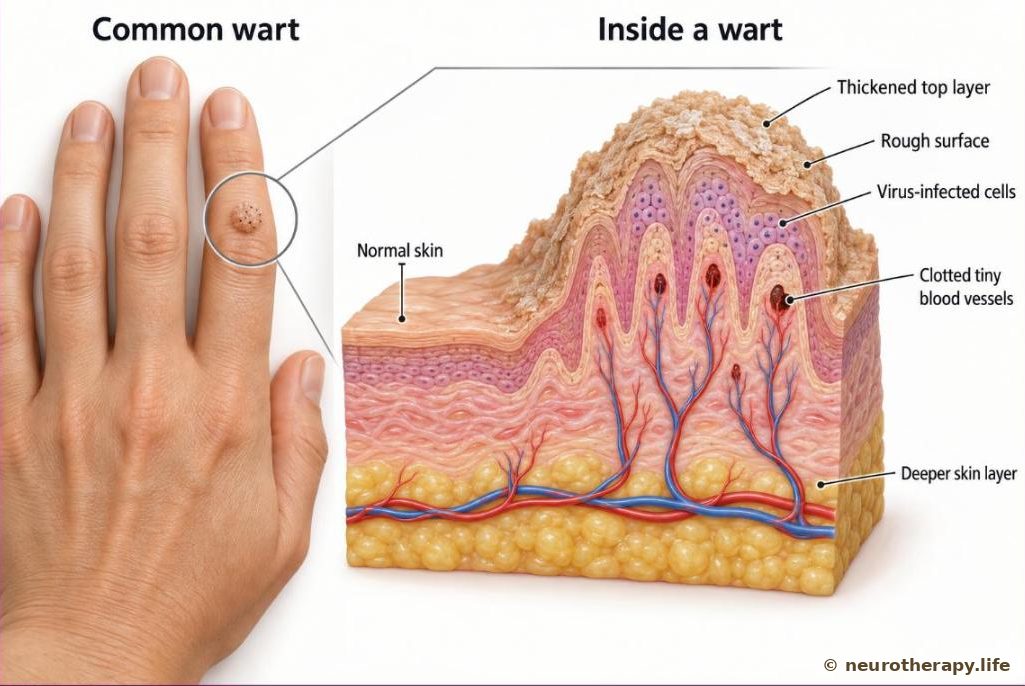
- Warts affect about 10% of people worldwide
- They are more common in school-age children — 10% to 20% of them
- About 65% of warts go away on their own within two years
- More than 100 types of HPV exist; the types that cause skin warts are not the ones linked to cancer
Source: Cleveland Clinic (warts); MedlinePlus (warts); British Association of Dermatologists guideline 2014
What is Warts?
A wart forms when the human papillomavirus (HPV) gets into the top layer of the skin, usually through a tiny cut or scrape. The virus makes the skin cells there grow too fast, and they pile up into a small, hard, rough bump.
Common warts grow on fingers and hands, plantar warts on the soles of the feet, and flat warts where the skin is often shaved. Warts are not cancer. In children they often go away on their own; in adults they tend to stay longer.
What are the symptoms?
- A small, fleshy, grainy bump, usually on fingers or hands
- Rough to the touch
- Tiny black dots on it — clotted small blood vessels
- On the sole of the foot: a hard, flat patch that can hurt when walking
- Several warts close together, or new ones near an old one
What causes it, and who is more likely to get it?
The virus
- Human papillomavirus (HPV), entering through a break in the skin such as a hangnail or scrape
How it spreads
- Touching someone's wart, or sharing towels or razors
- Biting the nails or picking at a wart, which spreads it to nearby skin
- Walking barefoot in shared bathrooms and pool areas
Who is at higher risk
- School-age children and young adults
- People whose immune system is weak
- People who handle raw meat for work
How is it found?
A doctor can usually tell a wart just by looking at it. Tests are needed only when it is unclear what the growth is.
Looking closely
The doctor checks its shape, surface and the tiny black dots, and may gently pare the top layer to see them better.
Skin biopsy
Rarely, a tiny piece is removed and checked under a microscope — for example when a growth bleeds, changes or looks unusual.
A neurotherapist does not treat the wart itself. Mu° on the left flank and Liv° on the right are pressed and compared, the two ring fingers are compared, and you are asked about your stool and how much water you drink — because in LMNT the wart is a sign of what is happening inside.
How Neurotherapy (LMNT) sees Warts
LMNT reads warts through water. Guruji's teaching lists them on the acid side, among the signs of a body short of water — signs that show on the intestine, nose, hair, skin and the other organs that get rid of waste: hard constipation, piles, a blocked nose, dandruff, early grey hair, dry skin, warts or moles, allergy and psoriasis.
Behind the wart, as LMNT reads it
- Too little waterone chief sign of the acid side is a shortage of water in the body
- Hard constipationthe bowel is the first place the dryness shows
- Dry skinthe skin, like the other organs that get rid of waste, dries out
- Warts or molesappear in the same list as dry skin, allergy and psoriasis
- Pain at Mu°the finding on the day that decides whether the acid formula may be given
So LMNT teaching says: when a patient shows you one member of this family, do not treat the member. Look for the constipation standing behind it, and for the water pot standing behind that. The chief treatment for the acid side is the Acid Treatment Formula (ATF) — but only when the examination on that day allows it.
No other drink can be a substitute for water.
Neurotherapy (LMNT) treatment for Warts, step by step
Examine first
The therapist presses Mu° and Liv°, compares the two ring fingers, feels the Acid point, and asks about stool, water and every tablet you take.
The gate: no pain at Mu°, no ATF
ATF is given only when Mu° is clearly painful and Liv° has no pain, or very little. More pain in the left ring finger than the right, and pain on the left side of the body, confirm it — but Mu° decides.
Look behind the wart
Hard constipation and too little water are looked for and worked on, because in LMNT they stand behind the dry-skin family that warts belong to.
Check again at every visit
The Mu° finding is made on the day, by the hand, minutes before treatment. If Mu° is no longer painful, ATF is not given that day.
Points and formulas used
ATF, form (a)
The Acid Treatment Formula — helps the body lower its acid side; given only when Mu° is strongly painful.
Works through
Open →Never do this
- ATF is never given without clear pain at Mu°. If Mu° is not painful on the day, ATF is not given — whatever the complaint. ATF, form (a)
- (6) Adr, at the end of ATF, lowers immunity and raises alkali: it is not given in high blood pressure, septicaemia, AIDS/HIV or cancer. Some people with diabetes feel unwell after it — tell the therapist how you felt. (6) Adr
- Do not cut, burn or pick a wart at home — it can bleed, get infected or spread.
- See a doctor if a growth bleeds, hurts, burns or itches, changes shape or colour, grows or spreads fast, keeps coming back, or appears on the face or genitals — and always if you have diabetes (especially a wart on the foot) or a weak immune system.
- Cancer: if the person has cancer, (10) Pan, Thymus, Pit, Lu + Sh, Rt. Ov / Lt. Ov and (30) Medulla are never given — the therapist changes the plan.
- Keep taking the medicines your doctor prescribed. Neurotherapy (LMNT) works alongside your medical care, never instead of it.
Watch

Shows the Acid Treatment formula step by step: (8) Pan, (3) Gal, (5) Mu°, 3 Acid on the side of the right thigh, (4) Chest Only, and (6) Adr on the upper back, given without breaks. It is used to support the body's acid–alkali balance when acid is raised.
Note: the Acid Treatment formula is given only when the Mu° point is tender, and (6) Adr is not given in high BP, diabetes, cancer or HIV — the therapist checks first.
The Acid Treatment formula, demonstrated step by step — for warts it is given only when Mu° is strongly painful.
From Ayurveda and the kitchen
Test yourself
What research says
- Strong evidence
Warts come from HPV infecting the cells of the top layer of the skin. In children about half clear within a year and about two-thirds within two years; in adults they can last much longer. For people with a healthy immune system, simply waiting is an entirely acceptable choice.
No clinical trial of Neurotherapy (LMNT) in warts has been published yet. Improvements reported by neurotherapists are clinical observations.
For you
Parents
Warts are common in school children and often fade on their own. Teach the child not to bite nails or pick the wart, and to keep their own towel.
People with diabetes or low immunity
A wart on the foot needs a doctor, not home treatment. Tell your therapist about your diabetes or any immune condition — (6) Adr in ATF may not be right for you.
People with dry skin or hard constipation
Keep your skin moisturised, and drink enough water through the day. In LMNT these are part of the same picture as the wart.
This page explains; it does not diagnose. Neurotherapy (LMNT) works alongside your medical care — keep taking the medicines your doctor prescribed, and see a doctor for any new or severe symptom.