Urinary Problems
Passing too much urine, too little, urine that will not come, or urine that leaks with a sneeze — four different troubles of the same system, and each needs its own care.
- About 62% of women aged 20 and over have some kind of urine leakage; in men it is a little under 14%
- Most adults pass at least 500 ml of urine a day; more than 2.5 litres a day is called passing too much
- About 10% of men over 70, and up to 30% over 80, have trouble emptying the bladder
Source: Cleveland Clinic (urinary incontinence; urinary retention); MedlinePlus (urine output; excessive urination volume)
What is Urinary Problems?
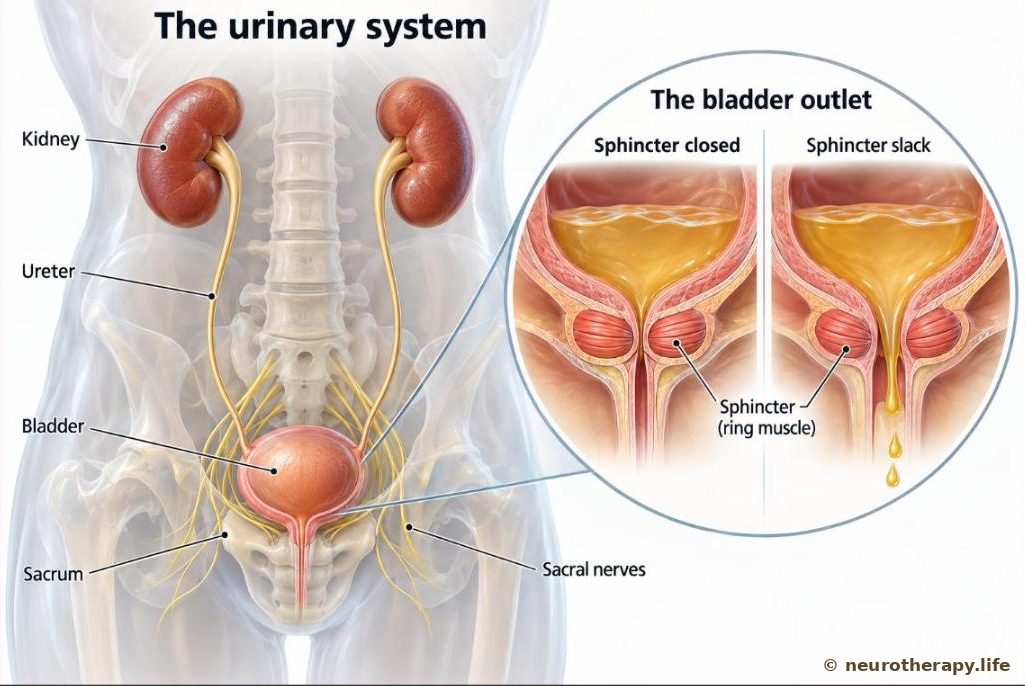
Your two kidneys filter the blood all day and make urine. It runs down into the bladder, a muscle bag that stores it. A ring of muscle at the bladder's outlet, the sphincter, stays closed until you decide to go. Nerves from the base of the spine and the brain run the whole system.
Trouble can come at any step. The body may make too much urine or too little. The outlet may be narrowed, so urine will not come. Or the ring muscle may be slack, so urine leaks with a cough, a sneeze or a laugh. These look alike from outside but are opposite problems.
What are the symptoms?
- Passing large amounts of urine, day and night
- Passing only small amounts, or dark, concentrated urine
- Urine that is hard to start, comes in a weak stream, or will not come at all
- Burning or pain while passing urine
- Leaking urine with a cough, sneeze, laugh or lifting
- A sudden, strong urge to go, with leaking before you reach the toilet
What causes it, and who is more likely to get it?
Water and habits
- Drinking too little water, or tea and cold drinks instead of water
- Drinking very large amounts, or a lot of tea, coffee or alcohol
- Holding urine for long hours
- Long-standing constipation
The outlet and its muscles
- Loose pelvic muscles after childbirth, menopause or with age
- An enlarged prostate or a narrowed passage in men
- A urine infection
Medicines
- Water tablets (diuretics) and some other medicines
How is it found?
The first job is to find out which kind of problem it is — too much, too little, held back, or leaking — because each has different causes.
Bladder diary
For a few days you write down what you drink, how often you pass urine, how much, and when it leaks.
Urine test
Looks for infection, blood or sugar in the urine.
Blood tests
Sugar and kidney function, to look for a cause of too much or too little urine.
Bladder ultrasound and after-urine check
Shows the kidneys and bladder, and how much urine is left behind after you go.
Special bladder tests
Flow and pressure tests, or a look inside with a thin scope, when the doctor needs more detail.
A neurotherapist first asks which of the four problems it is — too much, too little, held back or leaking — because a point that helps one is barred in another. You will be asked about water, blood pressure, diabetes and kidney reports, and the kidney points Liv° and Mu° are checked.
How Neurotherapy sees Urinary Problems
In LMNT, the outlet of the bladder is worked from the back of the pelvis. Some points open the ring muscles, others tighten them — and the same points on opposite sides do opposite work. So the first question is always which way the trouble is going.
When the body is short of water — one event, four faces
- Too little waterdrunk between meals — tea and cold drinks do not count
- The body closes its tapsand holds back water at every exit — urine, sweat, saliva and stool
- Urinebecomes scanty, dark and burning
- Stool and skinthe stool turns hard, the skin dry, the mouth dry
So scanty dark urine, a dry mouth, dry skin and hard stool are often one story. LMNT teaching asks about all four, and puts water right before choosing any point.
No other drink can be a substitute for water.
Neurotherapy treatment for Urinary Problems, step by step
Examine first
The therapist asks which of the four problems it is, checks Liv° and Mu°, and asks about blood pressure, diabetes, kidney reports and every tablet — these decide which points are allowed.
Water first
A glass of water half an hour after a meal, and then every hour — not all of it at meals, and not in big gulps. Do not hold the urge to pass urine.
Urine held back or scanty: (2) S4–S5
Given lying face down, the heels work beside the sacrum to relax and open the ring muscles of the bladder. Where a narrowed passage makes urine come with burning in a forceful stream, (6) Left Swt may be added.
Leaking with a sneeze or laugh: the incontinence treatment
(15) Right Medulla and (6) Right Swt, three rounds a minute and a half apart, then the Triangle for piles. The right side narrows a slack outlet; the Triangle tightens the pelvic muscles.
Little urine from failing kidneys
In kidney failure, LMNT teaching gives (2) Pan to increase urine, and holds back the kidney points — always alongside the kidney doctor's care.
Points and formulas used
Incontinence treatment
For urine that leaks with a sneeze, a laugh or lifting — narrows a slack outlet and tightens the pelvic muscles.
Works through
Open →(2) S4 – S5
Relaxes and opens the ring muscles of the bladder — given to bring urine that is held back or scanty. Never when too much urine is passed.
Open →(6) Left Swt
Opens a narrowed passage where urine comes with burning in a forceful stream. Not for people with diabetes.
Open →Never do this
- (2) S4–S5 is never given to someone who passes too much urine — it opens the ring muscles and increases urine. The bar lifts once the amount has settled. (2) S4 – S5
- When too little urine is passed, the Triangle for piles (it tightens the ring muscles) and Gal are not given. Both bars lift once the amount has settled. Triangle for Piles
- (6) Right Swt is not given with high blood pressure, and (6) Left Swt is not given with diabetes. (6) Right Swt
- Kidneys: in kidney failure the kidney points Liv° and Mu° are not pressed and (10) Medulla is not given. No firm pressure on a tender flank, and none at all over a transplanted kidney, a recent biopsy, or a tube or stent. Kidneys
- Children: a child gets half the adult dose and light treatment only, given by a trained therapist. Bed-wetting in children
- See a doctor the same day — or go to hospital — if you cannot pass urine at all or have passed none for 8 hours; if there is blood in the urine; fever or shivering with loin pain or burning urine; or new loss of bladder or bowel control with numbness around the seat or weak legs. Urine obstructed
- Cancer: if the person has cancer, (10) Pan, Thymus, Pit, Lu + Sh, Rt. Ov / Lt. Ov and (30) Medulla are never given — the therapist changes the plan.
- Keep taking the medicines your doctor prescribed. Neurotherapy works alongside your medical care, never instead of it.
Watch

A Hindi demonstration of the treatment given when a urine infection has gone on long enough to become inflamed: Liv° and Mu°, Chest Only, 20 Round Arrow along the spine, then (6) Adr on the back.
A urine infection — especially with fever, loin pain or blood in the urine — needs a doctor first. (6) Adr is not given with high blood pressure or when immunity is already low; the video does not say this.
A demonstration of the treatment given for a long-standing urine infection.
From practice
The tailor whose urine burned
A teaching case — a composite from practice, not one patient's file
52 years · tailor · burning, mustard-yellow urine and an old ache in the low back
- What was found
- Told to drink more water, he had been drinking a sweet cold drink instead. His stools were hard, every third day; his skin was dry; Mu° was tender. Before anything else the therapist checked for blood in the urine, fever with loin pain, or urine that had stopped — none was present, so he could be treated.
- What was done
- Water and digestion first, because the hard stool and the dark urine were both signs of a body holding back water. Within ten days the urine had cleared and the stool had softened.
- What it teaches
- A cold drink is not water. And a therapist must know what sends a patient to the doctor that same morning — blood in the urine, fever with loin pain, or urine that has stopped.
From Ayurveda and the kitchen
The urges that must not be held
Classical Indian medicine lists natural urges that must not be held back — passing urine and stool among them — and says holding them habitually leads to disease. The advice still works: go when the body tells you to.
Mūtra — one of the three excreta
Ayurveda counts urine (mūtra), with stool and sweat, as one of the three malas. Their proper making and leaving is itself a sign of health — which is why a vaidya asks about them first.
Test yourself
What research says
- Strong evidence
Filling, holding and emptying the bladder is run by nerves from the spinal cord and the brain. Nerve signals keep the ring muscle of the outlet closed, and let it open when you go.
Fowler CJ, Griffiths D, de Groat WC. The neural control of micturition. Nat Rev Neurosci. 2008.
- Strong evidence
A review of 31 trials in 1,817 women: training the pelvic floor muscles helped women with leakage on coughing or sneezing — they were several times more likely to improve or become dry than women who did not train.
No clinical trial of Neurotherapy for urinary problems has been published yet. Improvements reported by neurotherapists are clinical observations.
For you
Women
Leaking with a sneeze or laugh is common after childbirth and in middle age, as the muscles below the navel loosen. It is worth treating — tell your doctor and your therapist.
Older men
A weak stream or trouble starting often comes from the prostate. Get it checked; urine that stops completely is an emergency.
People with diabetes or high BP
Some of these points are barred for you. Always tell the therapist, and keep checking your sugar and pressure.
This page explains; it does not diagnose. Neurotherapy works alongside your medical care — keep taking the medicines your doctor prescribed, and see a doctor for any new or severe symptom.