Staying well (prevention)
You do not have to be ill to see a neurotherapist. LMNT teaching gives two gentle treatments for a person who is well and wants to stay well — or who has no clear picture yet — and a few daily checks anyone can learn to watch.
- Adults need at least 150 minutes of moderate activity a week
- Children and teenagers need an average of 60 minutes of activity a day
- 31% of adults and 80% of adolescents worldwide do not get enough
Source: World Health Organization, Physical activity fact sheet (2024); WHO 2020 guidelines (Bull et al.)
What is Staying well (prevention)?
Staying well is not a disease, so this page is different. It explains what LMNT offers a person who feels fine, a small child, someone just after a fever, or someone whose picture is not yet clear — and how the therapist decides what, if anything, to give.
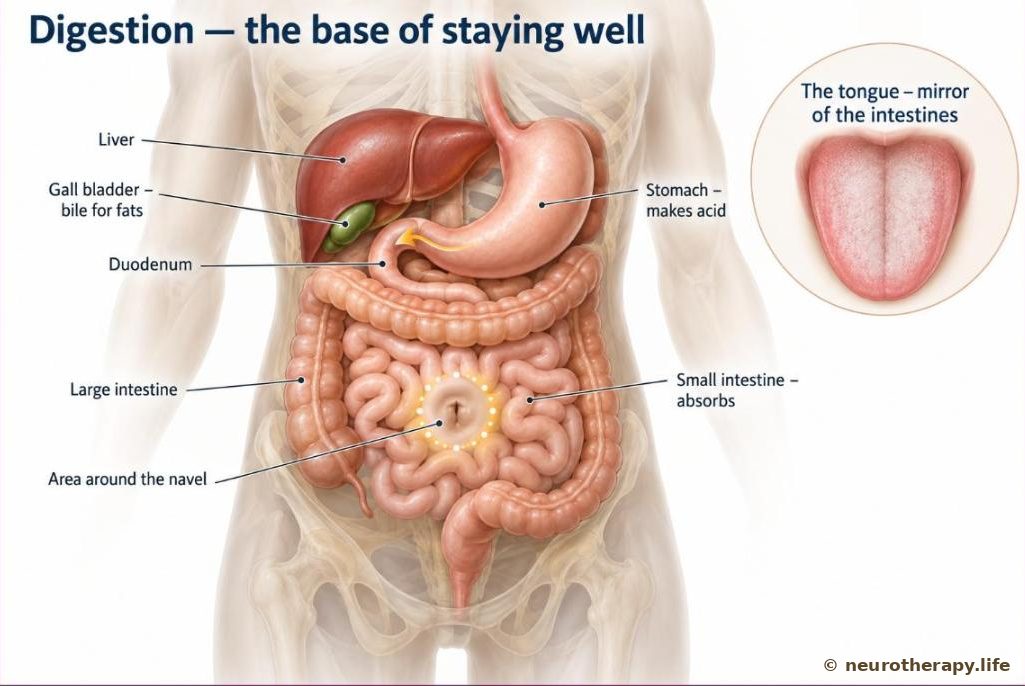
Guruji's teaching starts from digestion. If the stomach's acid is right, hunger is felt properly and food digests properly, and disease does not easily enter the body. Yoga calls this digestive fire jaṭharāgni. Much of staying well, in LMNT, is keeping that fire right and noticing early when it is not.
What are the symptoms?
- Early signs LMNT watches for: hunger not felt properly
- Soft stools three or four times a day, or needing to go straight after eating
- Undigested food in the stool — seeds, leaves or whole grains coming out as they went in
- Lines or scratches on the tongue, or a white coating, clearest in the morning
- In a small child, milk vomited back as milk rather than as curd
- Pain or hardness around the navel, or between the bottom of the breastbone and the navel
What causes it, and who is more likely to get it?
What weakens the stomach, in LMNT teaching
- Drinking water or cold drinks along with food, which quietens the stomach's acid
- Protein not digested well, so the digestive enzymes — themselves made of protein — are not made well either: a vicious cycle
- Too little acid in the stomach, so bacteria or viruses that enter can stay alive there
Around the navel
Everyday risks (medical)
- Too little physical activity, which raises the risk of heart disease, diabetes and some cancers
- Skipping regular check-ups, screening tests and vaccines
How is it found?
Staying well also means seeing your doctor for regular check-ups. They are different from visits for illness: screening tests can find problems early, when care works better, and vaccines prevent some diseases.
Regular check-up
How often depends on your age, sex, health, family history and risks. Take your family history and a list of every medicine and supplement you take.
Screening tests and vaccines
Ask your doctor which screening tests and vaccines are due for you.
The neurotherapist examines the belly first: points around the navel are felt for pain or hardness, and Mu° and Liv° are compared. They look at the tongue in good light, ask how many times a day the stool comes and whether undigested food is seen, and ask a child's mother whether vomited milk comes out as milk or as curd. They write what they see, not what they conclude.
How Neurotherapy sees Staying well (prevention)
LMNT does not wait for a disease name. It treats according to the condition of the body on that day — and on a well day, that means light, general treatments that keep the organs working and the picture clear.
Why the stomach's acid matters — as LMNT teaches it
- Stomach acidneeds histamine, acetylcholine and gastrin to be made
- Protein digestedso that the body can build its own digestive enzymes
- Duodenumacid food arriving here, below pH 4.5, triggers secretin
- Liver and gall bladdersecretin prompts bile, which helps digest fats
- Absorptionthe intestines take in what the body needs
Break any link and the whole chain slows. That is why LMNT checks the stomach first in almost everyone, and why pain relieved around the navel is felt at once as a sense of well-being.
Every person, from a one-day-old infant up to the age of a hundred years, can take this treatment.
Neurotherapy treatment for Staying well (prevention), step by step
Examine first
The navel points, Mu° and Liv°, the tongue, the stool — and, for a small child, the curd question. The therapist also asks about every medicine and report.
Organ Clearance
For a well person, or when there is no clear picture yet — and for small children and the elderly — LMNT teaching gives Organ Clearance, daily or even twice a day. It is a gentle palm treatment over the back, and the teaching says it benefits everybody.
VTF (Mild)
For a person who is well and wants to stay well, for a small child, and after a fever has come, LMNT gives the mild form of the Viral Treatment Formula — never in an auto-immune disorder.
Keep the stomach's fire right
Do not drink water or cold drinks along with food. Watch your stool and tongue, and tell the therapist when something changes.
When a picture appears
If the examination shows a clear direction — undigested food, a tender Mu° or Liv°, a fever — the plan changes to that finding.
Points and formulas used
Organ Clearance (as a daily treatment)
A gentle palm treatment over the whole back — for ordinary difficulties, small children, the elderly, and when there is no clear picture yet; daily, or even twice a day.
Works through
Open →VTF (Mild)
The mild Viral Treatment Formula — for a well person who wants to stay well, a small child, and after a fever; not in an auto-immune disorder.
Open →Never do this
- Auto-immune disorder: VTF (Mild) is not given. Tell the therapist if you have one, even if you feel well. VTF (Mild)
- Children get half the adult dose and light treatment only, given by a trained therapist — with the palm, never the heel of the hand or the foot.
- A baby who vomits forcefully and again and again, is not gaining weight, brings up anything green or blood-stained, or becomes floppy or hard to wake needs a doctor the same day.
- Diarrhoea goes to a doctor at once in an infant or small child, or with blood in the stool, vomiting that will not stop, no urine for many hours, sunken eyes, confusion, or a high fever. Keep giving the drink on the way.
- Cancer: if the person has cancer, (10) Pan, Thymus, Pit, Lu + Sh, Rt. Ov / Lt. Ov and (30) Medulla are never given — the therapist changes the plan.
- Keep taking the medicines your doctor prescribed, and keep your regular check-ups and vaccines. Neurotherapy works alongside your medical care, never instead of it.
Watch
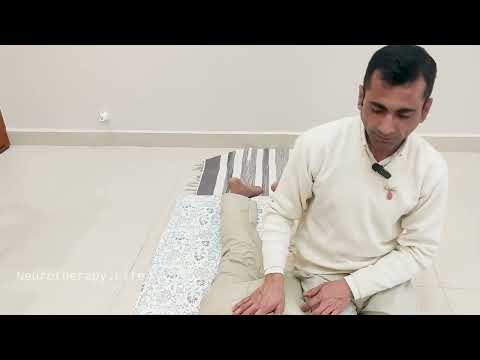
A short Hindi demonstration of Organ Clearance: the patient lies face down on two pillows, and the therapist's open hands work over the whole back in overlapping strokes — first up and down, then side to side — twice each, leaving no area out.

An overview of LMNT's diagnostic pain points — the places around the navel that the therapist presses to read the body before choosing a treatment.
How Organ Clearance is given over the back, and the diagnostic pain points the therapist checks first. In LMNT teaching Organ Clearance is given with a light hand.
From Ayurveda and the kitchen
Test yourself
What research says
- Strong evidence
WHO advises adults to do 150–300 minutes of moderate activity a week and children an average of 60 minutes a day; some activity is better than none, and more brings more benefit.
- Emerging evidence
In mice that make little stomach acid, more of several food-borne bacteria survived — support for the idea that stomach acid is a barrier against germs we swallow.
No clinical trial of Neurotherapy for prevention has been published yet. Improvements reported by neurotherapists are clinical observations.
For you
Parents of small children
For ordinary loose motions, LMNT reverses the toe-finger (TF) order — starting from the little toe of the right foot. Right Chest Only helps sudden sneezing with a running nose if given within the first few sneezes. The Triangle treatment helps control of urine — but not in a child who passes little urine.
Older people
Organ Clearance is named for the elderly too. The Triangle treatment is also used for control of urine in the elderly. Keep your doctor's check-ups going.
After a fever
Once a fever has come, LMNT teaching gives VTF (Mild). A high or long-lasting fever needs a doctor first.
This page explains; it does not diagnose. Neurotherapy works alongside your medical care — keep taking the medicines your doctor prescribed, and see a doctor for any new or severe symptom.