Myasthenia gravis
Myasthenia gravis is a long-lasting illness in which the muscles you move by choice tire and weaken quickly — often the eyelids and eyes first. The weakness gets worse with use and better with rest.
- About 20 in every 100,000 people around the world have it
- Most common in women under 40 and men over 60
- Up to 1 in 5 people with it have a myasthenic crisis — a breathing emergency
Source: Cleveland Clinic; MedlinePlus
What is Myasthenia gravis?
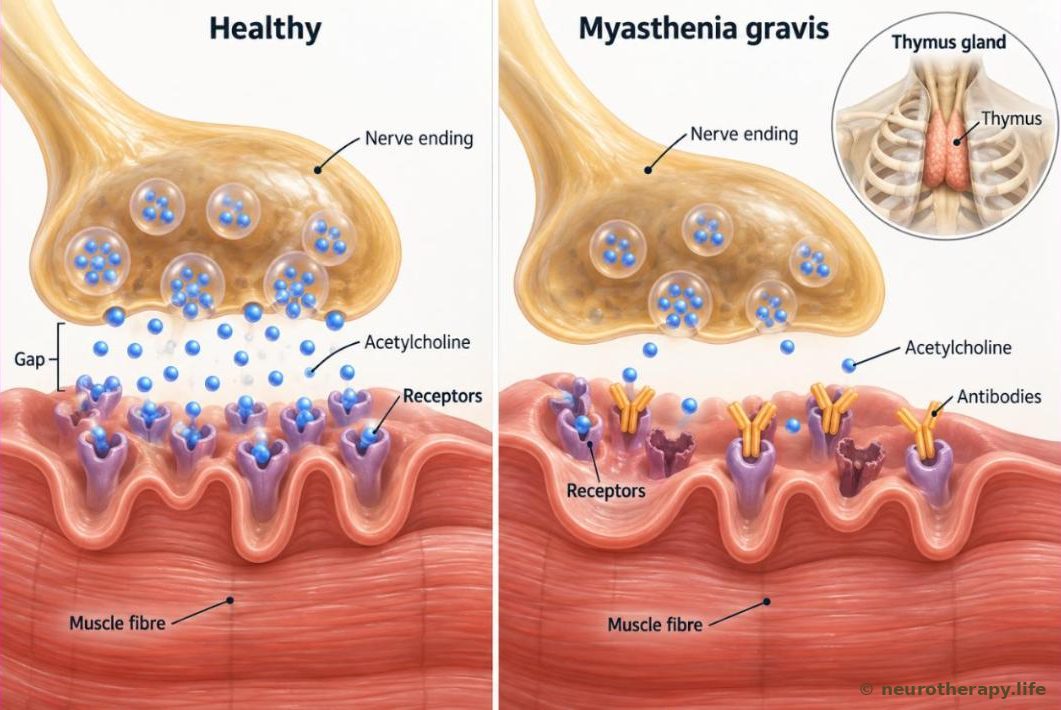
To move a muscle, a nerve releases a chemical messenger called acetylcholine at the spot where it meets the muscle. The messenger fits into receptors on the muscle, like a key in a lock, and the muscle contracts.
In myasthenia gravis, the body's defence system makes antibodies that block or destroy these receptors. The nerve still sends its message, but fewer locks are open, so the muscle tires fast. The thymus gland, behind the breastbone, is often involved. It is an autoimmune illness and is usually not inherited.
What are the symptoms?
- Drooping eyelids
- Blurred or double vision
- A change in facial expression; trouble chewing, swallowing or speaking
- Weak arms or legs that tire with use and recover with rest
- Trouble breathing — an emergency
What causes it, and who is more likely to get it?
The body attacks itself
- Antibodies against the acetylcholine receptors on the muscle
- Less often, antibodies against other proteins at the same junction
The thymus gland
- About two in three people with it have overactive thymus cells
- About 1 in 10 have a growth (tumour) of the thymus
Things that can make it worse
- Infections and surgery
- Some medicines, such as some used for malaria or for heart rhythm
- Having another autoimmune illness or thyroid disease raises the risk
How is it found?
A neurologist confirms myasthenia gravis with a few tests.
Antibody blood test
Looks for the antibodies that attack the nerve–muscle junction.
EMG and nerve conduction tests
Measure how well messages pass from nerve to muscle, and whether the muscle tires with repeated signals.
CT or MRI scan of the chest
Checks the thymus gland for enlargement or a growth.
Before anything else, the neurotherapist asks about breathing and swallowing — any trouble there goes to the hospital first. The therapist also notes that this is an autoimmune illness, because in LMNT some points, such as Spl, are not given in autoimmune disorders.
How Neurotherapy (LMNT) sees Myasthenia gravis
LMNT teaching calls (15) Medulla the acetylcholine treatment — it is held to make or stimulate acetylcholine, which the voluntary muscles and the breathing centre need. Guruji's teaching says myasthenia gravis arises from a shortage of acetylcholine receptors, with the eyelids drooping by themselves as one sign, and records that such patients have been seen to benefit from (15) Medulla.
How a muscle gets its message
- The nerveA message travels down the nerve to the muscle.
- AcetylcholineThe nerve ending releases acetylcholine into a tiny gap.
- ReceptorsIt fits into receptors on the muscle. In myasthenia gravis, antibodies block many of them.
- The muscleWith fewer open receptors, the muscle contracts weakly and tires fast.
Myasthenia gravis is a long-lasting illness, and Neurotherapy (LMNT) does not reverse it. It may support strength, comfort and daily function alongside the neurologist's care — never in place of it. In the list of nerve treatments, myasthenia gravis also appears beside (3) Medulla, the eyelid nerve, but with a question mark: a thought for research, not an instruction.
Wherever there is a question mark, it is an indication that this is my own thinking, on which other people can now do research.
Neurotherapy (LMNT) treatment for Myasthenia gravis, step by step
Examine first
Breathing and swallowing are checked first — any trouble means hospital, not the mat. Then the diagnostic points Liv° and Mu°, and the neurologist's reports: antibody test, EMG and chest scan.
(15) Medulla
Given seated, on both sides of the neck below the ears — the acetylcholine treatment for the voluntary muscles.
Spl is left out
In LMNT, Spl is not given in autoimmune disorders, and myasthenia gravis is one.
Points and formulas used
(15) Medulla
(15) Medulla — the acetylcholine treatment; for the voluntary muscles and breathing, and named for myasthenia gravis.
Open →Never do this
- Trouble breathing or swallowing, a weak voice, or choking means hospital at once — this can be a myasthenic crisis.
- Spl is not given in autoimmune disorders, including myasthenia gravis. LMNT records one patient who felt much relief after a single Spl treatment — one patient, not a rule. Spl
- Myasthenia medicines are never stopped or reduced because the muscles feel stronger. Only the neurologist changes them. Tell the doctor about any infection — it can make the weakness worse.
- Cancer: if the person has cancer, (10) Pan, Thymus, Pit, Lu + Sh, Rt. Ov / Lt. Ov and (30) Medulla are never given — the therapist changes the plan.
- Keep taking the medicines your doctor prescribed. Neurotherapy (LMNT) works alongside your medical care, never instead of it.
Watch

A short self-help demonstration for vomiting, including travel sickness: a finger strokes straight down the Medulla line just beside and below the ear, 30 strokes on the left and 30 on the right — (15) Medulla — with a one-minute gap, repeated two or three times. Talc or a little oil is used so the skin is not rubbed raw.
LMNT teaching lists (8) Medulla — not (15) — for giddiness with nausea and vomiting, and the first point it gives for nausea and vomiting is Gas Only. Vomiting with blood, severe belly pain, a stiff neck or signs of losing water needs a doctor first.
A short @neurotherapylife demonstration of where and how (15) Medulla is given, beside and below the ears. The video itself is about vomiting; it is shown here only for the technique of (15) Medulla, the LMNT treatment named for myasthenia gravis. With myasthenia, it is given by a trained therapist.
From Ayurveda and the kitchen
Test yourself
What research says
- Strong evidence
In myasthenia gravis, antibodies attack proteins at the nerve–muscle junction — most often the acetylcholine receptors. They destroy receptors and block acetylcholine, so the muscle gets a weaker signal and tires with repeated use.
Suresh AB, Asuncion RMD. Myasthenia Gravis. StatPearls. StatPearls Publishing; updated 2023.
No clinical trial of Neurotherapy (LMNT) in myasthenia gravis has been published yet. Improvements reported by neurotherapists are clinical observations.
For you
Drooping eyelids or double vision that come and go
Especially if it is worse by evening, see a neurologist — eye signs are often the first ones.
Families and carers
Know the danger signs: trouble breathing or swallowing, or a weak voice. Go to hospital at once.
People with myasthenia gravis
Before any new medicine or surgery, remind the doctor that you have myasthenia — some can make it worse.
This page explains; it does not diagnose. Neurotherapy (LMNT) works alongside your medical care — keep taking the medicines your doctor prescribed, and see a doctor for any new or severe symptom.