Multiple sclerosis (MS)
Multiple sclerosis (MS) is a lifelong condition in which the body's own defence system damages the coating around the nerves of the brain and spinal cord, so messages between the brain and the body slow down or get blocked.
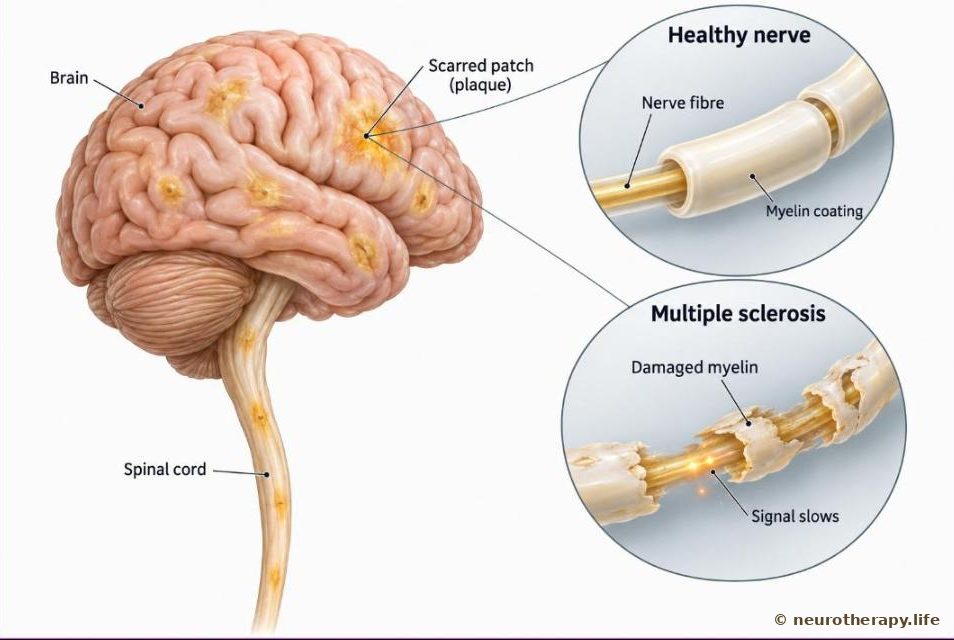
- Two to three times more common in women than in men
- It usually begins between the ages of 20 and 40
- About 85% of people are first diagnosed with the relapsing-remitting type — flare-ups followed by quieter spells
Source: MedlinePlus (NIH); Cleveland Clinic
What is Multiple sclerosis (MS)?
Every nerve fibre in the brain and spinal cord is wrapped in a fatty coating called myelin. It works like the plastic insulation on an electric wire, helping messages travel fast and cleanly.
In MS, the immune system — the body's defence force — attacks this coating by mistake. Small scarred patches form in many places. Where the coating is damaged, messages slow down or get blocked, and that part of the body stops working as it should. The exact cause is still not known.
What are the symptoms?
- Blurred vision, eye pain or other vision problems
- Numbness or tingling in different parts of the body
- Weak or stiff muscles
- Trouble with balance and coordination
- Extreme tiredness (fatigue)
- Problems with bladder control, memory or thinking
What causes it, and who is more likely to get it?
The immune system
- The body's defence system attacks the nerve coating by mistake — an autoimmune disease
- The exact trigger is not yet known
Who is more at risk
- Age 20 to 40
- Being a woman
- MS in the family
Environment and habits
- Smoking
- Little sunlight and low vitamin D
- An earlier Epstein-Barr virus infection (the virus behind glandular fever)
- Obesity
How is it found?
No single test proves MS. A neurologist (nerve specialist) puts the picture together from several checks, and rules out other diseases that look similar.
Nerve examination
The doctor checks strength, feeling, reflexes, balance and eye movements, and asks about every episode so far.
MRI of the brain and spinal cord
A scan that shows the scarred patches, where they are, and whether new ones have appeared.
Lumbar puncture (spinal fluid test)
A small sample of the fluid around the spinal cord is tested for signs of immune activity.
Blood tests
Used mainly to rule out other conditions that can look like MS.
A neurotherapist asks for the neurologist's letter and the MRI report before the first session, and asks two questions that change the plan: is there any heart disease, and is there any infection right now?
How Neurotherapy (LMNT) sees Multiple sclerosis (MS)
In LMNT, MS is one of the old, long-standing diseases in which undigested food is often found. Guruji's reasoning: nerves need raw materials, carried by the blood from digested food, to make their chemical messengers. When digestion is weak, those raw materials are short — and the nerves show it.
From the plate to the nerve — LMNT's chain
- Digestionbreaks food down into usable raw materials
- Bloodcarries those raw materials to every part of the body
- Nerve cellsbuild their chemical messengers from them
- Bodymoves, feels and balances when the messages arrive
LMNT does not claim to reverse MS. Its aim is to support comfort, strength and daily function — digestion first, then treatments that LMNT teaching gives for the prostaglandins and for the pineal gland. Progress is judged by what the person can now do: eat, sit, walk, sleep, manage themselves.
I am yet to understand the human body. My knowledge is hardly the tip of the iceberg. Neurotherapy (LMNT) is just in its infancy. There is a long way to go.
Neurotherapy (LMNT) treatment for Multiple sclerosis (MS), step by step
Examine first
The therapist checks the diagnostic points Liv° and Mu°, reads the neurologist's reports, asks about the stools, and asks about heart disease and any current infection — both change which treatments may be given.
Digestion first
If undigested food is found in the stool, that is set right first. In LMNT, the raw materials for the nerves come from digestion.
(30) Medulla and G. Heparin
(30) Medulla is LMNT's prostaglandin treatment, written for inflammation and for autoimmune disorders such as MS. G. Heparin puts (30) Medulla at the head of the Heparin formula. Neither is given where there is heart disease.
(½) Ku – 40 secs and (15) Medulla
(½) Ku – 40 secs is one press at the base of the spine, held for forty seconds. LMNT teaching gives it for the pineal gland and for disorders of the brain, speech or spinal fluid such as MS. (15) Medulla is also among the treatments given in MS.
Measure what the person can do
Progress is written down in plain terms — eating, sitting, walking, sleeping, holding things — not as a percentage and never as a promise. Physiotherapy and the neurologist's care continue alongside.
Points and formulas used
(30) Medulla
The prostaglandin treatment — in LMNT teaching it calms inflammation and is written for autoimmune disorders such as MS. Not in heart disease or infections.
Open →G. Heparin ('glandins)
The Heparin formula headed by (30) Medulla — given in LMNT for autoimmunity such as MS; never in heart disease.
Works through
Open →(½) Ku – 40 secs
One forty-second press at the base of the spine, for the pineal gland — given in LMNT for brain, speech and spinal-fluid disorders such as MS.
Open →Never do this
- MS is an autoimmune disease, so the whole autoimmune bar applies: Th, Th + Ch, Lymph, Armpits, Ton 'P', Ton 'T' and Spl are never given — where the immune system is already misbehaving, it is not stimulated. Autoimmune disorders
- G. Heparin is never given in heart disease. (30) Medulla is not given to heart patients, nor in diseases of infection. No Heparin formula while a wound is open. (30) Medulla
- For the frail and anyone long unable to move: no forceful work, no leverage, shorter holds. Where the person cannot feel the pressure, the therapist checks the skin after every session.
- See the neurologist promptly for any new or worsening symptom — loss of vision or eye pain, new weakness or numbness, loss of bladder control. Sudden weakness of one side, slurred speech or trouble breathing is an emergency: call 108 / 112.
- MS is lifelong. Keep the neurologist's treatment, physiotherapy and any speech or occupational therapy going — Neurotherapy (LMNT) may support comfort and daily function, never instead of them.
- Cancer: if the person has cancer, (10) Pan, Thymus, Pit, Lu + Sh, Rt. Ov / Lt. Ov and (30) Medulla are never given — the therapist changes the plan.
- Keep taking the medicines your doctor prescribed. Neurotherapy (LMNT) works alongside your medical care, never instead of it.
From Ayurveda and the kitchen
Test yourself
What research says
- Strong evidence
A major review: MS risk is shaped by genes together with outside factors such as low vitamin D, smoking and obesity. Early diagnosis with MRI and spinal-fluid tests matters, and many medical treatments now exist for the relapsing form.
Thompson AJ, Baranzini SE, Geurts J, Hemmer B, Ciccarelli O. Multiple sclerosis. Lancet. 2018.
No clinical trial of Neurotherapy (LMNT) in multiple sclerosis has been published yet. Improvements reported by neurotherapists are clinical observations.
For you
Young women
MS most often begins between 20 and 40, and more often in women. Blurred vision or numbness that comes and goes is worth showing to a doctor.
People who smoke
Smoking raises the risk of MS. Stopping is one of the few risk factors fully in your own hands.
Families and carers
Treatment for a lifelong condition continues at home. Ask the therapist what can safely be done at home, and keep the physiotherapy exercises going every day.
This page explains; it does not diagnose. Neurotherapy (LMNT) works alongside your medical care — keep taking the medicines your doctor prescribed, and see a doctor for any new or severe symptom.