Hydrocephalus
Hydrocephalus means too much of the brain's own fluid has collected inside the brain. The extra fluid presses on the brain, so it needs a doctor's care — usually surgery — first.
- 1 to 2 of every 1,000 babies in the United States are born with it
- The brain makes about 500 ml of this fluid every day — it must keep flowing and draining
- Untreated, it is usually fatal; with treatment, many people lead normal lives
Source: Cleveland Clinic; StatPearls (Koleva & De Jesus, 2023); MedlinePlus
What is Hydrocephalus?
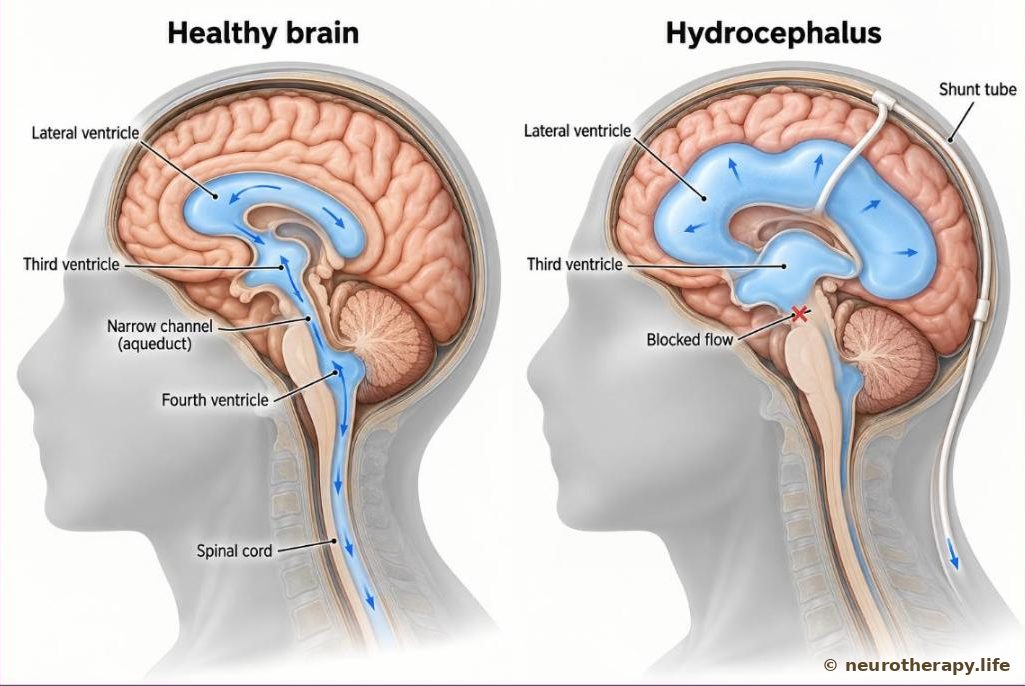
Your brain floats in a clear, watery fluid called cerebrospinal fluid (CSF). It is made inside four small spaces in the brain, called ventricles. It flows from one space to the next, then around the brain and spinal cord, and is finally soaked up into the blood.
In hydrocephalus this flow is blocked, or the fluid is not soaked up. The fluid keeps being made, so it builds up, the spaces swell, and the pressure harms the brain. It can be present at birth, or come later after an injury, bleeding, infection or a growth in the brain.
What are the symptoms?
- In babies: a head that grows unusually large, and a bulging soft spot on top
- Eyes that stay turned downward, vomiting, and unusual sleepiness
- In older children and adults: headache, nausea and blurred vision
- Poor balance and trouble with thinking or memory
- In older adults: trouble walking, forgetfulness and loss of bladder control
What causes it, and who is more likely to get it?
Present at birth
- Spina bifida
- A narrowed channel between the fluid spaces (aqueductal stenosis)
- Problems from being born too early
- Infections in the mother during pregnancy
Coming later in life
- Head injury
- Stroke or bleeding in the brain
- Meningitis and other brain infections
- Tumours of the brain or spinal cord
In older adults
- Normal pressure hydrocephalus — often no clear cause
How is it found?
Hydrocephalus is found by scans that show the size of the fluid spaces in the brain. In babies it is often suspected first because the head is growing too fast.
Ultrasound
Used before birth, and in babies through the soft spot on the head. Painless and without radiation.
CT scan or MRI
Pictures of the brain that show swollen fluid spaces and often the place where the flow is blocked.
Eye check and pressure tests
A doctor may look at the back of the eye for signs of pressure, and sometimes measures the fluid pressure with a spinal tap.
A neurotherapist asks for the scan reports and whether a shunt has been fitted before the first treatment. A shunt changes how the neck is treated: with much less pressure.
How Neurotherapy (LMNT) sees Hydrocephalus
Guruji's teaching describes hydrocephalus in one line: when there is a blockage in the third ventricle of the brain, water fills up in the brain. For this, LMNT names M. Heparin — the Heparin formula headed by (6) Medulla, given on both sides of the neck just below the ears.
The fluid's path — every link must stay open
- Two side ventriclesmake most of the clear fluid
- Third ventriclecollects it in the middle of the brain — the place LMNT names for the blockage
- Narrow channelcarries it down to the fourth ventricle
- Around the brain and spinal cordthe fluid cushions and bathes them
- Bloodfinally soaks the fluid up, so it never builds up
Why a Heparin formula? LMNT teaching reasons — and marks it with its own "perhaps" — that the brain's barrier keeps most medicines out but lets the body's own chemicals in, so a chemical the body makes in answer to the treatment may reach where a tablet cannot. It is an explanation, not a promise: the neurosurgeon's care comes first.
Whether or not the patient gets immediate benefit from our treatment, let no harm reach him through our carelessness — attend to this.
Neurotherapy (LMNT) treatment for Hydrocephalus, step by step
Examine first
The therapist checks the diagnostic points Liv° and Mu°, reads the scan reports, and asks whether a shunt has been fitted and when the last operation was.
The neurosurgeon's care first
Hydrocephalus is usually treated with surgery, most often a shunt. Neurotherapy (LMNT) is given only alongside that care, never in place of it.
M. Heparin
Seated, (6) Medulla is given on both sides of the neck below the ears, one side at a time. Then, lying down, the Heparin sequence: Pan, Liv and Ch. Only.
With a shunt — less pressure on the neck
A shunt does not rule the formula out. But its tube runs under the skin down the side of the neck, exactly where (6) Medulla is given. So the therapist feels first, works away from the tube, and presses lightly.
(6) Adr for the swelling — only when allowed
LMNT teaching allows (6) Adr to be added to M. Heparin to help reduce inflammation and swelling in the brain — but not with high blood pressure or where immunity is already low.
Points and formulas used
Never do this
- With a shunt: much less pressure on the neck. Feel for the tube under the skin and work away from it. Never work the front of the neck. Medulla
- No Heparin formula at all while a wound is open or bleeding — for example, soon after shunt surgery, until the wound has healed.
- (6) Adr is not given with high blood pressure, nor where immunity is already low (septicaemia, HIV/AIDS, cancer). (6) Adr
- Go to hospital at once for signs that the shunt may be blocked or infected, or the pressure is rising: bad headache, repeated vomiting, drowsiness, a fit, blurred vision, a bulging soft spot in a baby, fever, or redness along the shunt.
- Children get half the adult dose and light treatment only, given by a trained therapist.
- Hydrocephalus is usually lifelong and needs regular check-ups with the neurosurgeon. Neurotherapy (LMNT) may support comfort and daily function; it never replaces the shunt or the surgeon's care.
- Cancer: if the person has cancer, (10) Pan, Thymus, Pit, Lu + Sh, Rt. Ov / Lt. Ov and (30) Medulla are never given — the therapist changes the plan.
- Keep taking the medicines your doctor prescribed. Neurotherapy (LMNT) works alongside your medical care, never instead of it.
Watch

A demo of the M. Heparin formula — the Heparin formula headed by Medulla ((6) Medulla, (8) Pan, (7) Liv, (8) Chest Only) — used for neck and shoulder pain and for headache that keeps coming back.
The M. Heparin formula, shown on an adult without a shunt. With a shunt, the neck is worked much more lightly, away from the tube; a child gets light treatment and half the dose.
From Ayurveda and the kitchen
Test yourself
What research says
- Strong evidence
The brain makes about 500 ml of CSF a day. It flows from the side ventricles to the third, then the fourth ventricle, and is absorbed into the veins. Hydrocephalus comes when this flow is blocked or the fluid is not absorbed.
No clinical trial of Neurotherapy (LMNT) in hydrocephalus has been published yet. Improvements reported by neurotherapists are clinical observations.
For you
Parents of a baby
Keep every check-up where the head is measured. A head that grows fast, a bulging soft spot or eyes that stay turned down need the doctor the same day.
People living with a shunt
Learn the signs of a blocked shunt and keep them written at home. Tell every therapist about the shunt before any treatment of the head or neck.
Older adults
Trouble walking, forgetfulness and bladder leaks together are not just "old age" — ask a doctor to check for normal pressure hydrocephalus.
This page explains; it does not diagnose. Neurotherapy (LMNT) works alongside your medical care — keep taking the medicines your doctor prescribed, and see a doctor for any new or severe symptom.