Heel spur
A heel spur is a small bony growth under the heel bone, where the thick band on the sole of the foot is attached. Many cause no pain; when the heel does hurt, it is often worst with the first steps in the morning.
- About 15% of people have a heel spur
- Most spurs cause no pain by themselves — spurs are found in people with and without heel pain
- The heel pain that often goes with it, plantar fasciitis, is most common between 40 and 60
Source: Cleveland Clinic; MedlinePlus (US National Library of Medicine); Mayo Clinic
What is Heel spur?
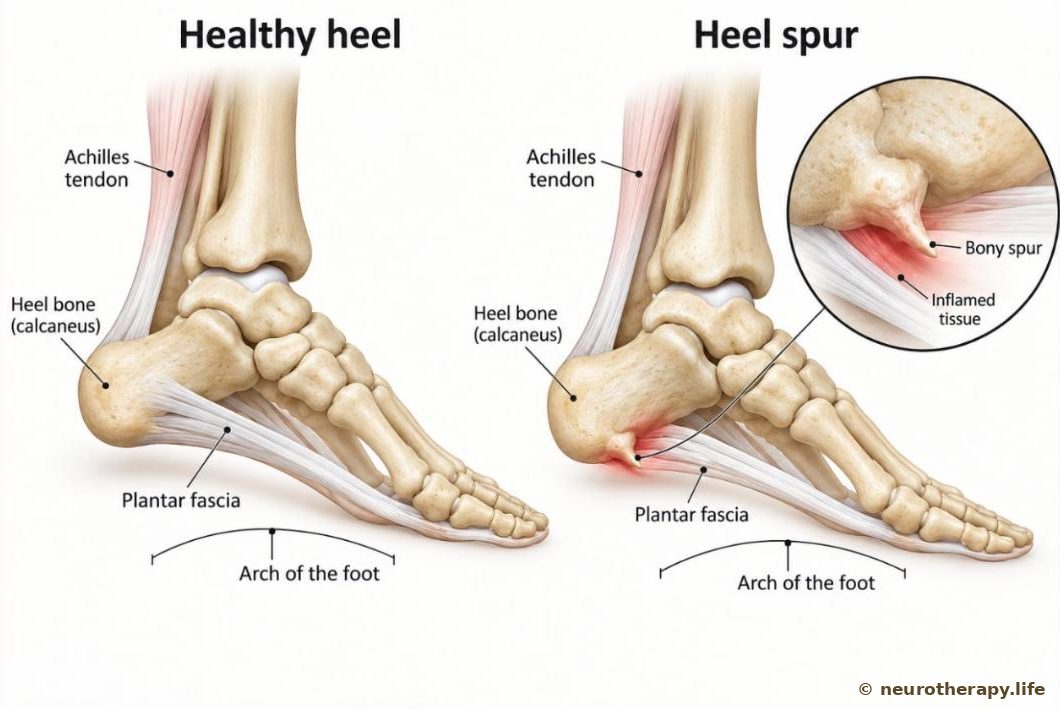
Under your foot runs a thick band of tissue, the plantar fascia. It starts at the heel bone, ends at the toes and holds up the arch. Where it pulls on the heel bone, the body sometimes lays down extra bone — a small hook or shelf. That is a heel spur.
A spur grows slowly, in response to strain on the foot over months or years. Many people find it on an X-ray by chance. When the heel hurts, the pain usually comes from the strained, inflamed band around the spur rather than from the bone itself.
What are the symptoms?
- A sharp, stabbing pain under the heel with the first steps in the morning
- Pain that eases with walking, then returns after long standing or sitting
- A tender spot under the front of the heel
- Aching after walking on hard floors or in worn-out shoes
- Sometimes no pain at all — the spur is found only on an X-ray
What causes it, and who is more likely to get it?
Strain on the sole
- Plantar fasciitis — an inflamed band under the foot
- Long hours on the feet, or running on hard ground
- Worn-out or unsuitable shoes
Foot shape and walk
- Flat feet or high arches
- An uneven way of walking
Age and weight
- The band loses its stretch with age
- Extra body weight on the heel
Joint diseases
How is it found?
A doctor asks when the heel hurts and what you do on your feet, and presses the sole to find the tender spot.
Examination of the foot
Tenderness under the heel, the shape of the arch, and a tight Achilles tendon.
X-ray
Shows the spur itself, and rules out other causes such as a crack in the bone.
For a neurotherapist the X-ray matters in a special way: the word “spur” on a report, or calcification at a heel, closes certain points for good. The therapist also checks Liv° and Mu°, and asks about diabetes and thin bones before choosing anything.
How Neurotherapy sees Heel spur
LMNT sees two opposite things happen in bone and joint. In some people bone wears away. In others, calcium is laid down where it should not be — between the joints, or as a bone growing outward. Spur belongs to the second family, together with bamboo spine. So nothing is given that builds more calcium into bone, and the work is aimed at calcium that has gone to the wrong place.
Guruji's teaching says people with calcium deposits need both Thymus and Adrenal. For them two complete orders were written — one ending with Thymus and Chest, the other with Adrenal. They are alternatives, not halves: one is chosen, given whole, and written on the card. Separately, (4) Para is the point used where bone has grown in an unwanted place.
We cannot provoke the organs in an order of our own choosing.
Neurotherapy treatment for Heel spur, step by step
Examine first
The therapist checks Liv° and Mu°, reads the X-ray report, and asks about diabetes, heart disease and any bone density report — each one changes what may be given.
Choose one calcium-deposit order
Order I ends with Thymus and Chest; order II ends with Adrenal. Only one is given — never both, never run one after the other, never spliced into one line.
(4) Para, given separately
(4) Para is the point LMNT uses where bone has grown in an unwanted place — but never on its own in a person with osteoporosis.
Write it down
The card records which order was given, so that the next therapist knows — and the patient is examined again at each visit.
Points and formulas used
Calcium-deposit order, version I
For calcium deposited between the joints or in the tissues — spur and bamboo spine; the version that ends with Thymus and Chest.
Open →Calcium-deposit order, version II
The same purpose; the version that ends with the adrenal point. An alternative to order I, never an addition to it.
Open →Never do this
- Thrd and Thrd 'P' are never given for a spur, or wherever bone has grown in an unwanted place — they build more calcium into bone. Thrd 'P'
- The two calcium-deposit orders are alternatives. Give one, whole, and write down which — never both. Calcium-deposit order, version I
- Order I carries every rule attached to Thymus and Chest: it is not given to people with diabetes. Th + Ch
- In osteoporosis, (4) Para is never given on its own — only the full 1,25 DCC formula. (4) Para
- See a doctor first if the heel pain began with a fall or injury, if you cannot put weight on the foot, if the heel is red, hot and swollen or you have fever, or if there is numbness, tingling or a wound on the foot — especially with diabetes.
- Cancer: if the person has cancer, (10) Pan, Thymus, Pit, Lu + Sh, Rt. Ov / Lt. Ov and (30) Medulla are never given — the therapist changes the plan.
- Keep taking the medicines your doctor prescribed. Neurotherapy works alongside your medical care, never instead of it.
From Ayurveda and the kitchen
Test yourself
What research says
- Strong evidence
A review of what a heel spur is made of and why it forms. Age, weight, sex, arthritis, plantar fasciitis and the way the foot is held are all linked to spurs. Several ideas about how they form are still debated, and so is how often the spur itself causes the pain.
No clinical trial of Neurotherapy in heel spur has been published yet. Improvements reported by neurotherapists are clinical observations.
For you
People who stand all day
Teachers, shopkeepers and factory workers: cushioned, well-fitting shoes and short sitting breaks take load off the heel.
People with diabetes
Check both feet daily for wounds or numbness, and tell the therapist — order I is not given in diabetes.
People carrying extra weight
Every step puts your weight on the heel. Even a little weight loss eases the pull on the sole.
This page explains; it does not diagnose. Neurotherapy works alongside your medical care — keep taking the medicines your doctor prescribed, and see a doctor for any new or severe symptom.