Frozen shoulder
Frozen shoulder makes the shoulder painful and stiff, so the arm will not lift or turn fully. It comes on slowly and can last many months.
- About 2 to 5 people in every 100 get a frozen shoulder at some time
- Most common between 40 and 60, and more common in women
- 10% to 20% of people with diabetes develop it
Source: Cleveland Clinic; Leafblad et al., Physical Medicine and Rehabilitation Clinics of North America 2023
What is Frozen shoulder?
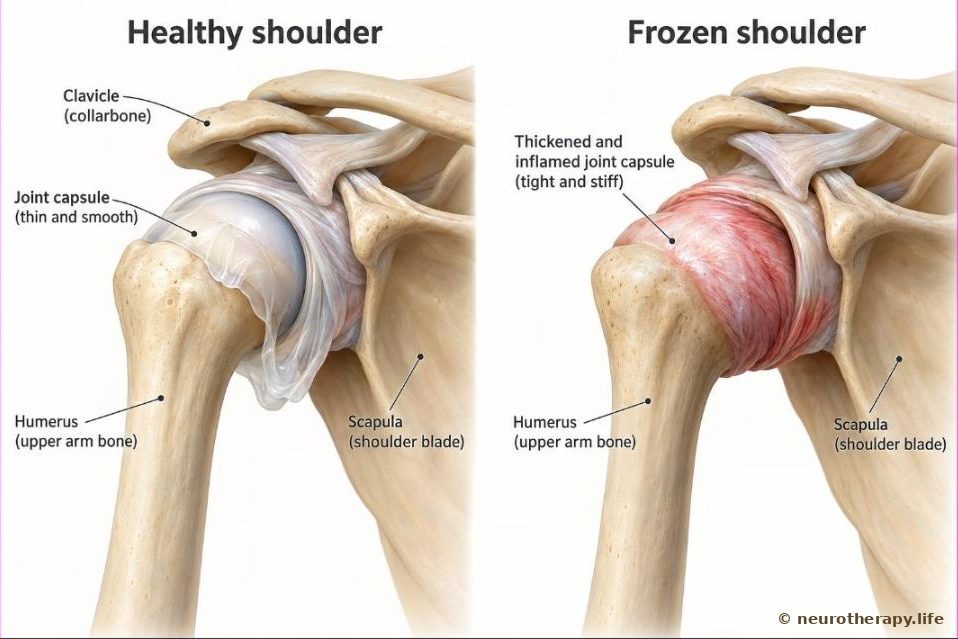
The shoulder is a ball-and-socket joint. The ball at the top of the arm bone sits in a shallow cup on the shoulder blade, wrapped in a soft bag of tissue called the capsule. Normally the capsule is loose, so the arm can swing, lift and turn.
In frozen shoulder the capsule becomes inflamed, then thick and tight. It squeezes the joint, so movement hurts and then becomes limited. It usually passes through three stages — freezing, frozen and thawing — over one to three years.
What are the symptoms?
- A dull ache in the shoulder, sometimes spreading into the upper arm
- Pain that is often worse at night, and on lying on that side
- Stiffness — the arm will not lift above the shoulder
- Trouble turning the arm, e.g. reaching behind the back or combing the hair
- The same stiffness whether you move the arm or someone else moves it for you
What causes it, and who is more likely to get it?
Age and body
- Being between 40 and 60 years old
- Being a woman, especially around menopause
A shoulder kept still
- An injury or operation that kept the arm still, such as a sling
- Surgery on the breast or the heart
- A stroke that left the arm weak
Other conditions
- Diabetes
- Thyroid problems
- Heart disease
- Parkinson's disease
- Problems of the discs in the neck
How is it found?
A doctor usually knows it from the examination: the shoulder will not turn, even when the doctor moves the arm gently for you.
Examination of movement
The doctor compares how far you can move the arm with how far it moves when they move it. In frozen shoulder both are limited.
X-ray
Does not show the frozen capsule, but rules out arthritis, a broken bone or calcium deposits.
MRI or ultrasound
Sometimes used to look at the soft parts, such as a torn tendon, but often not needed.
A neurotherapist first listens to what the patient calls a “stiff shoulder”. Pain or pressure in the chest, or between the shoulder blades, in someone with heart risk is not a shoulder at all. The therapist also asks about thin bones, steroid tablets and old fractures, because these change how firmly the hand may press.
How Neurotherapy (LMNT) sees Frozen shoulder
Neurotherapy (LMNT) reads frozen shoulder as a problem of muscles and of the nerve that moves them. The trapezius — the great diamond-shaped muscle that shrugs and steadies the shoulder blade — is carried by the eleventh cranial nerve, the accessory nerve. When that territory will not move enough, the neck will not turn, the shoulder will not rotate, and the arm will not rise.
Two treatments answer this. Shivaji relaxes the muscles all round the shoulder by pressing again and again, so that blood flows better in them and flexibility returns. And (11) Left Medulla, because of the polarity rule: left is given where something will not move enough — left opens; right is given where something has moved too far — right closes. A frozen shoulder is the plainest case of “will not move enough”.
Whenever there is an obstruction or blockage in the blood circulation of any part of the body, then pain or numbness is felt in that part.
Neurotherapy (LMNT) treatment for Frozen shoulder, step by step
Listen and examine first
The therapist asks where exactly it hurts and what the patient means by a stiff shoulder, and asks about heart risk, thin bones, steroid tablets and old fractures before any pressure is given.
Shivaji
Seated, with the palm of the hand on the forehead and the shoulder loose. With the base of the palm, rotating clockwise: down the side of the chest from the shoulder joint, up the back from the lower edge of the shoulder blade, then both sides of the spine from T6 to L3.
(11) Left Medulla — whichever shoulder is stiff
Left, because the shoulder must open — not because the complaint is on the left. As with every cranial-nerve Medulla treatment, (15) Medulla comes first, and it is given three times, ninety seconds apart.
Tell it apart from a dropped shoulder
A shoulder that has come out of its place, or dropped after a fall or a blow, has moved too far. That is the opposite complaint, and it gets (11) Right Medulla, not Left.
Points and formulas used
Never do this
- The side in a Medulla row is the side of the treatment, not of the complaint. Left opens; right closes. A frozen right shoulder still gets (11) Left Medulla. Medulla
- Pressure or pain in the chest — including pain between the shoulder blades — in someone with heart risk is an emergency, not a shoulder. Send the person to a doctor the same day and give nothing.
- Thin bones, long use of steroids, an earlier fracture from a small injury, frailty, or cancer that may have reached bone: light contact only over the ribs and spine, and none where bone is known to be involved.
- Cancer: if the person has cancer, (10) Pan, Thymus, Pit, Lu + Sh, Rt. Ov / Lt. Ov and (30) Medulla are never given — the therapist changes the plan.
- Keep taking the medicines your doctor prescribed. Neurotherapy (LMNT) works alongside your medical care, never instead of it.
From Ayurveda and the kitchen
Test yourself
What research says
- Strong evidence
A review: frozen shoulder affects about 2–5% of people. The lining of the shoulder joint slowly scars and tightens, which limits movement — both when you move the arm and when someone moves it for you — and causes pain.
Leafblad N, Mizels J, Tashjian R, Chalmers P. Adhesive Capsulitis. Phys Med Rehabil Clin N Am. 2023.
- Strong evidence
Frozen shoulder mostly affects middle-aged adults, especially people with diabetes or thyroid problems, who may have a more severe form. It is often recognised late, which prolongs the disability.
Li D, St Angelo JM, Taqi M. Adhesive Capsulitis (Frozen Shoulder). StatPearls. 2025.
No clinical trial of Neurotherapy (LMNT) in frozen shoulder has been published yet. Improvements reported by neurotherapists are clinical observations.
For you
People with diabetes
Frozen shoulder is much more common in diabetes and can be more stubborn. Mention any new shoulder stiffness early, to your doctor and your therapist.
After an injury or operation
A shoulder kept still for a long time is at risk. Ask your doctor when and how you may start moving it again.
People with heart disease
Tell your therapist about your heart before the first session. A pain near the shoulder can come from the heart.
This page explains; it does not diagnose. Neurotherapy (LMNT) works alongside your medical care — keep taking the medicines your doctor prescribed, and see a doctor for any new or severe symptom.