Earache
Earache is pain in or around the ear. It is very common in young children, and most often comes from a middle-ear infection after a cold. Most earaches start to get better within a few days — but some signs need a doctor quickly.
- 3 out of 4 children have at least one ear infection by their third birthday
- Most common between 6 months and 2 years of age
- Most earaches in children come from an ear infection and start to improve after a few days
Source: MedlinePlus; Cleveland Clinic; NHS
What is Earache?
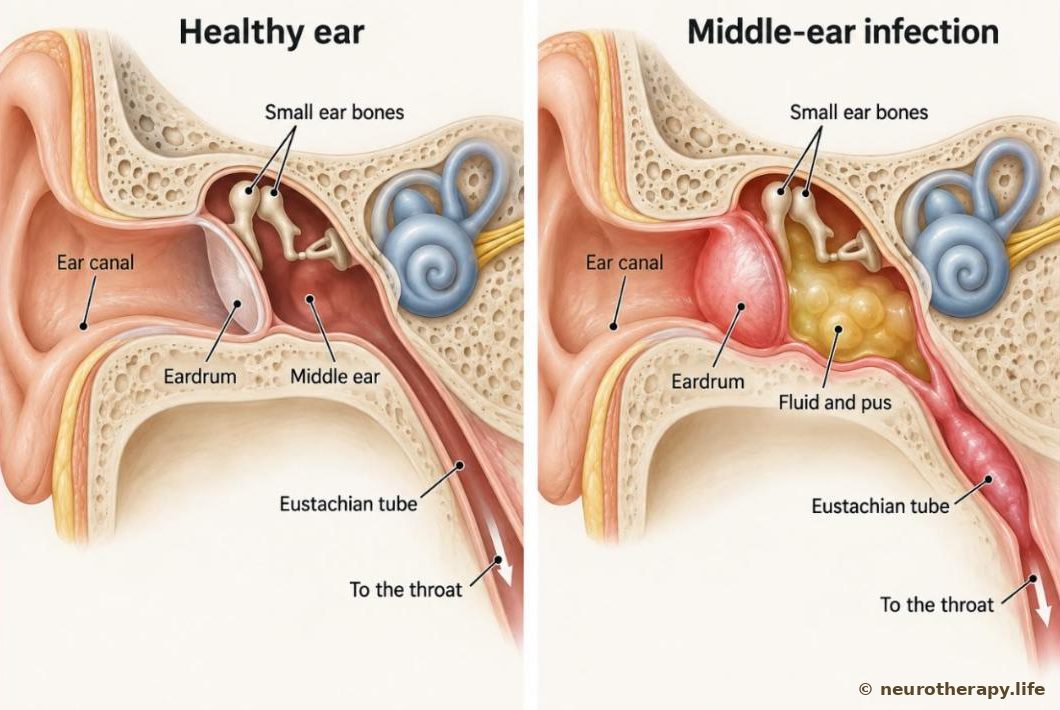
Behind the eardrum is a small air-filled space, the middle ear. A thin tube — the Eustachian tube — joins it to the back of the throat, letting air in and fluid drain out.
After a cold, this tube can swell shut. Fluid collects behind the eardrum, germs grow in it, and the pressure makes the ear hurt. In young children the tube is short and nearly level, so it blocks easily. Earache can also come from nearby — teeth, throat or tonsils — or from wax or something stuck in the ear.
What are the symptoms?
- Pain in the ear; a small child rubs or pulls at the ear
- Crying, irritability, restless sleep
- Fever of 38°C or more
- Off food; not reacting to some sounds
- Fluid coming out of the ear, or losing balance
What causes it, and who is more likely to get it?
Infections
- Middle-ear infection, often after a cold or flu
- Sore throat or tonsillitis
- Glue ear — sticky fluid that stays behind the eardrum
Pain from nearby
- Teething in babies
- A tooth abscess
In the ear itself
- Earwax build-up
- Something stuck in the ear
- A torn (perforated) eardrum
What makes infections more likely
- Age 6 months to 2 years
- Being with many other children, such as at a crèche
- Cigarette or other smoke in the home
- Bottle-feeding while the baby lies flat
How is it found?
A doctor usually finds the cause by looking and asking a few questions.
Looking into the ear (otoscope)
A small lighted instrument shows whether the eardrum is red, bulging, torn, or hidden by wax.
Checking the throat, nose and teeth
Because earache often comes from nearby — tonsils, a cold or a bad tooth.
Temperature and hearing
Fever and any change in hearing tell the doctor how serious it is and whether it needs follow-up.
A neurotherapist does not look inside the ear or treat an infection. The therapist first asks about fever, fluid from the ear, swelling behind it and a stiff neck — any of these goes to the doctor first. The therapist also asks about diabetes, polio, autoimmune illness and cancer, because they bar the armpit treatment.
How Neurotherapy sees Earache
For earache in children, LMNT uses a point far from the ear: (12) Armpits. The armpit holds many lymph nodes — the body's small filter stations for fighting germs. Guruji's teaching says this treatment opens the small blockages inside them and so stimulates their work. The same point is used for bacterial and viral illness, tonsils, sore throat, and mild cold and cough in children.
For inflammation in the ear, LMNT names (6) Adr, its anti-inflammatory count. For ear problems in general it names the Ear Points, H Arrow and (4) Thrd. Each is given only when its own bars allow, and always alongside the doctor's care for an infection.
Every person, from a one-day-old infant up to the age of a hundred years, can take this treatment.
Neurotherapy treatment for Earache, step by step
Check the danger signs first
High fever, fluid or pus from the ear, swelling or redness behind the ear, a stiff neck, a weak face or an unsteady walk — doctor first. Also check for diabetes, polio, autoimmune illness and cancer.
(12) Armpits — for earache in children
Given lying on the back, from the inner armpit out to the middle of the upper arm. For a child: hand only, half the adult dose, light pressure.
(6) Adr — for inflammation in the ear
Not where immunity is low, and not in high blood pressure.
Ear points, H Arrow and (4) Thrd
LMNT's general points for ear problems, chosen by the findings. (4) Thrd is replaced by another point in heart patients.
Points and formulas used
Never do this
- See a doctor first — the same day — for a high fever, fluid or pus from the ear, swelling or redness behind the ear, a stiff neck, a weak face, an unsteady walk, a very drowsy child, a child under 2 with pain in both ears, a change in hearing, or earache lasting more than 2–3 days.
- Children get half the adult dose and light treatment only, given by a trained therapist.
- (12) Armpits is not given in lymph node cancer, polio, diabetes, or any autoimmune disorder. Armpit
- (6) Adr is not given where immunity is low, or in high blood pressure. (6) Adr
- Never put cotton buds, oil or anything else into a painful ear, and do not try to remove wax yourself.
- Cancer: if the person has cancer, (10) Pan, Thymus, Pit, Lu + Sh, Rt. Ov / Lt. Ov and (30) Medulla are never given — the therapist changes the plan.
- Keep taking the medicines your doctor prescribed. Neurotherapy works alongside your medical care, never instead of it.
From Ayurveda and the kitchen
The channels (srotas)
Classical Indian physicians described the body as a network of channels — srotas — through which nourishment flows, and saw much disease as a channel blocked where it should move. A blocked Eustachian tube is exactly that; and LMNT's armpit treatment, which opens small blockages in the lymph nodes, starts from the same instinct: look first at what is not moving.
Test yourself
What research says
- Strong evidence
After a viral cold, swelling blocks the narrow Eustachian tube, so the middle ear cannot air or drain. Middle-ear infection peaks between 6 and 12 months of age and falls after age 5 as the tube's angle changes. Most cases settle on their own.
Matz SW, Sutton AE, Ashurst JV. Acute Otitis Media. StatPearls. StatPearls Publishing; updated 2026.
No clinical trial of Neurotherapy in earache has been published yet. Improvements reported by neurotherapists are clinical observations.
For you
Parents of babies and toddlers
Feed the baby sitting up, not lying flat, and keep the home free of smoke. Watch for ear-pulling, fever and poor sleep after a cold.
At home
A warm cloth held against the ear can ease the pain. Keep water out of a sore ear.
Earache that keeps coming back
Repeated ear infections can affect hearing. See a doctor and ask for a hearing check.
This page explains; it does not diagnose. Neurotherapy works alongside your medical care — keep taking the medicines your doctor prescribed, and see a doctor for any new or severe symptom.