Dysentery (bloody loose motions)
Dysentery is an infection of the bowel that causes loose motions with blood, and often mucus, along with belly cramps and fever. It usually settles within about a week, but blood in the stool always needs a doctor's check.
- Dysentery means loose motions with blood in them, caused by an infection
- It usually gets better by itself within about 7 days
- Shigella, the commonest germ behind it, causes about 164,000 deaths a year worldwide
- Children aged 1 to 4 are hit hardest
Source: NHS (dysentery); CDC (Shigella); Kotloff et al., The Lancet 2018
What is Dysentery (bloody loose motions)?
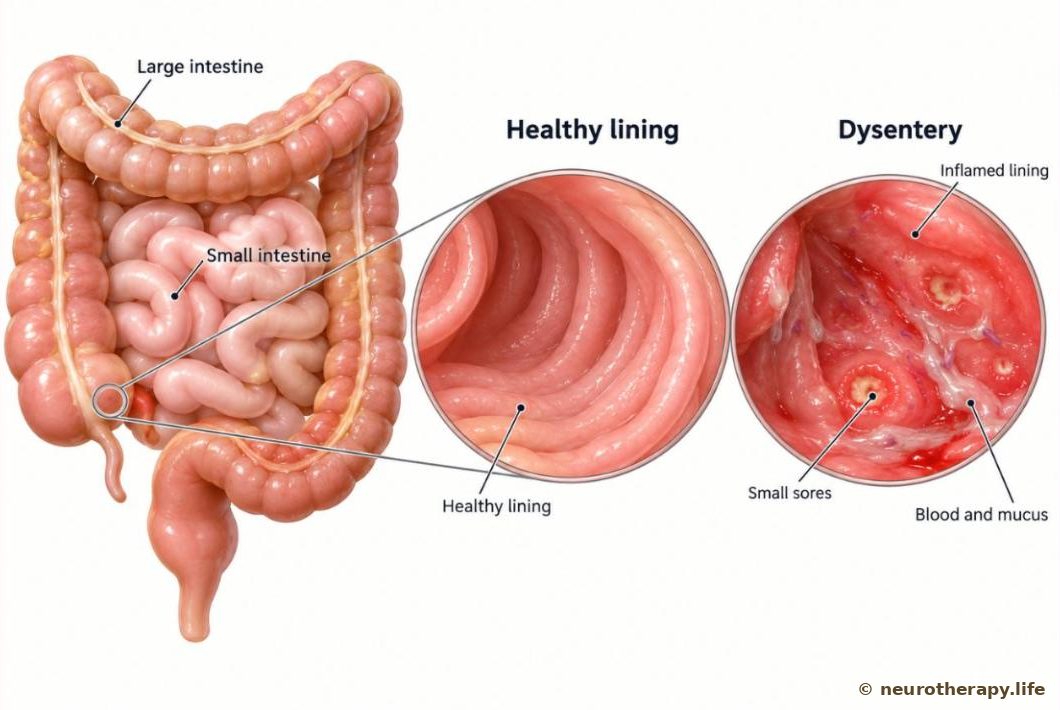
In dysentery, germs get into the large intestine and inflame its lining. The lining swells and forms small sores that bleed, so the motions come often, in small amounts, with blood and mucus, and there is a constant urge to go.
There are two main kinds. Bacillary dysentery is caused by bacteria, most often Shigella, and starts quickly. Amoebic dysentery is caused by a tiny parasite, Entamoeba histolytica; it can come on more slowly and, rarely, spread to the liver.
What are the symptoms?
- Loose motions with blood, and often mucus (a clear slime)
- Cramping belly pain
- A constant urge to pass stool, even when little comes
- Fever, and sometimes nausea or vomiting
- Signs of losing water: thirst, dry mouth, little dark urine, tiredness
What causes it, and who is more likely to get it?
Germs
- Bacteria, most often Shigella — even a small amount swallowed can make you ill
- A parasite, the amoeba Entamoeba histolytica
How it spreads
- Food or drink touched by unwashed hands
- Unclean water, or raw fruit and salad washed in it
- Close contact with someone who has it — germs pass from stool to hands to mouth
Who is at higher risk
- Young children, especially under 5
- Travellers, and people without clean water or toilets
How is it found?
A doctor asks when it started, how often you go, whether there is blood, fever or vomiting, and about recent food, water and travel — and first checks how much water your body has lost.
Stool test
The main test. It finds which germ is causing the dysentery — bacteria or amoeba — so the right treatment can be chosen. Amoebas may need more than one sample.
Blood tests
Can show infection, lost salts, or a strain on the kidneys from losing water.
Looking inside the lower bowel
Sometimes a doctor looks at the lower large intestine with a thin tube (sigmoidoscopy), when the cause is not clear.
A neurotherapist first asks to see the stool report and the doctor's advice. Then the flanks are pressed — Liv° on the right and Mu° on the left — the stool is asked about, and the points around the navel, Dys and Const, are felt. All of it is written on the card before anything is given.
How Neurotherapy sees Dysentery (bloody loose motions)
Neurotherapy began with bellies. Guruji's first patients, in Amritsar in the early 1940s, were a queue of people with constipation, dysentery and other stomach troubles, and he treated them free of charge. That is why, in LMNT, examination begins at the navel. LMNT teaching reads the bowel from two sides: pain at Mu°, the acid side, goes with very hard stools; pain at Liv°, the alkaline side, goes with soft or thin stools, stools again and again, or loose motions.
Two points around the navel, one on each side
- Dysthe dysentery point — right side, between the navel and the rib margin; tender in loose motions
- Constits mirror on the left — the constipation point; tender whenever there is constipation
- Symptoms, not organsthese are the only two front points named for a symptom — they show up as pain where the symptom is
- Block firstin dysentery Gas 'I' and Const are marked on the card as not to be given
LMNT teaching places dysentery together with loose motions, and plans its treatment the same way — so the formulas are described on the loose motions page. What belongs here is the order: the stool report and the doctor first, then the examination, then the blocked points marked, and only then a plan.
Whether or not the patient gets immediate benefit from our treatment, let no harm reach him through our carelessness — attend to this.
Neurotherapy treatment for Dysentery (bloody loose motions), step by step
Doctor and stool report first
Blood in the stool is a reason to see a doctor before anything else. The therapist asks for the stool report and the doctor's advice, and asks about water: urine, dry mouth, dizziness.
Examine first — every day
Liv° and Mu° are compared, the stool is asked about, and Dys and Const are felt. LMNT teaching never gives a treatment without examining the pain points that day — yesterday's picture has already changed.
Block before planning
Gas 'I' and Const are boxed on the card as not to be given while the dysentery lasts. The block is lifted once the chief symptoms have ended.
Treated as loose motions
LMNT teaching sends dysentery to the loose motions plan. The therapist chooses from it according to that day's findings — as support alongside the treatment the doctor has given.
Points and formulas used
Never do this
- Blocked in dysentery: Gas 'I' and Const are not given while it lasts. Const
- Dysentery is an infection. In LMNT's list of blocked points, (6) Adr and (30) Medulla are not given in diseases of infection. (6) Adr
- See a doctor the same day for any blood in the stool. Go at once for: signs of losing a lot of water — little or no urine, sunken eyes, a drowsy or floppy child; high fever; severe belly pain; vomiting that stops you drinking; or a child under 5 with bloody motions.
- Keep drinking, and take ORS. Wash hands with soap after the toilet and before food, and stay off work, school or nursery until 48 hours after the motions stop.
- Cancer: if the person has cancer, (10) Pan, Thymus, Pit, Lu + Sh, Rt. Ov / Lt. Ov and (30) Medulla are never given — the therapist changes the plan.
- Keep taking the medicines your doctor prescribed. Neurotherapy works alongside your medical care, never instead of it.
From Ayurveda and the kitchen
Test yourself
What research says
- Strong evidence
Shigella infects the lining of the bowel. It can cause anything from watery diarrhoea to severe dysentery with frequent small bloody stools and fever. It hits children aged 1 to 4 in poorer countries hardest and still causes about 164,000 deaths a year, and germs resistant to antibiotics are spreading.
- Strong evidence
The wall of the gut carries its own network of nerves, which controls how the bowel moves, what it secretes and its blood flow, working together with the brain. It helps explain why LMNT reads the bowel through points on the belly around the navel.
No clinical trial of Neurotherapy in dysentery has been published yet. Improvements reported by neurotherapists are clinical observations.
For you
Parents of young children
Children under 5 are most at risk. Give ORS from the first loose motion, keep feeding, and take a child with bloody motions to a doctor the same day. Wash your hands well after changing nappies.
Families caring for someone ill
Dysentery spreads easily at home. Wash hands with soap after the toilet and before cooking, wash soiled clothes and bedding in hot water, and clean the toilet every day.
Travellers
Drink only boiled or bottled water, and avoid raw salad or fruit washed in water you are not sure of. Tell the doctor about recent travel if bloody motions start.
People who usually have constipation
Tell your therapist on a day you have loose or bloody motions — the Const point you usually get is not given then.
This page explains; it does not diagnose. Neurotherapy works alongside your medical care — keep taking the medicines your doctor prescribed, and see a doctor for any new or severe symptom.