Conjunctivitis (pink eye)
Conjunctivitis is inflammation of the thin, clear layer over the white of the eye and inside the eyelids. The eye turns red, itchy or gritty and waters. Germs, allergy or irritants can cause it, and most cases settle within a couple of weeks.
- About 6 million people in the US get acute conjunctivitis every year
- Viruses cause up to 80% of infectious cases; allergy affects 15–40% of people
- It usually gets better in a couple of weeks and rarely harms eyesight
Source: Azari & Barney, JAMA 2013 (systematic review); NHS (Conjunctivitis); MedlinePlus (Pink Eye)
What is Conjunctivitis (pink eye)?
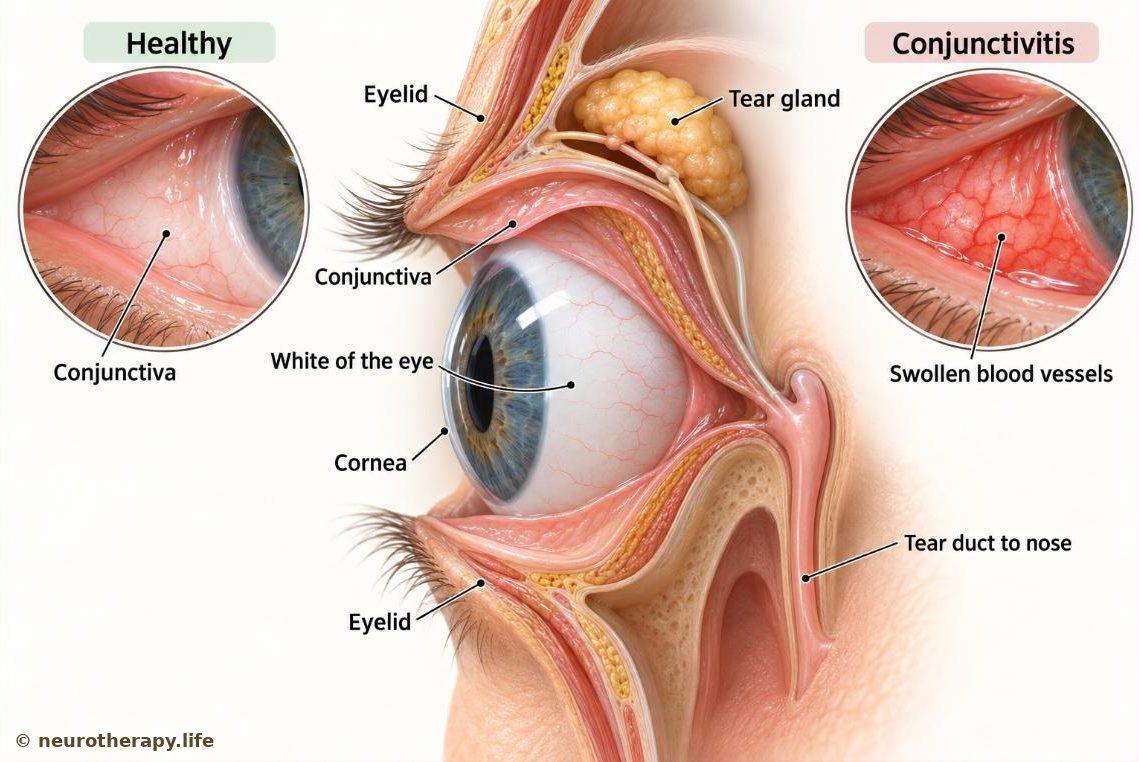
The conjunctiva is a thin, clear skin that covers the white of the eye and lines the inside of the eyelids. It is full of tiny blood vessels. When it is irritated or infected, those vessels swell — and the white of the eye turns pink or red.
Viral and bacterial conjunctivitis spread easily, by hands, towels and pillows. Allergic conjunctivitis — from pollen, dust or pets — does not spread, and itching is its main sign. Smoke, chemicals and eye products can also inflame the eye. Eyes that stay red and watery for a long time need an eye doctor to find the reason.
What are the symptoms?
- Pink or red white of the eye
- Watering eyes
- Itching, burning or a gritty feeling
- Sticky discharge; eyelids stuck together in the morning
- Swollen eyelids — often in both eyes
What causes it, and who is more likely to get it?
Germs — these spread
Allergy — does not spread
Irritants
- Smoke, fumes, chemicals or a splash in the eye
- Contact lens products, eye drops or ointments
How is it found?
Most conjunctivitis is recognised by looking at the eye and asking about the symptoms: itching points to allergy; sticky discharge in both eyes points to germs.
Eye check by a doctor or pharmacist
For a simple red, sticky or itchy eye that is not painful and does not affect your sight.
Eye specialist
Needed for pain, light sensitivity, blurred vision, heavy pus, a contact-lens wearer, a newborn, or when it is not better after about a week or keeps coming back.
A neurotherapist first rules out an eye emergency. Then comes the question LMNT teaches for every long-standing red, watering eye: when exactly did it start, and what happened the day before — a new medicine, an injection, a new product near the eyes? Blood pressure is checked too, because two of the treatments are barred in high BP.
How Neurotherapy (LMNT) sees Conjunctivitis (pink eye)
LMNT reads the name itself. “-itis” at the end of a word means inflammation — conjunctiv-itis is the conjunctiva on fire. So conjunctivitis belongs to the inflammation family, whose seed is the adrenal treatment, (6) Adr × 3 treatments — the adrenal cortex makes the body's own inflammation-calming hormone. The Inflammation Treatment Formula (ITF) builds on it over two days: on the first day (30) Medulla, then (6) Adr twice; on the second day (6) Adr three times.
(5) Medulla is given with it — the fifth cranial nerve carries feeling from the eyelids and the front of the eye. For eyes that stay red and water all the time, LMNT gives (5) Medulla and (6) Adr, and adds Lu + Sh, which Guruji's teaching says reduces watering of the eyes. Because (6) Adr lowers immunity and Lu + Sh raises blood pressure, both have firm bars.
We do not give treatment for any one disease; rather we treat according to the condition of the body on that day.
Neurotherapy (LMNT) treatment for Conjunctivitis (pink eye), step by step
Examine first
Warning signs are asked first. Then the diagnostic points Liv° and Mu°, blood pressure, and the story in order — when it began and what came just before it.
(5) Medulla for the fifth nerve
Given on both sides of the neck below the ears, for the fifth cranial nerve that serves the eyelids and the front of the eye.
The adrenal treatment
(6) Adr × 3 treatments, on the upper back — the treatment LMNT gives for any “-itis”, after checking that immunity is not low and blood pressure is not high.
ITF over two days
Day one: (30) Medulla, then (6) Adr twice. Day two: (6) Adr three times. In a heart patient (30) Medulla is left out and (6) Adr is given seated.
For constant watering — Lu + Sh
Pressure on the shoulders opens the chest; LMNT teaching also gives it to reduce watering of the eyes — only where blood pressure is normal and the heart is healthy.
Points and formulas used
(6) Adr × 3 treatments
The adrenal treatment — aimed at the gland that makes the body's own inflammation-calming hormone; LMNT gives it for any “-itis”, including conjunctivitis.
Works through
Open →Never do this
- Eye emergency — go to an eye hospital the same day: sudden loss of vision, severe eye pain, an eye that cannot bear light, a very red eye, an injury to the eye, or chemicals in the eye. A baby under a month old with red, sticky eyes needs a doctor urgently. Eyes
- (6) Adr lowers immunity, so it is never given where immunity is already low — septicaemia, cancer, AIDS — nor in heart disease or high blood pressure. (6) Adr
- In ITF, (30) Medulla is not given to heart patients; if needed, (6) Adr is given with the patient seated. (30) Medulla
- Lu + Sh raises blood pressure — it is not given in high blood pressure or heart disease. Lu + Sh
- Nothing presses on the eyeball. The tear-duct point at the inner corner of the eye is not given in a red, painful eye, after an eye injury or recent eye surgery, or where the inner corner is hot, red and swollen. Hands are washed before and after touching near the eyes. Lacrimal Point
- Cancer: if the person has cancer, (10) Pan, Thymus, Pit, Lu + Sh, Rt. Ov / Lt. Ov and (30) Medulla are never given — the therapist changes the plan.
- Keep taking the medicines your doctor prescribed. Neurotherapy (LMNT) works alongside your medical care, never instead of it.
From practice
The woman whose eyes watered for months
A case recorded in the therapy's own account, from Guruji's practice — the patient's name was not recorded
A woman · red, itching, burning, watering eyes for many months
- What was found
- The clue was not in the eyes but in her story. Some time earlier she had been given an injection for a quite different illness, and from the very next morning her eyes had begun to itch, burn and water. A complaint that starts the day after a medicine, in a part of the body the medicine was not given for, was read as a reaction to that medicine — a kind of inflammation.
- What was done
- She was given the adrenal treatment, (6) Adr × 3 treatments, just once. The account records that the benefit came at once. The same treatment was later tried on many people with such reactions to medicines, and Guruji went on using it for that purpose for decades.
- What it teaches
- The deciding question was about time, not about the eye: when did it start, and what happened the day before? One treatment was given and the result was watched — and only after many more people was it taught as a use.
From Ayurveda and the kitchen
Resting the eyes with warm palms
The yoga texts teach palming: rub the palms warm and cup them over closed eyes, touching nothing, until the darkness is complete. Like the gentle eye work of LMNT, it makes no claim to treat an eye disease — it is a way of caring for a tired organ. With an infection, wash your hands first.
Test yourself
What research says
- Strong evidence
Viruses cause most infectious conjunctivitis, allergy is very common, and many cases settle on their own within one to two weeks. Pain, light sensitivity, loss of vision or heavy pus mean an eye specialist is needed.
Azari AA, Barney NP. Conjunctivitis: a systematic review of diagnosis and treatment. JAMA. 2013.
No clinical trial of Neurotherapy (LMNT) in conjunctivitis has been published yet. Improvements reported by neurotherapists are clinical observations.
For you
Families, schools and hostels
Infectious conjunctivitis spreads fast. Wash hands often, keep your own towel and pillow, wash them in hot water, and try not to rub your eyes.
Contact lens wearers
Take the lenses out until the eyes are completely better, and see a doctor — lens wearers need a proper eye check.
Parents of babies
A newborn with red, sticky eyes needs a doctor urgently, and children under two should always be seen by a doctor.
People using eye drops
Keep using the drops your doctor gave you. If the trouble goes completely, ask that doctor whether you still need them — the decision is theirs.
This page explains; it does not diagnose. Neurotherapy (LMNT) works alongside your medical care — keep taking the medicines your doctor prescribed, and see a doctor for any new or severe symptom.