Chorea
Chorea causes quick, jerky, dance-like movements of the face, arms or legs that the person cannot control. It is a sign of another condition affecting the brain, not a disease on its own.
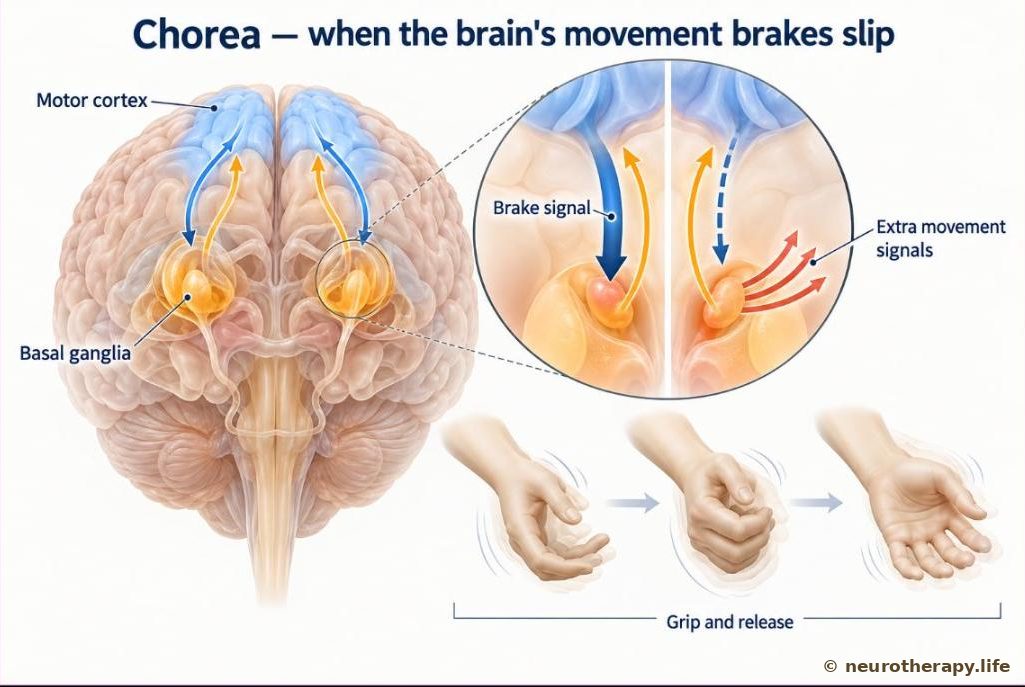
- The name comes from the Greek word for "to dance"
- Movements usually get worse with stress or illness and settle during sleep
- Sydenham chorea in children, after rheumatic fever, usually settles within two years
Source: Cleveland Clinic; MedlinePlus; Bhidayasiri & Truong, Postgraduate Medical Journal 2004
What is Chorea?
Deep inside the brain sits a group of centres called the basal ganglia. They work like brakes and filters for movement — they let through the movements you want and hold back the ones you do not.
In chorea these brakes slip. Short, random movements break through: fingers bending and straightening, a face grimacing, a shoulder rising, a tongue that darts in and out. They can look like fidgeting, and people often try to hide them inside a normal movement.
What are the symptoms?
- Quick, jerky movements that cannot be stopped at will
- Face grimacing, or the tongue darting in and out
- A grip that squeezes and lets go on its own ("milkmaid's grip")
- Trouble walking, speaking or swallowing
- Movements that worsen with stress and fade in sleep
What causes it, and who is more likely to get it?
Inherited
- Huntington's disease — a genetic brain condition
- Wilson disease — copper building up in the body
After infection or immune reaction
- Sydenham chorea in children, after a strep throat and rheumatic fever
- Lupus and some other autoimmune conditions
Medicines and body chemistry
- Some medicines, such as those for Parkinson's disease, fits or mood
- Thyroid disease
- Pregnancy (a rare type)
Damage to the brain
How is it found?
Chorea is seen by the doctor on examination. The tests look for the cause behind it.
Blood tests
Blood count, body chemistry, thyroid, copper, and tests for a recent strep infection or for autoimmune disease.
Brain scan
A CT or MRI scan of the brain, to look for a stroke or other change.
Genetic test
If Huntington's disease runs in the family, a blood test can check the gene — after proper counselling.
A neurotherapist asks for the doctor's diagnosis and reports, and then examines the kidney points and the ring fingers before choosing any formula.
How Neurotherapy (LMNT) sees Chorea
LMNT teaching lists chorea among the conditions for which the New Star Modified formula has been given with benefit. That formula belongs to the Star family, which LMNT uses for joint pain and rheumatoid arthritis. The formula is chosen by the body's findings, not by the name of the disease.
Before choosing, the therapist squeezes both kidney points (Liv° and Mu°) and both ring fingers together — the "two-key rule". New Star Modified is given when Mu° is clearly painful. It is not given when the pain is only in the right ring finger, or only at Liv°.
We do not give treatment for any one disease; rather we treat according to the condition of the body on that day.
Neurotherapy (LMNT) treatment for Chorea, step by step
Examine first — the two-key rule
The therapist presses Liv° and Mu° and both ring fingers, and asks for the doctor's diagnosis and reports.
New Star Modified — only when the findings fit
Given when Mu° is clearly painful, together with equal pain in both ring fingers, more pain in the left, equal pain at Liv° and Mu°, or more at Mu° than at Liv°.
Keep the medical care going
The cause of chorea — an infection, a medicine, a thyroid problem or an inherited condition — is looked after by the doctor. LMNT is given alongside that care, never instead of it.
Points and formulas used
New Star Modified
A Star-family formula for joint pain and rheumatoid arthritis; LMNT teaching records benefit with it in chorea too. Given only when the kidney points and ring fingers call for it.
Open →Never do this
- Never give New Star Modified where the pain is only in the right ring finger, or only at Liv° with none at Mu°. New Star Modified
- New jerky movements always need a doctor first. Go the same day if they start suddenly, on one side of the body, after a new medicine, in pregnancy, or in a child after a sore throat or fever. Go to a hospital at once if they come with weakness, confusion, a fit, or chest pain and breathlessness.
- Huntington's disease and other lifelong causes: LMNT may support comfort and daily function, alongside the doctor's care and therapy. It does not promise to reverse the condition.
- Children get half the adult dose and light treatment only, given by a trained therapist.
- Cancer: if the person has cancer, (10) Pan, Thymus, Pit, Lu + Sh, Rt. Ov / Lt. Ov and (30) Medulla are never given — the therapist changes the plan.
- Keep taking the medicines your doctor prescribed. Neurotherapy (LMNT) works alongside your medical care, never instead of it.
From Ayurveda and the kitchen
Test yourself
What research says
- Strong evidence
A review explaining that chorea means irregular, random, involuntary movements that worsen with stress and settle in sleep. Sydenham chorea is the commonest type in children; Huntington's disease and medicines are common causes in adults.
Bhidayasiri R, Truong D. Chorea and related disorders. Postgraduate Medical Journal. 2004.
No clinical trial of Neurotherapy (LMNT) in chorea has been published yet. Improvements reported by neurotherapists are clinical observations.
For you
Parents
A child who suddenly becomes clumsy, fidgety or grimaces after a sore throat or fever needs a doctor — Sydenham chorea can come with heart trouble from rheumatic fever.
Families with Huntington's disease
Keep with the neurologist, physiotherapy and speech therapy. A calm home helps, because stress makes the movements worse.
People on long-term medicines
Some medicines can cause chorea. Do not stop any medicine yourself — tell your doctor and your therapist.
This page explains; it does not diagnose. Neurotherapy (LMNT) works alongside your medical care — keep taking the medicines your doctor prescribed, and see a doctor for any new or severe symptom.