Cerebral atrophy
Cerebral atrophy means the brain has lost cells and the links between them, so it shrinks — in one area or all over. It can affect memory, speech, mood and movement.
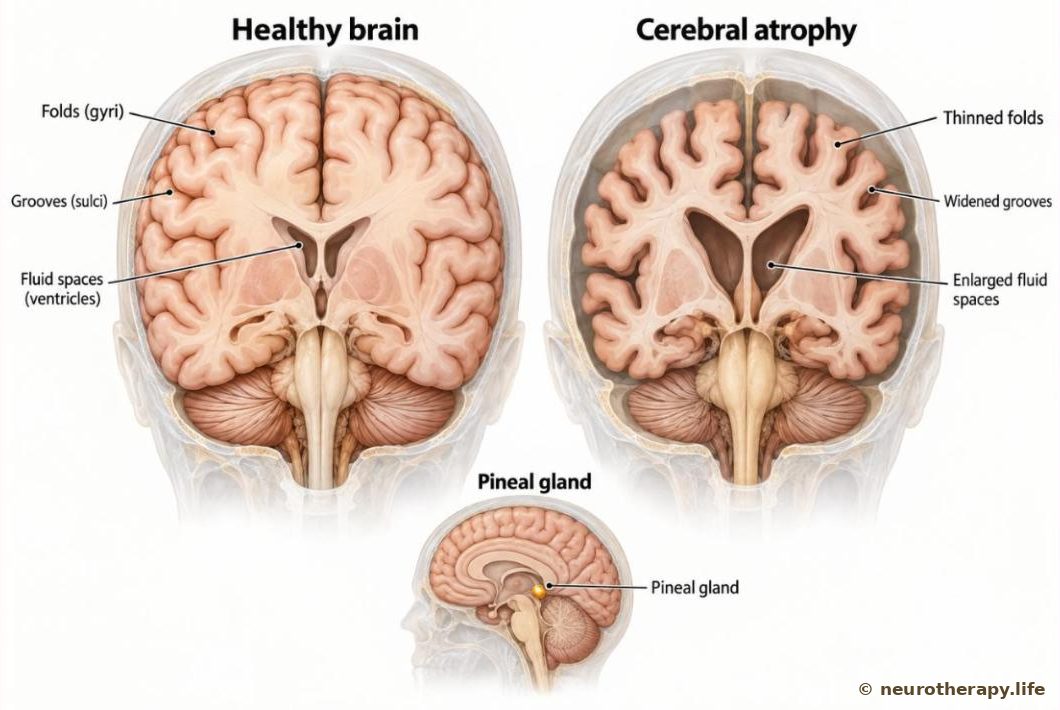
- After age 40, brain volume falls by around 5% per decade — faster after 70
- It can be focal (one area) or generalised (the whole brain)
- Lost brain cells do not grow back, so care aims to slow it and support daily life
Source: Peters R, Postgraduate Medical Journal 2006; Cleveland Clinic
What is Cerebral atrophy?
Your brain is made of billions of nerve cells joined by countless connections. Everyone loses some of them with age. Cerebral atrophy is when this loss goes faster than normal ageing, or is caused by a disease or injury.
It is not one disease but a sign seen on a scan. What it does depends on where it happens: memory and thinking, speech, mood, or fits. It usually cannot be reversed — so the aim is to protect what remains and keep daily life going.
What are the symptoms?
- Memory loss and trouble thinking or planning
- Changes in mood, behaviour or personality
- Trouble speaking, finding words or understanding speech
- Fits (seizures)
- Poor balance or coordination, depending on the area affected
What causes it, and who is more likely to get it?
Ageing
- Some shrinking is normal with age — atrophy is when it goes faster
Brain diseases
- Alzheimer's disease and other dementias
- Multiple sclerosis
- Huntington's disease
Injury and blood supply
- Stroke
- Head injury
Infections
- Encephalitis (infection of the brain)
- HIV/AIDS
From birth
How is it found?
Atrophy is seen on a brain scan. A doctor also tests memory, speech and movement to find which part is affected and why.
Neurological examination
Checks memory, language, problem-solving, eye movement and coordination.
MRI scan
The most sensitive scan. It shows shrinking in one area or all over.
CT scan
A quicker scan that also shows atrophy, though it misses small changes more often.
A neurotherapist asks for the MRI or CT report. Before the first session the therapist asks two questions that change the plan: is your blood pressure low, and — for a woman — is she menstruating? The main LMNT point for this condition is not given in either case.
How Neurotherapy sees Cerebral atrophy
In LMNT, the key treatment for cerebral atrophy is a single, long hold at the base of the spine: (½) Ku – 40 secs. LMNT teaching gives it to stimulate the pineal gland, for melatonin, and to support disorders of the brain, speech and the brain fluid — and rates it very highly for cerebral atrophy.
What (½) Ku – 40 secs is taught to reach
- (½) Ku – 40 secsone press with the middle of the sole at the base of the spine, held for forty seconds
- Pineal glanda tiny gland deep in the centre of the brain
- Melatoninits hormone — the night-time messenger of sleep
- Brain, speech and brain fluidthe disorders LMNT aims this timing at
For brain disease more widely, LMNT teaching also gives the body-pain, brain-disease and paralysis UDF formula (with Necklace first), M. Heparin, H arrow and Dorsal — and says plainly that research on this is still going on. The aim is comfort, function and daily ability, not a promise to regrow what is lost.
I am yet to understand the human body. My knowledge is hardly the tip of the iceberg. Neurotherapy is just in its infancy. There is a long way to go.
Neurotherapy treatment for Cerebral atrophy, step by step
Examine first
The therapist checks Liv° and Mu°, reads the scan report, and asks about low blood pressure, menstruation, diabetes, stomach acid and heart disease.
Digestion first
For brain disease, LMNT gives the body-pain, brain-disease and paralysis UDF formula, beginning with Necklace.
(½) Ku – 40 secs
Lying face down, one press with the middle of the sole at the base of the spine, held once for forty seconds, then released gently. Never two holds of twenty — that is a different treatment.
Check Mu° again
If pain remains at Mu° after Ku, Round Arrow is given as needed until the Mu° pain clears.
Circulation to the brain
M. Heparin and H arrow may be added. LMNT teaching marks this brain-disease work as research still going on.
Points and formulas used
Body pain, brain disease, paralysis
Sets digestion right first — LMNT's formula for body pain, brain disease and paralysis.
Open →Never do this
- Ku in every form, including (½) Ku – 40 secs, is never given during menstruation or to people with low blood pressure. The therapist asks about both before the session. (4) Ku
- (10) Medulla, part of the brain-disease UDF formula, is not given in diabetes, cancer or raised stomach acid. Heart patients get only (10) Left Medulla. (10) Medulla
- Sudden weakness or numbness on one side, a drooping face, sudden trouble speaking, a sudden severe headache or a first fit: this may be a stroke — go to hospital at once. Stroke, or a passing weakness, numbness or loss of vision, within three months
- Cerebral atrophy usually cannot be reversed. LMNT may support comfort, function and daily ability; keep the neurologist's care, physiotherapy and speech therapy going.
- Cancer: if the person has cancer, (10) Pan, Thymus, Pit, Lu + Sh, Rt. Ov / Lt. Ov and (30) Medulla are never given — the therapist changes the plan.
- Keep taking the medicines your doctor prescribed. Neurotherapy works alongside your medical care, never instead of it.
Watch

A demo of the M. Heparin formula — the Heparin formula headed by Medulla ((6) Medulla, (8) Pan, (7) Liv, (8) Chest Only) — used for neck and shoulder pain and for headache that keeps coming back.
How M. Heparin is given — (6) Medulla, (8) Pan, (7) Liv and (8) Ch. Only. The video shows it for neck pain and headache; here it is shown for the technique, as one part of LMNT's brain-disease work.
From Ayurveda and the kitchen
Test yourself
What research says
- Strong evidence
Brain volume falls by around 5% per decade after 40, faster after 70. Nerve cells shrink or are lost, the insulating myelin wears, and blood flow to the brain falls with age.
Peters R. Ageing and the brain. Postgraduate Medical Journal. 2006;82(964):84-88.
- Strong evidence
The pineal gland makes melatonin, which rises at night in darkness and helps set the sleep cycle. The review also notes that melatonin protects against the breakdown of nerve cells.
Ilahi S, Beriwal N, Ilahi TB. Physiology, Pineal Gland. StatPearls. 2023.
No clinical trial of Neurotherapy in cerebral atrophy has been published yet. Improvements reported by neurotherapists are clinical observations.
For you
Families and carers
Keep a simple diary of memory, speech, sleep and mood. It helps the doctor and the therapist see what is changing.
Women
Tell your therapist when your period starts — Ku is paused on those days.
People with low blood pressure
If you feel faint on standing, say so. Ku is not given with low blood pressure, so the therapist plans around it.
This page explains; it does not diagnose. Neurotherapy works alongside your medical care — keep taking the medicines your doctor prescribed, and see a doctor for any new or severe symptom.