Carpal tunnel syndrome
Carpal tunnel syndrome is numbness, tingling and pain in the thumb and first fingers, often worse at night. A nerve is squeezed in a narrow tunnel at the wrist. Caught early it can settle, but pressure left for too long can damage the nerve for good.
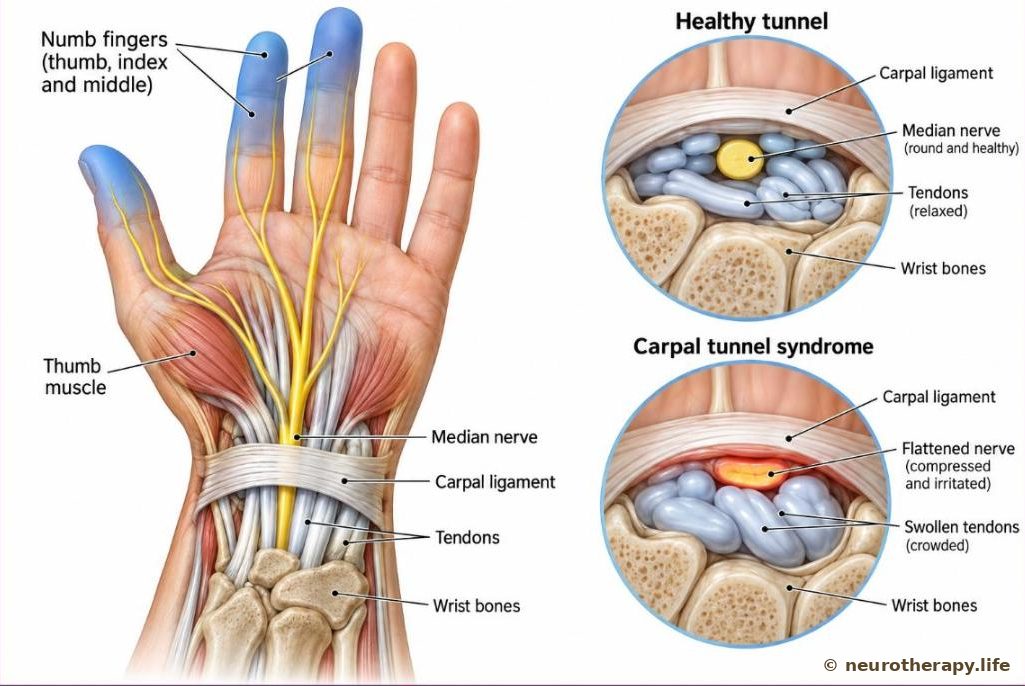
- Women get it about three times as often as men
- It usually starts between 40 and 60 years of age
- Bending the wrist fully can raise the pressure inside the tunnel 8 to 10 times
Source: MedlinePlus; StatPearls (Sevy, Sina & Varacallo, 2023); Cleveland Clinic; NHS
What is Carpal tunnel syndrome?
At the front of the wrist, the small wrist bones form a groove, and a tough band bridges over it like a roof. This narrow passage is the carpal tunnel. Through it run the tendons that bend the fingers and the median nerve, which gives feeling to the thumb, index, middle and half the ring finger.
The tunnel cannot stretch. When anything inside it swells — the linings of the tendons, fluid in pregnancy, arthritis — the nerve is squeezed. Its own tiny blood vessels are pressed shut, the nerve runs short of blood, and it starts to tingle and go numb. Pressure left for months can damage the nerve's coating and waste the thumb muscle.
What are the symptoms?
- Numbness, tingling or pins and needles in the thumb, index, middle and half the ring finger
- Worse at night — waking up and shaking the hand for relief
- Burning or aching pain that may spread up the forearm
- A weak grip, dropping things, difficulty with buttons
- Fingers feel swollen although they are not
- Later, the muscle at the base of the thumb gets thinner
What causes it, and who is more likely to get it?
Work and hands
- Repeated bending of the wrist and gripping — assembly work, carpentry, typing
- Vibrating power tools
Health conditions
Body changes
Injury and family
- A broken or sprained wrist in the past
- Carpal tunnel syndrome in the family
How is it found?
The doctor asks which fingers are numb and when, and examines the hand and wrist. Tests confirm how badly the nerve is squeezed and look for a cause.
Tinel's and Phalen's tests
Tapping over the nerve, or holding the wrist bent for a minute, to see if the tingling comes.
Nerve conduction study and EMG
Measure how fast the nerve carries signals and whether the thumb muscle is affected.
Ultrasound or X-ray
Show the nerve and the tunnel, or a bone problem in the wrist.
Blood tests
To look for diabetes, thyroid problems or arthritis behind it.
The neurotherapist asks which fingers go numb. A numb little finger, numbness running from the neck, or numbness of the whole arm is a different picture. The thumb muscle is looked at for thinning. Because LMNT treats this with a circulation formula also used for the heart, any heart trouble is asked about. Then Liv°, Mu° and the navel points.
How Neurotherapy sees Carpal tunnel syndrome
LMNT places carpal tunnel syndrome with the circulation. Guruji taught that wherever blood flow is blocked, pain or numbness is felt in that part. So P. Heparin — the formula for blood flow and clots — lists "intense pain or numbness in the fingers of the hands" among its uses, and the Angina / Athero treatment names carpal tunnel and tarsal tunnel syndrome among its main illnesses. For a numb hand, Vasanti is added: a very soft stroke with the sole, from the fingers up to the elbow.
Here medical science and LMNT look at the same thing from two sides: the squeezed nerve runs short of blood through its own tiny vessels. But the pain points still decide on the day — if Mu° is painful with hard constipation, the therapist changes one part of the treatment.
Whenever there is an obstruction or blockage in the blood circulation of any part of the body, then pain or numbness is felt in that part.
Neurotherapy treatment for Carpal tunnel syndrome, step by step
Examine first
Which fingers are numb, is the thumb muscle thinning, is there any heart trouble? Then Liv° and Mu° — Mu° pain with hard constipation changes the plan.
Angina / Athero treatment — the neck and upper back
Seated: (4) Medulla Clockwise, the Up Arrow at T1/T2, and the Raman lift of the shoulder muscles. Then, lying down, (10) Pan and (2) Thrd, and (1) Single point Liv given twice.
P. Heparin with Sulta Ulta
P. Heparin — (8) Pan (7) Liv (8) Ch. Only — with Sulta Ulta: the soft part of the sole stroked six times from elbow to wrist and six times from wrist to fingertips, palm up and then palm down. The treatment ends with A. Heparin and Sulta Ulta. If Mu° is painful with hard constipation, the P. Heparin part is replaced.
Vasanti for the numb hand
With the soft middle of the sole, very softly, from the fingers up to the elbow. The direction is always towards the body — for the hand, fingers to elbow; for the leg, heel to knee.
Points and formulas used
P. Heparin (plasmin)
The Heparin formula for blood flow and clots — LMNT lists intense pain or numbness in the fingers among its uses.
Works through
Open →Angina / Athero treatment
A four-part circulation treatment written for the heart and arteries; LMNT names carpal and tarsal tunnel syndrome among its main illnesses.
Works through
Open →Never do this
- Numbness that never goes away, a weak thumb, dropping things, or a thinning muscle at the base of the thumb: see a doctor soon. A nerve squeezed for too long can be damaged for good.
- Arm numbness or pain with chest pain, breathlessness or sweating, or with a drooping face or slurred speech, is an emergency: call 108 / 112. Nothing is given. Stroke, or a passing weakness, numbness or loss of vision, within three months
- Numbness is not a sign that the treatment is working. When Liv is given on the arm and tingling runs into the hand, the therapist lets go at once and repositions. Vasanti is given very softly — a numb hand cannot report pressure. Vasanti
- Bars carried by these formulas: Pan is not given in fits (except inside the Heparin formula) and never in schizophrenia; Liv not in liver cancer; Ch. Only not in lung cancer; the acid point of A. Heparin not with loose motions or without pain at Mu°; heart patients get (2) Thrd, never (4) Thrd. Angina / Athero treatment
- Cancer: if the person has cancer, (10) Pan, Thymus, Pit, Lu + Sh, Rt. Ov / Lt. Ov and (30) Medulla are never given — the therapist changes the plan.
- Keep taking the medicines your doctor prescribed. Neurotherapy works alongside your medical care, never instead of it.
Watch

Shows the P. Heparin formula: (8) Pan at the top of the thighs, (7) Liv on the thigh and forearm, and (8) Chest Only with the palms on the chest. In the video it is given as the last part of the Angina treatment, to support circulation.

This video shows the right way to give (4) Medulla, Raman and the T1–T2 point for neck and shoulder pain and numbness.
How P. Heparin is given, and how (4) Medulla, Raman and the T1–T2 point are given — the parts of the Angina / Athero treatment named for carpal tunnel syndrome.
From Ayurveda and the kitchen
Test yourself
What research says
- Strong evidence
Carpal tunnel syndrome affects about 1–5% of people, three women for every man, mostly between 40 and 60. The median nerve is squeezed and stretched in the tunnel: blood cannot drain away, fluid builds up, and the nerve's own tiny blood vessels fail. Repeated pressure then strips the nerve's coating, and in the end the thumb muscle wastes.
Sevy JO, Sina RE, Varacallo MA. Carpal Tunnel Syndrome. StatPearls. 2023.
No clinical trial of Neurotherapy in carpal tunnel syndrome has been published yet. Improvements reported by neurotherapists are clinical observations.
For you
Pregnant women
Fluid in pregnancy often crowds the wrist tunnel. Tell your doctor about numb fingers, and tell your therapist you are pregnant before any treatment.
People with diabetes or thyroid problems
Both make carpal tunnel more likely. Keep your sugar and thyroid checked, and remind your therapist that numb hands need a very soft touch.
People who type or use tools all day
Keep the wrist straight, take short breaks, and cut down repeated bending and gripping. A wrist splint worn at night keeps the wrist straight while you sleep.
This page explains; it does not diagnose. Neurotherapy works alongside your medical care — keep taking the medicines your doctor prescribed, and see a doctor for any new or severe symptom.