Neurotherapy Support in Cancer Care
Cancer is a group of diseases in which some cells grow out of control and can spread. It is treated by a cancer doctor (oncologist) — with surgery, radiation, chemotherapy and other care. LMNT does not treat cancer. It is offered only as gentle support for comfort, alongside that treatment and never instead of it.
- Cancer caused nearly 10 million deaths in 2024 — nearly one in six deaths worldwide
- About 38% of cancers can be prevented today — tobacco, alcohol, weight, diet and exercise matter
- Many cancers can be treated successfully when found early and treated well
Source: World Health Organization — Cancer fact sheet; MedlinePlus
What is Neurotherapy Support in Cancer Care?
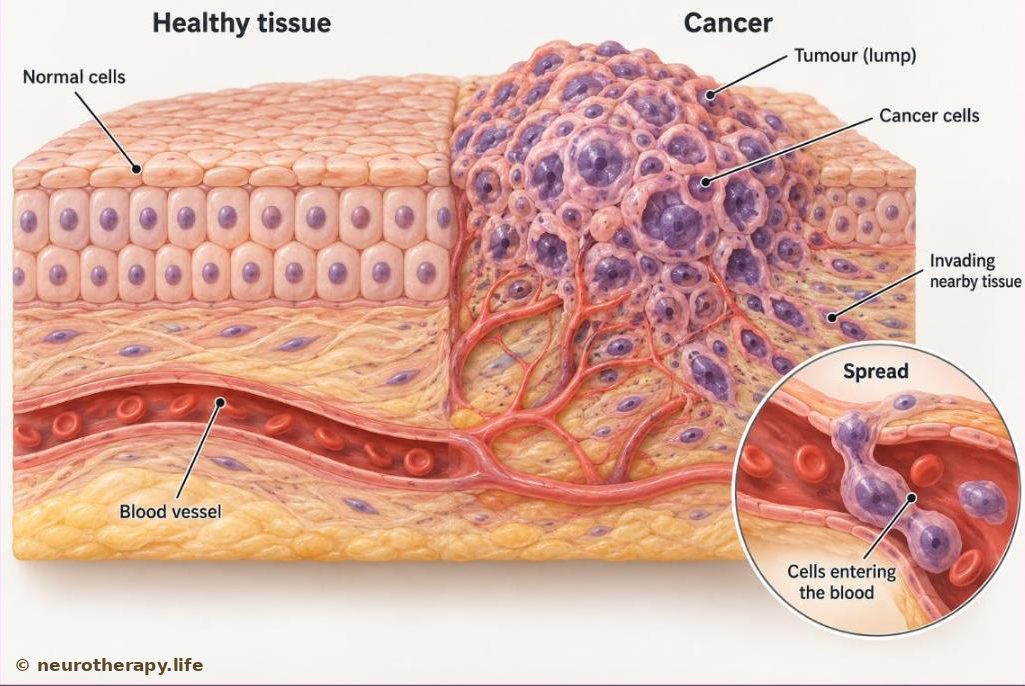
Your body is made of trillions of cells. Normally, new cells are made only when the body needs them, and old or damaged cells die. In cancer, changes in a cell's genes break this order: new cells keep growing when they are not needed, and old cells do not die when they should.
The extra cells can form a lump called a tumour. A benign tumour stays in its place. A malignant (cancerous) tumour can push into nearby tissue and break away to other parts of the body — this spread is called metastasis. Blood cancers, such as leukaemia, start in the bone marrow instead of forming a lump.
What are the symptoms?
- A new lump or thickening anywhere in the body
- Weight loss without trying, or tiredness that does not go
- Unusual bleeding or bruising — blood in the urine or stool
- A sore that does not heal, or a mole that changes
- Trouble swallowing, or a cough or hoarse voice lasting weeks
- Often no pain at all in the early stage
What causes it, and who is more likely to get it?
Changes in the genes
- Gene changes inside cells — most are not inherited from parents
- Growing older
Daily habits
- Tobacco in any form, and alcohol
- Excess body weight, too little fruit and vegetables, too little exercise
Surroundings and infections
- Strong sunlight, some chemicals and radiation
- Some long-lasting infections, such as hepatitis B and C (liver) and HPV (cervix)
How is it found?
There is no single test for cancer. The doctor takes a history, examines the person and chooses tests according to the part of the body involved.
Screening tests
Tests such as a mammogram (breast) or colonoscopy (bowel) look for cancer before there are any signs.
Blood tests and scans
Blood tests, X-rays, CT, MRI or ultrasound show what is happening inside and whether it has spread.
Biopsy
A small piece of tissue is taken and checked under a microscope. This is what confirms cancer and its type.
A neurotherapist asks every patient once, at the first visit and on paper, whether they have ever been treated for cancer. For a cancer patient the therapist reads the oncologist's letter, asks which organ the cancer is in and what treatment is going on now — before any plan is made.
How Neurotherapy sees Neurotherapy Support in Cancer Care
LMNT teaching is plain about this: nothing in this therapy treats a cancer, and no therapist of this therapy says otherwise. What it can offer is gentle hands-on support for comfort, given alongside the cancer team's treatment. So the first thing a therapist does for a cancer patient is not to add points but to close them — a fixed list of points is never given in cancer.
And one rule counts for more than the list: find out which organ the cancer is in, and leave out any point aimed at that organ. In lung cancer, Ch. Only and Thymus are not given; in liver cancer, Liv is not given; in kidney cancer, Liv° and Mu° are not stimulated; in cancer of a lymph node, Lymph and Armpits are not given. The treatment is kept light — two or three light sessions in place of one heavy one.
In this therapy we do not treat the disease; rather, we improve the body.
Neurotherapy treatment for Neurotherapy Support in Cancer Care, step by step
The cancer team stays in charge
Every scan, surgery, chemotherapy and radiation appointment is kept. Neurotherapy runs alongside, never instead — the therapist says this out loud at the first visit and once more in writing.
Examine first
The therapist checks the diagnostic points Liv° and Mu°, reads the latest reports, and asks which organ is affected, what treatment is going on, and about bruising, fever and tiredness.
Close the barred points
Before the plan is written, the whole cancer list is struck out on the card, and then the organ rule is applied: any point aimed at the organ the cancer is in is left out too.
Gentle support — light and exact
In place of (4) Adr and (4) Pan, LMNT gives (2) Pan — pressed for exactly six seconds, never longer (not in cancer of the pancreas). (1) point Liv × 6 treatments may be given through the day (not in liver cancer). Two or three light sessions replace one heavy one.
Points and formulas used
Never do this
- Never given in cancer: (10) Pan, Thymus, Pit, Lu + Sh, Rt. Ov / Lt. Ov and (30) Medulla. LMNT teaching also bars WD, (10) Medulla, (4) Adr, (6) Adr, (4) Pan and — nowadays — Spl. These points can push up sugar, oestrogen or growth, or lower immunity. Pit
- The organ rule: no point aimed at the organ the cancer is in — no (2) Pan in cancer of the pancreas, no Liv in liver cancer, no Ch. Only or Thymus in lung cancer, no Liv° or Mu° in kidney cancer, no Lymph or Armpits in cancer of a lymph node. Liv
- (2) Pan is pressed for exactly six seconds. Held longer, it acts like (4) Pan, which is barred in cancer — the count is the safety. (2) Pan
- No repeated pressure over a known tumour, over bone the cancer has reached, or over an area given radiation. No work on an arm or leg that swelled after lymph nodes were removed without the cancer team's word. During chemotherapy the body bruises and catches infection easily — hands stay light.
- Never delay, reduce, refuse or stop the treatment your cancer specialist advises. A treatable cancer treated late may no longer be treatable.
- See a doctor the same day for new back pain in anyone who has had cancer, pain that wakes you at night or runs round the body like a band, new numbness or weakness, or a change in bladder or bowel control. Go to hospital at once for fever or shivering during chemotherapy, bleeding that will not stop, or breathlessness. Weight loss is never called the treatment working.
- Cancer: if the person has cancer, (10) Pan, Thymus, Pit, Lu + Sh, Rt. Ov / Lt. Ov and (30) Medulla are never given — the therapist changes the plan.
- Keep taking the medicines your doctor prescribed. Neurotherapy works alongside your medical care, never instead of it.
From Ayurveda and the kitchen
Test yourself
What research says
- Emerging evidence
This review pooled trials of massage in people with cancer. Massage helped reduce pain, tiredness and anxiety, but the studies were small and varied, so firm conclusions cannot yet be drawn. It supports touch as comfort care — not as a treatment for the cancer itself.
- Strong evidence
A landmark review of what cancer cells do differently: they keep sending themselves growth signals, ignore signals to stop or die, build their own blood supply, and invade and spread. It explains why cancer needs specialist treatment aimed at those cells.
Hanahan D, Weinberg RA. Hallmarks of cancer: the next generation. Cell. 2011;144(5):646-674.
No clinical trial of Neurotherapy in cancer has been published yet. Improvements in comfort reported by neurotherapists are clinical observations.
For you
People on chemotherapy or radiation
Tell your therapist your treatment dates and latest blood counts. Skip a session on days of fever, and tell your cancer team that you are receiving Neurotherapy.
Families and carers
Comfort matters a great deal, but it must never replace an appointment. If anyone suggests delaying treatment because the pressing is helping, stop and ask the oncologist.
Anyone with a new lump or unexplained weight loss
Get a doctor's opinion this week. A lump is something to be identified, not something to be pressed.
This page explains; it does not diagnose. Neurotherapy works alongside your medical care — keep taking the medicines your doctor prescribed, and see a doctor for any new or severe symptom.