Vitiligo (White Patches, Leucoderma)
Vitiligo causes patches of skin to lose their colour and turn white or pale, because the cells that make skin colour stop working. It is not an infection, you cannot catch it, and it does not harm your general health — but it can weigh heavily on how a person feels.
- About 1 in every 100 people in the world has vitiligo
- It usually begins before the age of 30, but can start at any age
- It is not an infection — you cannot catch it from another person
Source: Cleveland Clinic; NHS (UK); MedlinePlus
What is Vitiligo (White Patches, Leucoderma)?
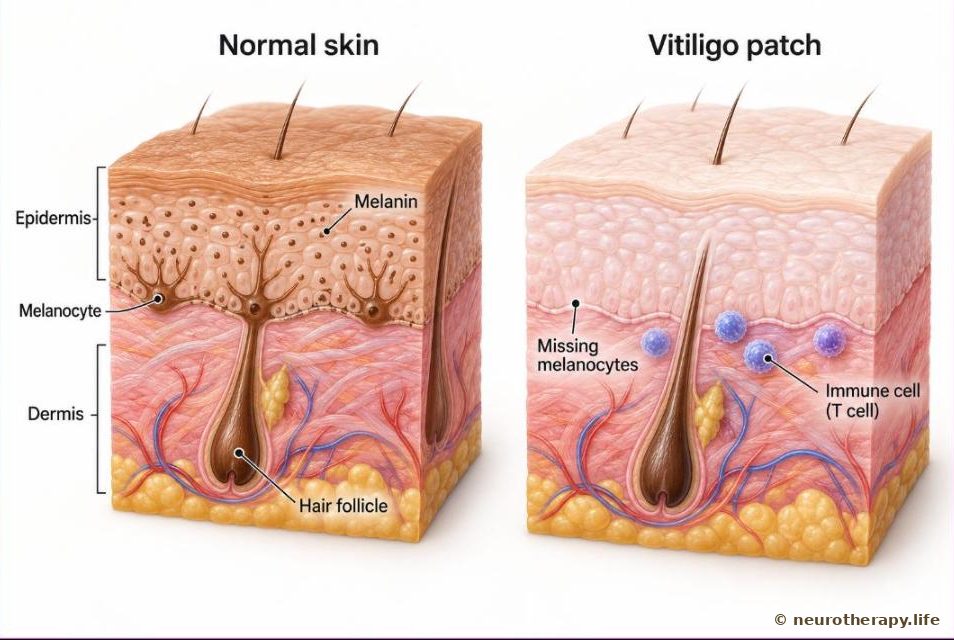
Skin gets its colour from melanin, a brown pigment made by special cells called melanocytes. In vitiligo, these cells are destroyed or stop working in some places, and the skin there turns white. In most people the body's own defence system — the immune system — attacks the pigment cells by mistake.
The patches often start on the face, hands, neck and skin folds. Some stay small for years; others slowly spread. The white skin is healthy skin in every other way, but it burns easily in the sun because it has lost its natural shade.
What are the symptoms?
- White or paler patches of skin, often on the face, hands, neck, around the mouth and eyes, and in skin folds
- Hair on a patch — including the eyebrows, eyelashes or beard — turning white or grey
- In darker skin, loss of colour inside the mouth
- Patches that slowly grow or new patches that appear over time
- Sometimes a mild itch, and patches that sunburn easily
What causes it, and who is more likely to get it?
The immune system
Family
- It can run in families
Triggers
- Stress
- Skin injury or bad sunburn
How is it found?
Other skin conditions can also leave pale patches, so a doctor — ideally a skin specialist (dermatologist) — should confirm what the patches are. Usually looking at the skin is enough, with one or two simple checks.
Examination of the skin
The doctor looks at where the patches are and how they have changed, and asks about family history, skin injuries and sunburn.
Wood's lamp
A small ultraviolet lamp in a dim room makes the patches show up clearly, which helps tell vitiligo apart from other pale patches.
Thyroid blood test
Because thyroid problems are more common with vitiligo, the doctor may check thyroid function.
A neurotherapist asks gently how long the patches have been there, and — the question that matters most here — whether the bowel opens every day. The Gal point is checked for pain, and the therapist asks about asthma, how much urine is passed, and any blood report, because Gal is not given in some of these.
How Neurotherapy sees Vitiligo (White Patches, Leucoderma)
In LMNT, leucoderma (vitiligo) is counted among the skin diseases — with allergy, psoriasis and others — for which (1) Pt. Gal is given as a course of six treatments. The Gal point works on the gall bladder, so that bile is released as the body needs it. LMNT teaching says the benefit is greatest where the patient also complains of constipation.
That is all LMNT teaching says about vitiligo, and this page does not add to it. It is support for the body alongside a skin doctor's care — it makes no promise about bringing colour back, and how the skin responds differs from person to person.
In this therapy we do not treat the disease; rather, we improve the body.
Neurotherapy treatment for Vitiligo (White Patches, Leucoderma), step by step
Examine first
The therapist makes sure a doctor has confirmed the patches are vitiligo, compares Liv° and Mu°, presses Gal for pain, and asks about the bowel, asthma, urine and blood reports.
(1) Pt. Gal × 6 treatments
The three Gal stations are taken one at a time, a minute apart, twice over. It is six treatments, not six applications — a short course, not a single press.
When there is constipation
LMNT teaching reports the greatest benefit where skin disease comes together with constipation, so the bowel is asked about at every visit and its own treatment is given alongside.
Alongside the skin doctor
Keep the skin specialist's treatment and follow-up. Protect the pale patches from strong sun with clothing and a high-SPF sunscreen.
Points and formulas used
(1) Pt. Gal × 6 treatments
Point Gal as a course of six treatments — for skin diseases, leucoderma among them, especially with constipation.
Open →Never do this
- Gal is not given in asthma — it increases the trouble. Asthma
- Gal is not given in leukaemia (blood cancer) or other diseases with a raised white cell count. Leukaemia
- Gal is not given to those who pass little urine. passing little Urine
- No emergency comes with vitiligo, but pale patches should be confirmed by a skin doctor, because other conditions can look similar. See a doctor too if tiredness, weight change or other new symptoms appear — thyroid problems are more common with vitiligo.
- If the patches are making you low, anxious or withdrawn, talk to your doctor or someone you trust — that feeling is common, and help is available.
- Cancer: if the person has cancer, (10) Pan, Thymus, Pit, Lu + Sh, Rt. Ov / Lt. Ov and (30) Medulla are never given — the therapist changes the plan.
- Keep taking the medicines your doctor prescribed. Neurotherapy works alongside your medical care, never instead of it.
Watch

A practical training demo on the Gal (gall bladder) point: how to give 1 Gal, 3 Gal and 1 Point Gal, used to support bile flow and digestion.

Shows how to give yourself the Gal (gall bladder) point on the left thigh: 1, 2 and 3 Gal pressed without a break, and 1 Point Gal × 6 with a one-minute gap each time. It is used to support bile flow and ease gas and heaviness after meals.
Training demonstrations in Hindi from @neurotherapylife of the Gal point, including 1 Point Gal given six times with a one-minute gap — the treatment LMNT gives in vitiligo. They are not about vitiligo itself; Gal is not given in asthma, leukaemia or to those who pass little urine.
From Ayurveda and the kitchen
Test yourself
What research says
- Strong evidence
A medical reference review: vitiligo affects about 0.5% to 2% of people worldwide. Immune cells attack the pigment cells, and harmful by-products of making pigment add to the damage. People with vitiligo more often have thyroid disease, and many carry real emotional strain and stigma — it is not just a cosmetic matter.
No clinical trial of Neurotherapy for vitiligo has been published yet. Improvements reported by neurotherapists are clinical observations.
For you
Children and young people
Vitiligo often begins young. What a child hears at home and school matters as much as any treatment: it is not catching, it is nobody's fault, and it does not make anyone less.
Families
Vitiligo is not an infection and does not spread by touch, sharing food or living together. Worry about marriage or what others say is common — a skin doctor can explain the condition plainly to the family.
People with a thyroid problem
Thyroid disease and vitiligo often travel together. Keep your thyroid tests and tablets as your doctor advises.
This page explains; it does not diagnose. Neurotherapy works alongside your medical care — keep taking the medicines your doctor prescribed, and see a doctor for any new or severe symptom.