Trigeminal neuralgia
Trigeminal neuralgia is a sudden, severe, electric-shock pain on one side of the face. It lasts seconds, and it can be set off by something as light as brushing the teeth or a breeze. The pain is not a danger in itself — but new numbness or weakness of the face needs a doctor.
- About 4 to 13 in every 100,000 people develop it each year
- Most people are over 50, and women get it more often than men
- Each attack lasts from a few seconds to about 2 minutes
Source: StatPearls (Kikkeri & Nagalli, 2024); Cleveland Clinic; NHS; MedlinePlus
What is Trigeminal neuralgia?
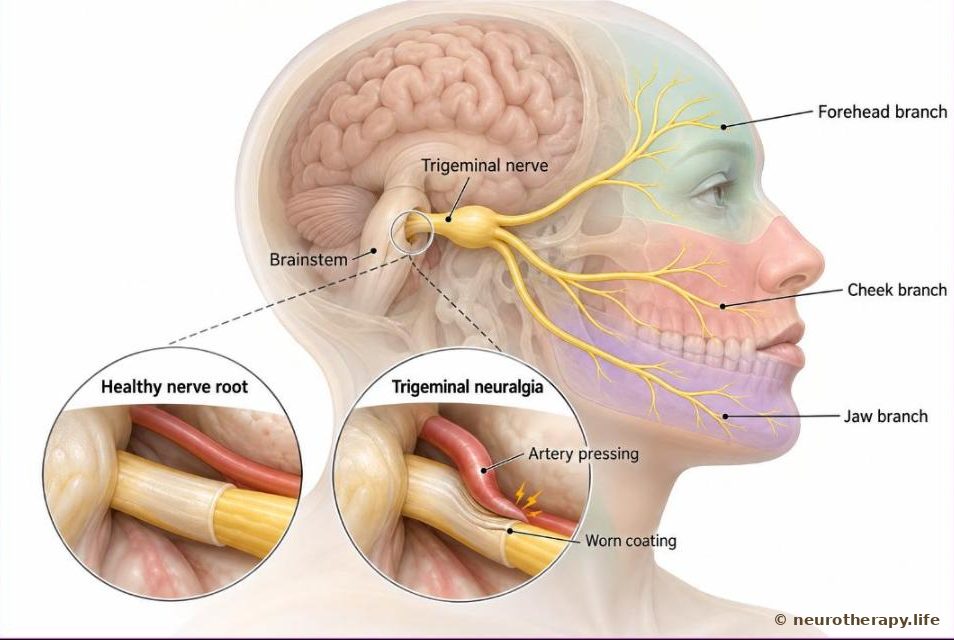
The trigeminal nerve — the fifth of the twelve nerves that leave the brain — carries feeling from the whole face: forehead, eyes, cheeks, nose, lips, teeth, gums and jaw. It also works the chewing muscles. It has three branches, and the pain usually follows one or two of them on one side.
In most people a blood vessel lies against the nerve root where it joins the brainstem. Over years its steady beat wears away the nerve's protective coating. Then an ordinary touch can spark across to the pain fibres, and the nerve fires in bursts. In a smaller number, the cause is another illness such as multiple sclerosis or a growth.
What are the symptoms?
- Sudden, stabbing or electric-shock pain on one side of the face — jaw, teeth, gums, cheek or around the eye
- Attacks lasting seconds to about two minutes, sometimes coming one after another
- Set off by light touch — washing the face, brushing teeth, shaving, eating, talking, or a breeze
- In some people, a burning or dull ache between attacks
- Weeks or months with no pain, then the attacks return
What causes it, and who is more likely to get it?
Pressure on the nerve
- A blood vessel pressing on the nerve root near the brainstem — the most common cause
Other illnesses
- Multiple sclerosis, which damages the coating of nerves
- A growth or a tangle of blood vessels pressing on the nerve (rare)
Who is at higher risk
- Age over 50, and being a woman
- High blood pressure
- Smoking, and trigeminal neuralgia in the family
How is it found?
There is no single test for trigeminal neuralgia. The doctor makes the diagnosis from how you describe the pain — and by ruling out other causes. Because it feels like toothache, many people see a dentist first.
Nerve examination
Checks of feeling on both sides of the face, the blink when the eye is touched, and the jaw muscles. Loss of feeling points to another cause.
MRI scan of the brain
Can show a blood vessel touching the nerve, and rules out multiple sclerosis or a growth.
Dental check
To make sure the pain is not coming from a tooth or the gums.
The neurotherapist asks where exactly the pain strikes, what sets it off, and how long each attack lasts. A light touch on both cheeks checks that feeling is normal. New numbness, weakness, pain on both sides, or other nerve symptoms send the patient to a doctor first. Then Liv°, Mu° and the navel points are examined as usual.
How Neurotherapy (LMNT) sees Trigeminal neuralgia
In LMNT each of the twelve nerves of the head is reached through the Medulla treatment of the same number. The trigeminal is the fifth, so its treatment is (5) Medulla — and Guruji's index names trigeminal neuralgia directly against it, together with pain of the face, the temple, the eyebrow and the cheekbone.
Why the neck, when the pain is in the face? At the top of the spinal cord, the nerves of the face and the nerves of the neck arrive on the same nerve cells. That is why a counted stroke at the back of the neck, LMNT teaches, can be felt in the head — and why the treatment for this face pain is given behind the ears.
Only they know the pain; you do not.
Neurotherapy (LMNT) treatment for Trigeminal neuralgia, step by step
Examine first
Where the pain strikes, what sets it off, and whether the face feels normal. Any warning sign sends the patient to a doctor first. Then Liv°, Mu° and the navel points.
(15) Medulla first
Before any Medulla given for a nerve of the head, (15) Medulla is given. The patient sits; the therapist's thumbs rest behind both ears, below the skull, and rub softly downward along the side of the neck, counting.
(5) Medulla, three times
Then (5) Medulla — the count for the fifth nerve — given three times, with a minute and a half of rest between the rounds.
Exact count, gentle glide
A different count is a different treatment, so the count is said aloud and never guessed. Every stroke is a glide — no jerk, no turning or pulling of the head.
Points and formulas used
Medulla
(5) Medulla — the Medulla count that LMNT gives for the fifth nerve, the feeling nerve of the face; given three times, always after (15) Medulla.
Open →(15) Medulla
(15) Medulla — given first, before every Medulla treatment for a nerve of the head.
Open →Never do this
- New numbness or weakness of the face, pain on both sides, trouble with hearing, vision or balance, or face pain in a younger person with other nerve symptoms: see a doctor first. Another illness, such as multiple sclerosis or a growth, must be ruled out.
- Jaw or face pain with chest pain, breathlessness or sweating, or a face that droops with slurred speech: call 108 / 112 at once. Nothing is given.
- A new headache unlike any before, dizziness, unsteadiness, or numbness of a limb: nothing is given at the head or neck — a doctor the same day. Medulla is given only at the side and back of the neck, never at the front, and never with force. Neck
- Cancer: if the person has cancer, (10) Pan, Thymus, Pit, Lu + Sh, Rt. Ov / Lt. Ov and (30) Medulla are never given — the therapist changes the plan.
- Keep taking the medicines your doctor prescribed. Neurotherapy (LMNT) works alongside your medical care, never instead of it.
From Ayurveda and the kitchen
Test yourself
What research says
- Strong evidence
About 4 to 13 people in 100,000 get it each year, mostly after 50 and more often women. In most classic cases an artery or vein presses on the nerve root; the nerve's coating is lost at that spot, and signals jump between neighbouring fibres. Loss of feeling, weakness, younger age or pain on both sides are warning signs of another cause.
Kikkeri NS, Nagalli S. Trigeminal Neuralgia. StatPearls. 2024.
- Strong evidence
Nerve cells in the trigeminal nucleus, at the top of the spinal cord, receive signals both from the face and from the upper neck. Stimulating one area can produce symptoms in the other. This explains how the face and the neck can refer pain to each other.
No clinical trial of Neurotherapy (LMNT) in trigeminal neuralgia has been published yet. Improvements reported by neurotherapists are clinical observations.
For you
People over 50
This is the age when it usually starts. A sudden shooting face pain is worth describing exactly to your doctor — where it strikes, how long it lasts, and what sets it off.
Younger adults with face pain
Trigeminal neuralgia is rare before 40. If it appears earlier, or with numbness, tingling elsewhere or trouble with vision, a doctor should check for another cause first.
People who think it is toothache
Have a dentist check the teeth. If the teeth are healthy and the pain comes in electric shocks, tell your doctor.
This page explains; it does not diagnose. Neurotherapy (LMNT) works alongside your medical care — keep taking the medicines your doctor prescribed, and see a doctor for any new or severe symptom.