Tennis elbow
Tennis elbow is pain on the outer side of the elbow, from a worn, overused tendon. Most people who get it have never played tennis — it comes from gripping and twisting, again and again.
- About 1 to 3 people in every 100 get it each year
- More than 9 in 10 cases have nothing to do with tennis
- Most common between 35 and 54; most people recover within 1–2 years
Source: StatPearls (NCBI Bookshelf); Cleveland Clinic; MedlinePlus; NHS
What is Tennis elbow?
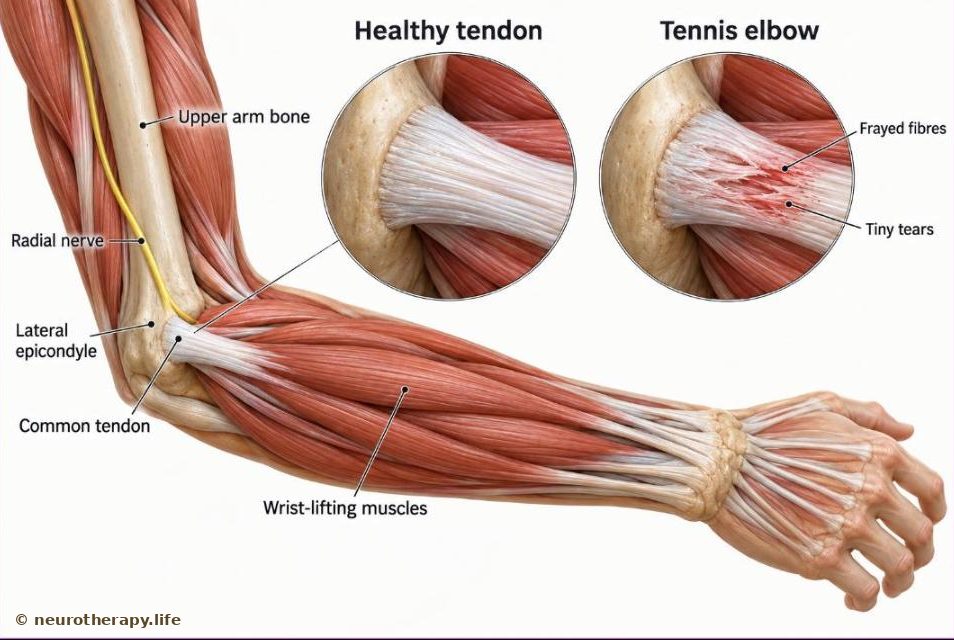
The muscles that lift your wrist and fingers run along the back of your forearm. At the top they join, through one shared tendon, to a small bony bump on the outer side of the elbow.
Every grip, twist and lift pulls on that one spot. When it is pulled too often, tiny tears form in the tendon faster than they can heal. The tendon becomes worn and weak — more wear than swelling — and gripping a cup or turning a door handle starts to hurt.
What are the symptoms?
- Pain on the outer side of the elbow
- Pain spreading down the forearm towards the wrist
- Pain when gripping, lifting or twisting — a cup, a jar lid, a door handle
- A weak grip
- Tenderness when the bony bump is pressed, and sometimes stiffness
What causes it, and who is more likely to get it?
Work
- Repeated gripping and twisting — painters, plumbers, carpenters, builders
- Long hours of typing or using a mouse, screwdrivers or other tools
Sport and hobbies
- Racket sports, especially the backhand stroke
- Sewing, knitting or playing an instrument for long hours
Risk
- Being over 40
- Smoking and being overweight
- Regularly lifting heavy loads
How is it found?
Tennis elbow is usually recognised from an examination: the doctor presses the bony bump on the outer elbow and asks you to lift your wrist against resistance. Tests are used when the picture is unclear.
X-ray
To rule out a bone problem or arthritis in the elbow.
Ultrasound or MRI
Show the tendon itself — how worn or torn it is.
EMG (nerve test)
When there is numbness or tingling, to check whether a nerve is being pinched instead.
The neurotherapist asks which arm, which movements hurt, and whether there is pain or numbness near the elbow bone. Numbness or weakness spreading into the hand, or pain coming down from the neck, is a different picture — a nerve or the neck may be the cause, and it is checked before anything is pressed.
How Neurotherapy (LMNT) sees Tennis elbow
LMNT has a point named after this very complaint: the Tennis Elbow point. Guruji's teaching describes patients whose elbow pain is so great that they cannot even lift a spoon. The therapist's foot rests on the upper arm just above the elbow, while the forearm stands relaxed — so that the muscles anchored at the elbow can let go and lengthen, and the blood can move freely through them again.
It is one of the few points whose count is set by the patient, not by a number: the hold lasts until the pain eases or numbness begins — and never longer than ninety seconds.
Whenever there is an obstruction or blockage in the blood circulation of any part of the body, then pain or numbness is felt in that part.
Neurotherapy (LMNT) treatment for Tennis elbow, step by step
Examine first
Which arm, which movements hurt, and is the pain or numbness near the elbow bone? Numbness or weakness spreading into the hand, or neck pain, is checked first.
Place the arm
The patient lies on the back. The elbow rests on the ground and the forearm stands up, palm facing up at a right angle, supported by a chair or a wall. The hand must rest against it, not grip it — a gripping hand keeps the very muscles tight that the treatment is trying to relax.
The hold
With the soft inner part of the sole, the therapist presses the upper arm very close to the elbow — for ninety seconds or less, until numbness begins to be felt. If a little pain remains, a light press is given once at the middle of the upper arm. If needed, the treatment may be repeated once the same day.
One arm at a time
It is given only in the arm that has the problem. If both arms need it, one is finished before the other is started — never both together.
Points and formulas used
Tennis Elbow
The one point LMNT names for this complaint — a long, steady hold just above the elbow that helps the forearm muscles relax, for pain or numbness near the elbow bone.
Open →Never do this
- Ninety seconds is the most, not the aim. Three large nerves of the arm pass close to the bone here: the therapist comes off at ninety seconds whatever has happened, and at once if numbness or weakness starts to spread down into the hand. Tennis Elbow
- Only as much pressure as the patient can bear, and one arm at a time — never both arms together.
- See a doctor first if the elbow pain began with a fall or injury, if the elbow is misshapen, very swollen, hot or red with fever, or if the arm pain comes with chest pain or breathlessness — that last one is an emergency.
- Cancer: if the person has cancer, (10) Pan, Thymus, Pit, Lu + Sh, Rt. Ov / Lt. Ov and (30) Medulla are never given — the therapist changes the plan.
- Keep taking the medicines your doctor prescribed. Neurotherapy (LMNT) works alongside your medical care, never instead of it.
From Ayurveda and the kitchen
Test yourself
What research says
- Strong evidence
Tennis elbow affects 1–3% of people a year, mostly over 40. It is wear of the tendon of a wrist-lifting muscle where it joins the outer elbow, with tiny tears and disordered fibres, and few signs of inflammation. It usually settles on its own: 80–90% of people recover within 1–2 years. A pinched radial nerve or a neck problem can look similar.
Buchanan BK, Varacallo MA. Lateral Epicondylitis (Tennis Elbow). StatPearls. 2023.
No clinical trial of Neurotherapy (LMNT) in tennis elbow has been published yet. Improvements reported by neurotherapists are clinical observations.
For you
People who grip and twist at work
Take short breaks, change hands where you can, and lift with the palm facing up rather than down. Tell your therapist what your work involves.
Office workers
Keep the wrist straight on the keyboard and mouse, and rest the forearm. Long hours of typing count as repeated gripping.
Anyone with numb fingers
Numbness or tingling in the fingers is not ordinary tennis elbow. Tell your therapist before the session — a nerve or the neck may need checking.
This page explains; it does not diagnose. Neurotherapy (LMNT) works alongside your medical care — keep taking the medicines your doctor prescribed, and see a doctor for any new or severe symptom.