Schizophrenia
Schizophrenia is a serious, long-term illness of the brain that changes how a person thinks, feels and sees the world. With steady medical care and the support of family, many people live full lives, and at least one in three recover fully.
- About 1 in every 300 people worldwide lives with schizophrenia
- Symptoms usually begin between the ages of 16 and 30
- At least 1 in 3 people with schizophrenia can recover fully — yet more than 2 in 3 people with psychosis do not get specialist care
Source: World Health Organization (schizophrenia fact sheet); MedlinePlus
What is Schizophrenia?
In schizophrenia the brain has trouble telling what is real from what is not. A person may hear voices no one else hears, hold firm beliefs that are not true, or find their thoughts and speech getting jumbled. Many also lose interest, energy and warmth in their feelings.
It is not a 'split personality', and most people with schizophrenia are not violent. It comes from genes, brain chemistry and life events together. It is nobody's fault, and it is treatable: medicines, talking therapy, family support and skills training all help.
What are the symptoms?
- Hearing or seeing things that are not there (hallucinations)
- Firm beliefs that are not true, such as being watched or controlled (delusions)
- Muddled thinking and speech that is hard to follow
- Pulling away from people; little speech or expression of feelings
- Losing interest in daily life and in looking after oneself
- Trouble paying attention, remembering and making decisions
What causes it, and who is more likely to get it?
Family and genes
- Schizophrenia in a close relative raises the risk
Triggers
- Very stressful life events
- Heavy cannabis (ganja, bhang) or other drug use
How is it found?
There is no single test for schizophrenia. A psychiatrist or other mental-health specialist makes the diagnosis after a careful talk with the person and, often, the family.
Mental-health assessment
Questions about thoughts, beliefs, voices, mood, sleep, drug use and how daily life has changed.
Mental status examination
The doctor observes speech, attention, memory and understanding during the visit.
A neurotherapist does not diagnose schizophrenia and does not change its treatment. On the first visit, before any treatment begins, the therapist marks on the card the point that must never be given — Pan — and plans the whole session inside that rule.
How Neurotherapy (LMNT) sees Schizophrenia
LMNT's teaching on schizophrenia is above all a teaching of care. Guruji recorded that when Pan — the pancreas point — was given, some patients with schizophrenia began to hear voices or the sound of bells in their ears. So Pan is never given to a person with schizophrenia. The therapist writes this block on the card on the very first day, so that no one forgets it.
The second part of the teaching is about touch itself. For a person with schizophrenia, a therapist sitting close, or pressure given with the foot, may feel frightening rather than just uncomfortable. So the therapist explains before touching, asks before each part of the body, and stops at any sign of distress. Neurotherapy (LMNT) here is gentle support alongside the psychiatrist's care — never in place of it.
Whether or not the patient gets immediate benefit from our treatment, let no harm reach him through our carelessness — attend to this.
Neurotherapy (LMNT) treatment for Schizophrenia, step by step
The psychiatrist's care comes first
The therapist asks about the person's doctor and medicines, and gently whether there is any risk of harm to self or others. If there is, help from a doctor or a helpline comes first, today.
Block Pan on the card
Before any plan is made, Pan is boxed on the card as a point that must not be given. The whole plan is then built inside that block — including any formula that contains Pan.
Explain, ask, and stop at distress
The therapist says what will happen before touching, asks before each part of the body, avoids sitting too close or using the foot if it frightens, and stops at once at any sign of fear.
Points and formulas used
Never do this
- If there is any risk of harm to self or others, get urgent help today — a doctor, or a helpline (India: Tele-MANAS 14416, free). In immediate danger, call 112.
- Pan is never given in schizophrenia — not on its own and not inside any formula, including the Heparin formulas, which all contain Pan. Pan
- Explain before you touch, ask before each part of the body, and stop at any sign of distress. Sitting close or pressure with the foot may feel frightening.
- Never stop, reduce or delay psychiatric medicines on your own — stopping them can bring the illness back. Any change is decided with the doctor.
- Cancer: if the person has cancer, (10) Pan, Thymus, Pit, Lu + Sh, Rt. Ov / Lt. Ov and (30) Medulla are never given — the therapist changes the plan.
- Keep taking the medicines your doctor prescribed. Neurotherapy (LMNT) works alongside your medical care, never instead of it.
From Ayurveda and the kitchen
Test yourself
What research says
- Strong evidence
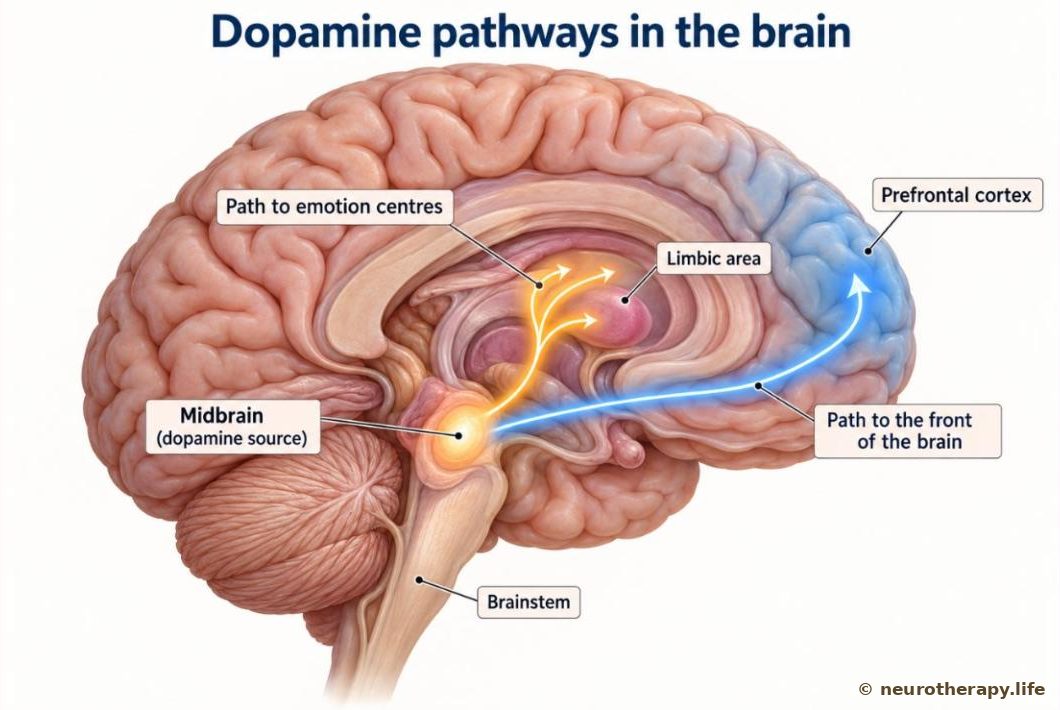
Schizophrenia affects about 1 in 100 people. Too much dopamine signalling in one brain pathway is linked with voices and false beliefs, and too little in another with low drive and thinking problems. People whose symptoms improve on medicine are advised to continue it.
- Strong evidence
Medicines, family support, talking therapy and rehabilitation all work, and at least one in three people recover fully. Stigma and neglect of human rights are common and keep many people from care.
No clinical trial of Neurotherapy (LMNT) in schizophrenia has been published yet. Improvements reported by neurotherapists are clinical observations.
For you
Family and carers
Stay calm and kind, do not argue about the voices or beliefs, and help the person keep their doctor's visits and medicines. Look after yourself too — carers need support.
Young people
Heavy cannabis use is linked with a higher risk. If a young person pulls away from everyone, stops sleeping, or says strange things, see a doctor early — early treatment works better.
People taking medicine for schizophrenia
Keep taking it as prescribed, even on good days. Tell your therapist every medicine you take, and talk to your doctor before any change.
This page explains; it does not diagnose. Neurotherapy (LMNT) works alongside your medical care — keep taking the medicines your doctor prescribed, and see a doctor for any new or severe symptom.