Low height in children (short stature)
Some children are much shorter than others of the same age. Often it runs in the family or the child is simply a late bloomer — but sometimes an illness or a hormone problem is holding growth back, and time matters, because bones stop growing in length once the growth plates close.
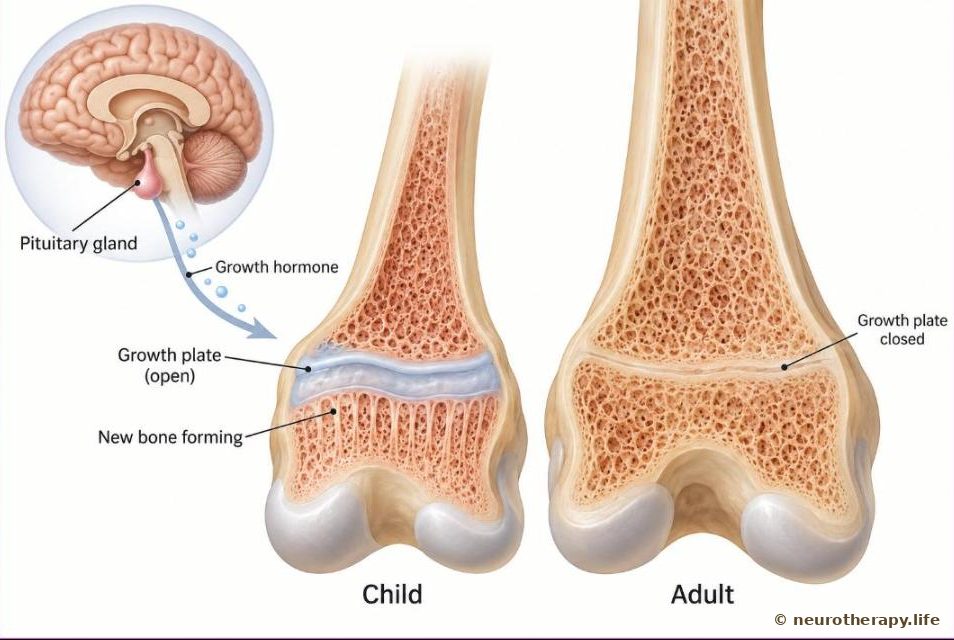
- Short stature means a height well below most children of the same age and sex — below the 2.3rd percentile on a growth chart
- Growth plates usually close at about 13–15 years in girls and 15–17 years in boys; after that the bones stop growing in length
- In the growth spurt of puberty, teenagers grow about 9–10 cm a year
Source: MedlinePlus; Nemours KidsHealth; Cleveland Clinic
What is Low height in children (short stature)?
Children grow at the ends of their long bones. Near each end there is a thin disc of soft cartilage called the growth plate. New bone is added there, and the bone gets longer. Growth hormone from the pituitary gland, under the brain, drives this work.
At the end of puberty the growth plate turns into bone and growing in height stops for good. Most short children are healthy — they have short parents, or they will grow later than their friends. A doctor looks for the few who have a medical reason.
What are the symptoms?
- Much shorter than most children of the same age
- Growing more slowly than before, or seeming to have stopped growing
- Clothes and shoes that still fit after a long time
- Puberty coming much later than in friends
- Slow growth together with tiredness, poor appetite or long-lasting stomach trouble
What causes it, and who is more likely to get it?
Normal differences
- Short parents — the child is healthy and simply short like the family
- A late bloomer — growth and puberty come later, and the child catches up
Long-lasting illness
Genes, bones and food
- Genetic conditions such as Down syndrome or Turner syndrome
- Bone disorders such as rickets
- Poor nutrition, or poor growth before birth
How is it found?
The doctor measures height and weight, plots them on a growth chart, and compares them over time. A child's own growth line, measured again and again, tells more than any single number.
Growth chart and body measurements
Height, weight and limb measurements, compared with children of the same age and sex.
Bone age X-ray
An X-ray of the left hand and wrist shows how mature the bones are and how much growing time may be left.
Blood tests
Thyroid function, IGF-1 (a marker of growth hormone), a blood count, and liver and kidney tests.
Growth hormone test
A special test, done in hospital, to see whether the body makes enough growth hormone.
A neurotherapist asks the child's exact age first, because some points are barred between 13 and 20 years, and asks what the doctor has found. The card is written with the growth bars on it before any treatment is given.
How Neurotherapy (LMNT) sees Low height in children (short stature)
LMNT teaching works on height from two sides. It gives points meant to support the body's own growth hormone: (20) Medulla together with (8) Medulla — because dopamine and serotonin both increase growth hormone — with (4) Pan or (10) Pan, (4) Pit and (4) Thrd 'P'. And it strictly holds back every point that could make the growth plates close early.
How height is made — and where it can be stopped
- Brainthe hypothalamus signals the pituitary; somatostatin can hold growth hormone back
- Pituitaryreleases growth hormone into the blood
- Growth plateadds new bone at the ends of the long bones
- Oestrogenat the end of puberty tells the plate to turn into bone — in boys as well as girls
- Closed plateno more growth in height — it does not open again
That is why the bars matter as much as the points. In Guruji's teaching these are the only bars whose harm cannot be undone: a sugar that rose comes down, but a growth plate that has closed does not open again.
Whether or not the patient gets immediate benefit from our treatment, let no harm reach him through our carelessness — attend to this.
Neurotherapy (LMNT) treatment for Low height in children (short stature), step by step
Examine first
The therapist checks Liv° and Mu°, asks the child's exact age, and asks for the doctor's findings — the growth chart, bone age X-ray and thyroid report. The growth bars are written on the card before the first session.
(20) Medulla with (8) Medulla
Given together at the neck, below the ears. LMNT teaching gives them for height because dopamine and serotonin both increase the release of growth hormone.
The right Pan
(4) Pan or (10) Pan is given — never (2) Pan, which stops growth hormone.
The glands
(4) Pit and (4) Thrd 'P' complete the points given for low height.
Gentle, child-sized work
A small child lies on a mat on the floor with the mother in sight. The therapist kneels at the child's level and uses the soft, flat palm — never the foot.
Points and formulas used
(20) Medulla
Given with (8) Medulla for height; in LMNT teaching it works through dopamine, which increases growth hormone.
Open →(8) Medulla
Given with (20) Medulla for height; linked in LMNT teaching to serotonin, which also increases growth hormone.
Open →Never do this
- Never (2) Pan for a child who is short or is being treated for height — it stops growth hormone. (4) Pan or (10) Pan is given instead. (2) Pan
- Never Lt. Ov., Rt. Ov., WD, Ton 'P' or Ton 'T' for a child being treated for height. Oestrogen and progesterone make the growth plates close early, and a closed plate does not open again. No substitute is given for these five. Lt. Ov.
- No (6) Medulla — and so no M. Heparin, which contains it — for a boy or girl between 13 and 20 who is being treated for height, unless there is a special need. It works through somatostatin, which holds growth hormone back. (6) Medulla
- Children get half the adult dose and light treatment only, with the hands — never the feet — given by a trained therapist.
- See a doctor first if a child is much shorter than others of the same age or seems to have stopped growing — especially with tiredness, poor appetite, long-lasting diarrhoea or very late puberty. A medical cause needs to be found early, while the growth plates are still open.
- Cancer: if the person has cancer, (10) Pan, Thymus, Pit, Lu + Sh, Rt. Ov / Lt. Ov and (30) Medulla are never given — the therapist changes the plan.
- Keep taking the medicines your doctor prescribed. Neurotherapy (LMNT) works alongside your medical care, never instead of it.
From Ayurveda and the kitchen
Test yourself
What research says
- Strong evidence
Growth hormone is released by the pituitary when the hypothalamus sends its releasing hormone, and its release rises with sleep, exercise and nutrition. Somatostatin, also from the hypothalamus, holds it back — the same brake that LMNT teaching avoids in a growing child.
Brinkman JE, Tariq MA, Leavitt L, Sharma S. Physiology, Growth Hormone. StatPearls. 2023.
No clinical trial of Neurotherapy (LMNT) in short stature has been published yet. Improvements reported by neurotherapists are clinical observations.
For you
Parents
Measure your child's height on the same wall every few months and write down the date. Show the record to the doctor — a slowing line matters more than one short reading.
Teenagers between 13 and 20
This is the age when the growth plates close. Tell the therapist your exact age — some points are held back from you while you are being treated for height.
Girls
Girls' growth plates usually close earlier than boys' — at about 13 to 15 — so if you are worried, see the doctor sooner rather than later.
This page explains; it does not diagnose. Neurotherapy (LMNT) works alongside your medical care — keep taking the medicines your doctor prescribed, and see a doctor for any new or severe symptom.