Hiccups
A hiccup is a sudden jerk of the diaphragm — the big breathing muscle under the lungs — followed by a quick snap of the vocal cords that makes the “hic” sound. Most bouts stop on their own within minutes.
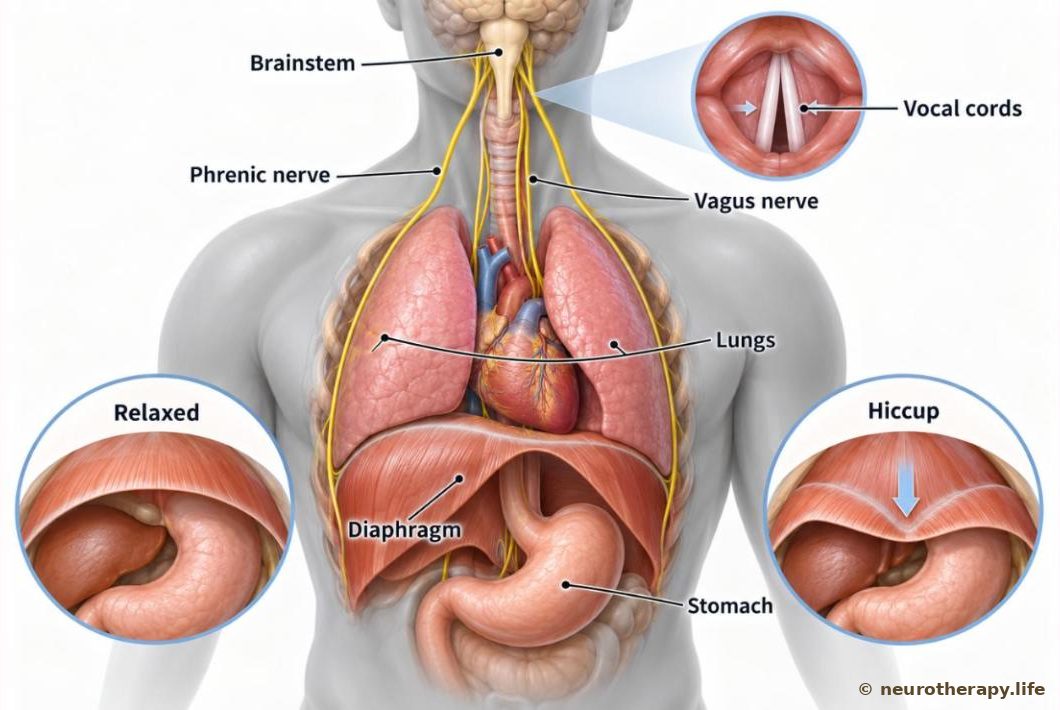
- Most bouts of hiccups stop on their own within a few minutes
- Hiccups that last more than 48 hours are called persistent — see a doctor
- About 8 in 10 people whose hiccups last more than a month are men
Source: MedlinePlus; NHS; Mayo Clinic; Nausheen et al., SpringerPlus 2016 (review)
What is Hiccups?
The diaphragm is a dome-shaped muscle that sits under your lungs. Each time it tightens, you breathe in. In a hiccup it tightens suddenly, on its own, and a split second later the vocal cords snap shut. That sudden stop of air makes the “hic”.
A hiccup is a reflex. Nerves from the stomach, chest and throat send a message to a centre in the brainstem, and the phrenic nerve carries the answer back to the diaphragm. So anything that stretches the stomach or irritates these nerves can start a bout. Short bouts are harmless. Hiccups that go on for days are rare and may point to another health problem.
What are the symptoms?
- A “hic” sound that repeats again and again
- A sudden jerk felt in the chest or upper belly
- A slight tight feeling in the chest, stomach or throat
- Bouts that usually stop within minutes
- In long-lasting hiccups: trouble eating, sleeping or talking, and tiredness
What causes it, and who is more likely to get it?
Eating and drinking
- Eating too fast or too much
- Fizzy drinks and alcohol
- Very hot or spicy food
- A bloated stomach
Air, feelings and temperature
- Swallowing air — chewing gum, smoking
- Excitement, nervousness or stress
- A sudden change in temperature
Nerves and brain (long-lasting hiccups)
Body chemistry, medicines and surgery
- Diabetes
- Kidney disease or a salt imbalance in the blood
- Some medicines, such as steroids and sedatives
- Recovery after an operation, especially on the belly
How is it found?
Short bouts need no tests. If hiccups last more than two days, the doctor asks when they started, what you eat and drink, and which medicines you take, then examines you and may order tests to find the cause.
Physical and nerve examination
Checks balance, coordination, muscle strength, reflexes and feeling.
Blood tests
Look for signs of diabetes, infection or kidney disease.
Chest X-ray, CT or MRI scan
Show problems inside the chest or head that may be pressing on the nerves of the diaphragm.
Endoscopy
A thin tube with a tiny camera looks inside the food pipe or windpipe.
A neurotherapist first asks how long the hiccups have lasted and checks the blood pressure, because one of the points used for hiccups raises it. Hiccups of more than two days, or with any warning sign, are sent to a doctor first.
How Neurotherapy sees Hiccups
In LMNT, a hiccup is read as a nerve reflex, and Guruji's teaching gives more than one answer to it. One is the ninth cranial nerve, which in LMNT looks after the throat and the closing of the epiglottis — the lid over the windpipe — and hiccups are listed in its territory: (9) Medulla. Another is Lu + Sh, which opens the muscles of the chest.
The hiccup reflex — one loop, many places to calm it
- TriggerA full stomach, fizzy drink, spice, excitement — or a nerve irritated by illness.
- Message upThe vagus and phrenic nerves carry the signal up to the brainstem.
- Hiccup centreA centre in the brainstem, near the breathing centre, fires the reflex.
- Diaphragm jerksThe phrenic nerve carries the order down; the diaphragm tightens suddenly.
- “Hic”The vocal cords snap shut and stop the rush of air.
LMNT adds two more answers for hiccups that will not settle. (15) Left Medulla with (6) Left Swt is the polarity pair that, in LMNT, opens what is in spasm. And (4) Medulla clockwise at T1/T2 with Raman reaches the nerves of the chest and the upper part of the diaphragm — Guruji's teaching gives it for stopping hiccups and for hiatus hernia. Neither answer cancels the other: the therapist has more than one thing to try, and an order to try them in.
This is exactly how it should be. And this itself is the secret of Neurotherapy's success.
Neurotherapy treatment for Hiccups, step by step
Examine first
The therapist asks how long the hiccups have lasted, checks the blood pressure and asks about heart disease, and checks the diagnostic points Liv° and Mu°.
(15) Medulla, then (9) Medulla
(15) Medulla always comes first. Then (9) Medulla for the nerve of the throat and the epiglottis — three treatments, a minute and a half apart.
Lu + Sh — only if the BP is not high
Pressing at the shoulder opens the muscles of the chest. LMNT gives it for hiccups — but it raises blood pressure, so it is left out in high BP and heart disease.
If the hiccups hold on: the left polarity pair
(15) Left Medulla with (6) Left Swt, three treatments, to open what is in spasm.
(4) Medulla clockwise at T1/T2 with Raman
For the nerves of the chest and the upper diaphragm. The side of Raman is chosen by the check: Left Raman with pain at Mu°, Right Raman with pain at Liv°.
Points and formulas used
Lu + Sh
Opens the muscles of the chest; given in LMNT for hiccups — never in high BP or heart disease.
Open →Medulla
(9) Medulla, after (15) Medulla — for the ninth cranial nerve, which LMNT links to the throat, the epiglottis and hiccups.
Open →(6) Left Swt
With (15) Left Medulla, × 3 treatments — the polarity pair that opens what is in spasm.
Open →(4) Medulla clockwise with T1/T2
Given with Raman, it reaches the chest nerves and the upper diaphragm — for hiccups and hiatus hernia.
Open →Never do this
- Hiccups that last more than 48 hours, or that stop you eating, sleeping or breathing easily, need a doctor. Hiccups with chest pain, breathlessness, sudden weakness, numbness or slurred speech need emergency care at once.
- Lu + Sh raises blood pressure. It is never given in high blood pressure or in heart disease. Lu + Sh
- Raman is added only after the Liv° and Mu° check, which decides whether the left or the right side is given. Raman
- Cancer: if the person has cancer, (10) Pan, Thymus, Pit, Lu + Sh, Rt. Ov / Lt. Ov and (30) Medulla are never given — the therapist changes the plan.
- Keep taking the medicines your doctor prescribed. Neurotherapy works alongside your medical care, never instead of it.
From Ayurveda and the kitchen
Test yourself
What research says
- Strong evidence
This review explains the hiccup reflex arc: messages travel up the phrenic, vagus and sympathetic nerves to a centre in the brainstem, and come back down the phrenic nerve to the diaphragm. It also notes that hiccups lasting more than a month are far more common in men.
Nausheen F, Mohsin H, Lakhan SE. Neurotransmitters in hiccups. SpringerPlus. 2016;5:1357.
No clinical trial of Neurotherapy in hiccups has been published yet. Improvements reported by neurotherapists are clinical observations.
For you
Everyone
Eat slowly, avoid too many fizzy drinks and very spicy food, and do not overfill the stomach.
Men over 50
Long-lasting hiccups are much more common in older men. If yours go on for more than two days, see a doctor.
People with high BP or heart disease
Tell the therapist before treatment — some points used for hiccups are not given to you.
This page explains; it does not diagnose. Neurotherapy works alongside your medical care — keep taking the medicines your doctor prescribed, and see a doctor for any new or severe symptom.