Tinnitus (ringing in the ears)
Tinnitus is hearing a sound — ringing, buzzing, hissing or roaring — that has no outside source, so nobody else can hear it. It is very common, and most often goes with some loss of hearing.
- About 14% of adults worldwide have tinnitus — more than 740 million people
- Nearly 1 in 4 people aged 65 and over has it
- About 2 in every 100 adults have it severely enough to disturb daily life
Source: Jarach et al., JAMA Neurology 2022 (systematic review); NIDCD (NIH); NHS
What is Tinnitus (ringing in the ears)?
Tinnitus is not a disease on its own. It is a sign that something along the hearing path is not working right — the ear, the hearing nerve, or the way the brain handles sound. It can be in one ear or both, soft or loud, steady or coming and going.
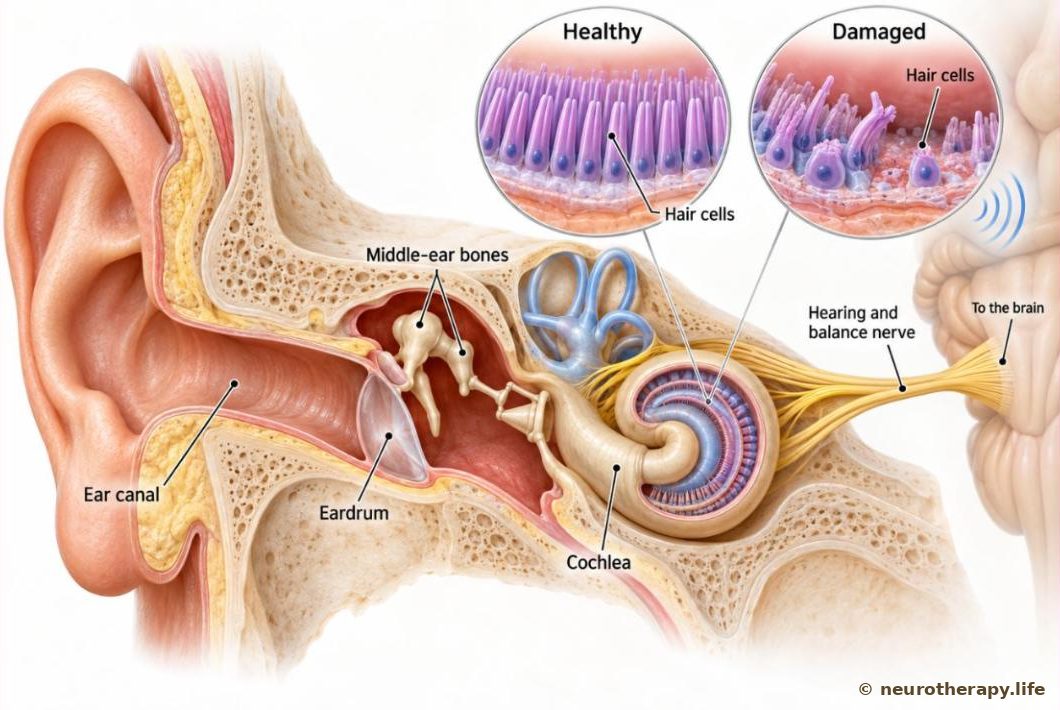
Deep inside the ear, tiny hair cells turn sound into nerve signals. When they are worn by age or loud noise, fewer signals reach the brain, and the brain may make up its own sound. Less often the cause is earwax, an infection, a blood-vessel problem or a medicine. A ringing that beats with your pulse is a different kind and needs a doctor's look.
What are the symptoms?
- Ringing, buzzing, hissing, humming or roaring that no one else hears
- The sound in one ear or both, steady or coming and going
- Some loss of hearing along with it
- Trouble sleeping or concentrating because of the sound
- Less often: a whooshing or throbbing that beats with your pulse
What causes it, and who is more likely to get it?
The ear itself
- Hearing loss with age
- Loud noise — at work, at functions, from headphones
- Earwax or an ear infection blocking the canal
- Ménière's disease
Other health conditions
- Thyroid problems
- Diabetes
- Heart and blood-vessel problems
- A head or neck injury
Medicines
- Some painkillers, some antibiotics and some cancer medicines
How is it found?
The doctor asks what the sound is like, which ear, since when, and which medicines you take, then looks into the ears and checks your hearing. Often an ear, nose and throat (ENT) specialist sees you next.
Ear examination
Looks for simple, treatable causes such as wax or an infection.
Hearing test
An audiologist measures how well each ear hears. Hearing loss is found in many people with tinnitus.
MRI or CT scan
Used when the sound is in one ear only, beats with the pulse, or comes with other nerve signs — to rule out a problem in the structures of the head.
A neurotherapist asks the warning questions first — one ear only? sudden hearing loss? spinning? a head injury? — and sends the patient on the same day if any is yes. The ENT report, a hearing test and the list of everything you take are asked for before treatment begins.
How Neurotherapy sees Tinnitus (ringing in the ears)
In LMNT, a ringing in the ears is read along one nerve: the eighth cranial nerve, which carries hearing from the inner ear and balance from the fluid loops beside it in a single bundle. That is why deafness, bells ringing in the ears and giddiness are listed together. (8) Medulla is the treatment for this nerve — Guruji's teaching gives it for all problems of the ear.
Thymus + Chest is the second point named for “hearing the sound of bells in the ears without cause”, and the armpits are given with it. LMNT also watches the other direction: the Pan point itself has made some patients hear bells — so a ringing that begins or grows during treatment is reported and the plan is changed. And the teaching asks how a person is woken: a sharp bell that jolts someone out of sleep can itself set the ears ringing.
Only they know the pain; you do not.
Neurotherapy treatment for Tinnitus (ringing in the ears), step by step
Examine first
Warning signs are asked first. Then the ENT report and hearing test, the diagnostic points Liv° and Mu°, and every tablet, drop and powder you take — some medicines can cause ringing.
(8) Medulla for the hearing nerve
Given on both sides of the neck below the ears, for the eighth cranial nerve that carries hearing and balance.
Thymus + Chest, with the armpits
Named in LMNT for hearing bells in the ears without cause. The armpits are always given with it. It has strict bars, so the therapist checks them first.
Wake gently, rise slowly
Fit a low-sounding buzzer rather than a sharp musical doorbell, and keep a phone alarm away from your ear. On waking, sit on the edge of the bed for at least thirty seconds before standing.
Leave the ear alone
No digging out wax and no drops poured into the ear. Blow the nose gently with both nostrils open, so mucus is not forced up into the ear.
Points and formulas used
Never do this
- Ringing in one ear only, or ringing with sudden hearing loss, a spinning feeling (vertigo) or weakness of the face, or after a head injury, needs a doctor urgently — the same day. A ringing that beats with your pulse needs a doctor soon. No neck work until you have been seen. Ears
- (8) Medulla is not given in inflammatory diseases, in cancer or in high blood pressure. (8) Medulla
- Thymus + Chest is not given in pregnancy, polio or other inflammatory diseases, heart disease, diabetes, rheumatoid arthritis, autoimmune disorders or kidney disease. Th + Ch
- The Pan point itself has made some patients hear bells. If a ringing starts or gets louder during a course of treatment, tell the therapist so the plan can be changed. Pan
- Nothing is ever poured into an ear that is discharging, has been injured, or may have a hole in the eardrum.
- Cancer: if the person has cancer, (10) Pan, Thymus, Pit, Lu + Sh, Rt. Ov / Lt. Ov and (30) Medulla are never given — the therapist changes the plan.
- Keep taking the medicines your doctor prescribed. Neurotherapy works alongside your medical care, never instead of it.
From Ayurveda and the kitchen
Test yourself
What research says
- Strong evidence
Pooling 113 studies, this review found that about 14% of adults have tinnitus, rising to about 24% in people aged 65 and over; about 2% have it severely.
No clinical trial of Neurotherapy in tinnitus has been published yet. Improvements reported by neurotherapists are clinical observations.
For you
Older adults
Tinnitus often comes with age-related hearing loss. A hearing test is worth having — a hearing aid can make the ringing less noticeable.
People in noisy work
Factory floors, DJ sets, generators and loud headphones all wear the ear. Use ear protection and give your ears quiet breaks.
People on several medicines
If the ringing began after a new medicine, tell your doctor. Do not stop any medicine on your own.
This page explains; it does not diagnose. Neurotherapy works alongside your medical care — keep taking the medicines your doctor prescribed, and see a doctor for any new or severe symptom.